What the Grooming Gangs Inquiry Didn't Want You Looking At
A statutory inquiry had one legal obligation on 13 July. Instead, it filled its website with everything except the one document it was supposed to publish.
On the day of its first deadline, the £65 million inquiry launched a webform, an empty hub, and a hearing room that shuts out survivors.
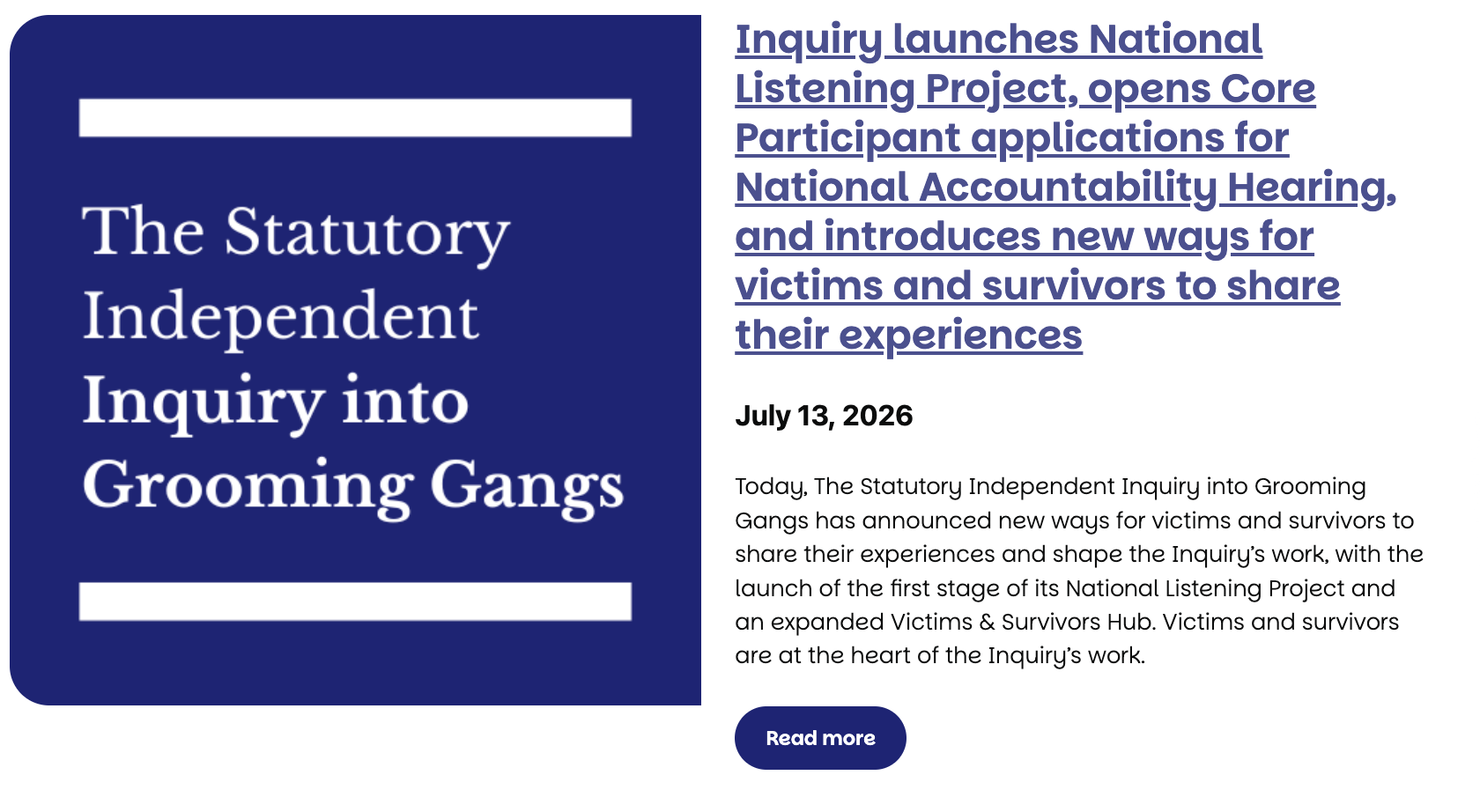
Yesterday, 13 July 2026, was supposed to be a significant day for the Statutory Independent Inquiry into Grooming Gangs. It was the day, according to the Inquiry's own Terms of Reference, that they were legally required to publish the criteria for selecting investigation areas.
They didn't do it. The deadline passed without a word about the criteria.
Instead, they filled the day with three other announcements: a webform for survivors to share their experiences, an expanded Victims and Survivors Hub on their website, and the opening of applications for Core Participant status in the Inquiry's hearings.
None of these are inherently bad things. But none of them were the task the Inquiry set for itself, in writing, with a hard deadline. And the failure to meet that very first deadline, while finding time for these other activities, tells us something important about the Inquiry's priorities and its commitment to its own rules.
The Missed Deadline The Terms of Reference, agreed with the Home Secretary and published on 31 March, were clear. The criteria used to select local areas would be published by the Inquiry within three months of the formal setting-up date. The setting-up date, confirmed by the Home Secretary in a written statement to Parliament, was 13 April. Three months from that date lands squarely on 13 July.
This was not a flexible target. It was a legal obligation, written into the very document that defines the Inquiry's work. And it was an obligation that the Inquiry took on solely for itself. The draft Terms of Reference said the criteria would be agreed between the Government and the Inquiry; the final version removed the Government from that sentence. The buck stops with the Inquiry, and specifically with its chair, Baroness Longfield.
Yet here we are, on 14 July, and the criteria are nowhere to be seen. The word "criteria" does not appear anywhere in the Inquiry's 13 July announcements. The document itself is not available on their website.
Instead, we have a webform, a "hub", and a call for applications that comes with a warning that survivors are unlikely to get a seat at the table.
Announcement One
A Form That Collects Pain, Not Evidence
The inquiry has launched what it calls a National Listening Project. Let's call it what it is: a box on their website. Victims, survivors, families and friends can type what happened to them into the box and press submit.
The inquiry's own press release states, in terms, that what you type is not treated as a formal witness statement and that submitting it does not make you a witness. It will, they claim, help the inquiry understand impact and identify themes. Understand impact? We survivors live with the impact every day. Themes? We've been screaming the themes at them for decades.
Now think about what filling in that box actually costs. A woman is going to sit at a kitchen table and type into a government webpage what grown men did to her when she was twelve. She will relive it with every key press. She will sleep badly for a week. Some of these women will drink again, or cut again, or go back on the medication, because that is what reopening this does, and every survivor reading this knows it.
So read the announcement again and look for what the inquiry has put in place for the woman it has just invited to do that.
- A counsellor attached to the process? No.
- A helpline commissioned to sit alongside the form? Absent.
- A trained person who contacts her after she presses submit? Nowhere to be found.
One-to-one conversations with trained facilitators are promised for later this year, undated. What the announcement offers her is a form, and a link marked Support Services. They're not even trying to hide the contempt.
Look, too, for any route to these women beyond the form itself. The announcement describes one way in. An online submission. Nothing published yesterday describes the inquiry going out to find the women who cannot face a screen, or will not put this in writing, or stopped believing years ago that anyone reads what they send. The women who were failed precisely because nobody came looking for them are, on the face of yesterday's announcement, required to come looking for the inquiry. It's a disgrace.
If more support exists behind that form, the inquiry chose not to mention it on launch day, and an inquiry announcing a listening exercise that forgets to announce the listening support has told you something either way. And what it's told you is ugly.
Announcement Two
A Hub That Promises Everything and Delivers Nothing
The second announcement is an expanded Victims & Survivors Hub. The inquiry says this hub now includes information about:
- How victims and survivors can stay informed throughout the Inquiry.
- Opportunities to help shape the Inquiry's work.
- Support available to those engaging with the Inquiry.
- Future opportunities to share experiences and views.
Dig into the detail, and what do these grand promises amount to? The hub, in the inquiry's own words, now contains information about planned newsletters, webinars, feedback reports, workshops and surveys. Planned ones. Not launched ones, not dated ones, not ones with a concrete offering attached. Just plans, for some indeterminate future point.
Workshops will be held, but they won't tell you when, or on what. Newsletters will be sent, but they won't tell you what will be in them, or how often they'll arrive. Feedback reports will be published, but they won't tell you what they'll cover, or what they'll do with the feedback they receive.
This is not a hub. It is a holding page, a facade, a pretty front with nothing behind it. It is the inquiry saying "trust us, we'll get to you" while giving you no reason to believe it and no route to hold them to account if they don't.
Survivors and campaigners have heard this before. We've spent decades being told our turn is coming, just wait, just be patient, just keep quiet. We've watched as report after report disappeared into a Whitehall filing cabinet and nothing changed. We know the sound of an empty promise. We know the sight of an institution going through the motions without ever intending to deliver.
The inquiry wants applause for launching a webpage full of things it claims it will do, someday, with no specifics and no accountability. It is an insult to every survivor who has been waiting years for concrete action. It is a dereliction of the inquiry's duty to those it claims to serve.
Announcement Three
A Room Survivors Are Not Invited To
The third item has legal substance, which is why it contains the nastiest detail of the day.
Applications opened yesterday for Core Participant status at the National Accountability Hearings. The inquiry's release explains what that status means. Core Participants receive relevant disclosure and make opening or closing statements at hearings. It is the keys to the kingdom, the seat at the table, the chance to look the failed institution in the eye and demand an answer.
Then comes the warning, and in the press release it is printed in italics, so no one can miss it. For the national accountability hearings, Core Participant status is more likely to be granted to groups or organisations representing victims, rather than to individuals.
So which groups have represented victims?
- The Maggie Oliver Foundation
- Rupert Lowe's Rape Gang Inquiry
- Tommy Robinson's The Rape of Britain
- Recusant Nine
Are these groups going to be allowed a seat at the table? I think you know the answer already.
Worse still. Think about what that means. A woman whose childhood was stolen by abusers while institutions looked the other way is told, in the plainest possible terms, that the inquiry thinks her too unimportant to be in the room when those institutions are called to account.
The organisation that failed to protect her, that ignored the reports, that chose not to see what was happening under its nose, that organisation is welcome to play a leading role. The survivor herself is not. The inquiry has decided, before a single application is read, that she needs to take a back seat to the great and the good.
It is a double cruelty, a second betrayal heaped on top of the first. To suffer at the hands of abusers is devastating. To watch the institutions that should have protected you close ranks and look away is shattering. Now, to be told by the inquiry set up to expose those failures that you are not important enough to sit at the table, that your voice must be filtered through an organisational mouthpiece that may have its own interests to protect, that is a blow that lands with the weight of every year of being silenced and ignored behind it.
There is no justification offered, no rationale given. The message is clear. The inquiry trusts organisations more than it trusts survivors. It would rather hear from the great and the good than from the people they failed. Accountability, in the inquiry's eyes, does not require the accuser to meet the accused. Justice can be served without the victim in the room.
Every survivor knows that is a lie. Every survivor who has fought for years to be heard knows that the truth is not found in glossy organisational submissions and carefully vetted public statements. It is found in the raw, unvarnished testimony of the people who lived it. It is found in the voices the institutions ignored the first time around.
An inquiry that shuts those voices out of its hearings is an inquiry that has chosen the side of the powerful over the powerless before it has even begun. It is an inquiry that has failed its most basic test of moral courage. It is an inquiry that has looked survivors in the eye and said "we don't trust you".
On this of all issues, that is an unforgivable position to take. And it tells you everything you need to know about where this inquiry is heading.
For 8 years I've exposed how politicians and police covered up the gang rape of working-class White girls by Pakistani grooming gangs. I, with the support of the people of Oldham, led the campaign that forced the National Inquiry. Now, with your help, we will force this inquiry to a place it does not want to go.
Should we succeed, politicians will go to prison. It is as simple as that. Surely, on this prospect alone, it is worth your support.
Please, to the over one million of you that read my articles each month, subscribe to my newsletter and help give us a fighting chance.
The Criteria Is Part Of The Cover Up
The miss matters more than a date in a diary. On 24 June the inquiry named Oldham, Bradford and Keighley, and London as its first areas, nineteen days before the criteria were due. It was forced to do this because Bradford were about to hold an Extraordinary Council Meeting on demanding the national inquiry select a city that many consider as ground zero in the rape gang epidemic.
The areas named exist only because ordinary people have fought for it. No statutory agency did this. And now, where the national inquiry should have helped put the onus back on those actually responsible, they have failed to publish the criteria for selecting localities.
The absence of the criteria makes it easier to hide. Until they appear, nothing prevents them being drafted to fit selections already made, and no one will ever be able to prove the reasoning did not run in reverse. Every town campaigning for inclusion is arguing against a blank page, and a blank page can be filled in later, in whatever shape keeps them out. It's a stitch-up, and not even a subtle one.
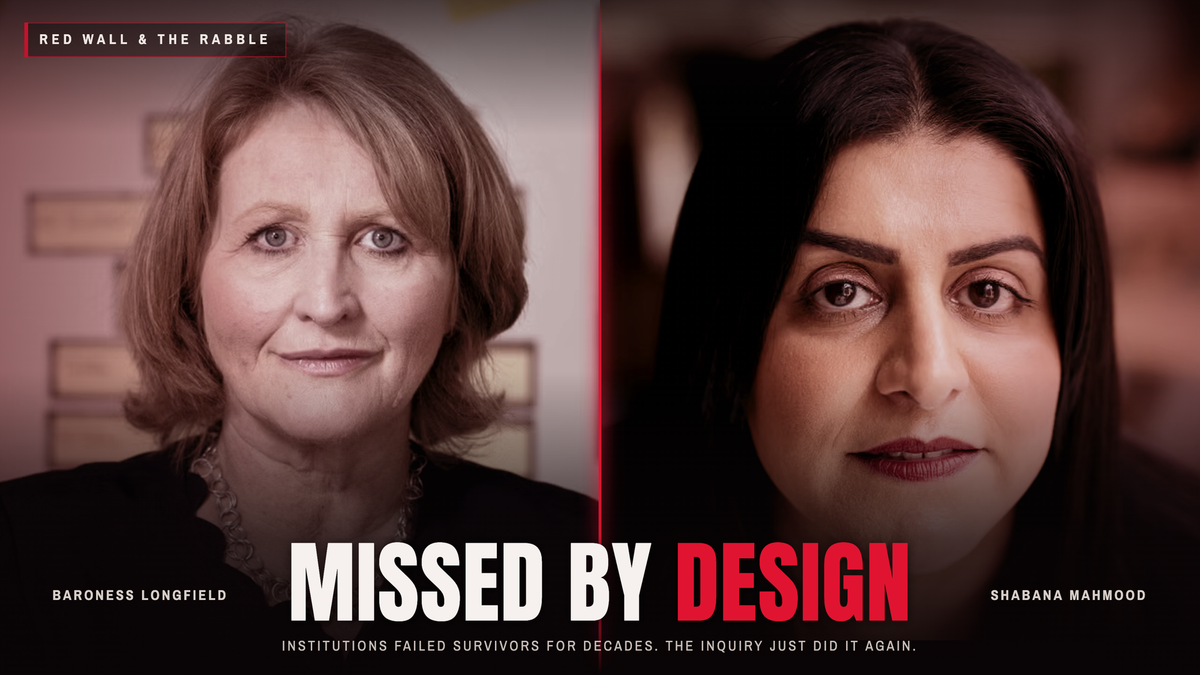
Institutions Failed Survivors for Decades. The Inquiry Just Did It Again.
This inquiry exists because institutions missed deadlines, buried documents and managed victims with warm words while the decisions were taken elsewhere. On day ninety-one, measured by its own published record, Anne Longfield and her team have missed a deadline, ignored what it had done and instead issued warm words to victims.
They had three months, They have access to £65 million and publishing this was one of their first dated deadlines. Instead of publishing the criteria for selection on the towns and cities, they spent the 13th launching a form that collects pain instead of evidence, a hub that promises everything whilst delivers nothing, and a hearing room that shuts out the very voices it was set up to listen to.
Not surprisingly, not a single mainstream news outlet or politician has said a word. Which is why you are here.
Raja Miah MBE
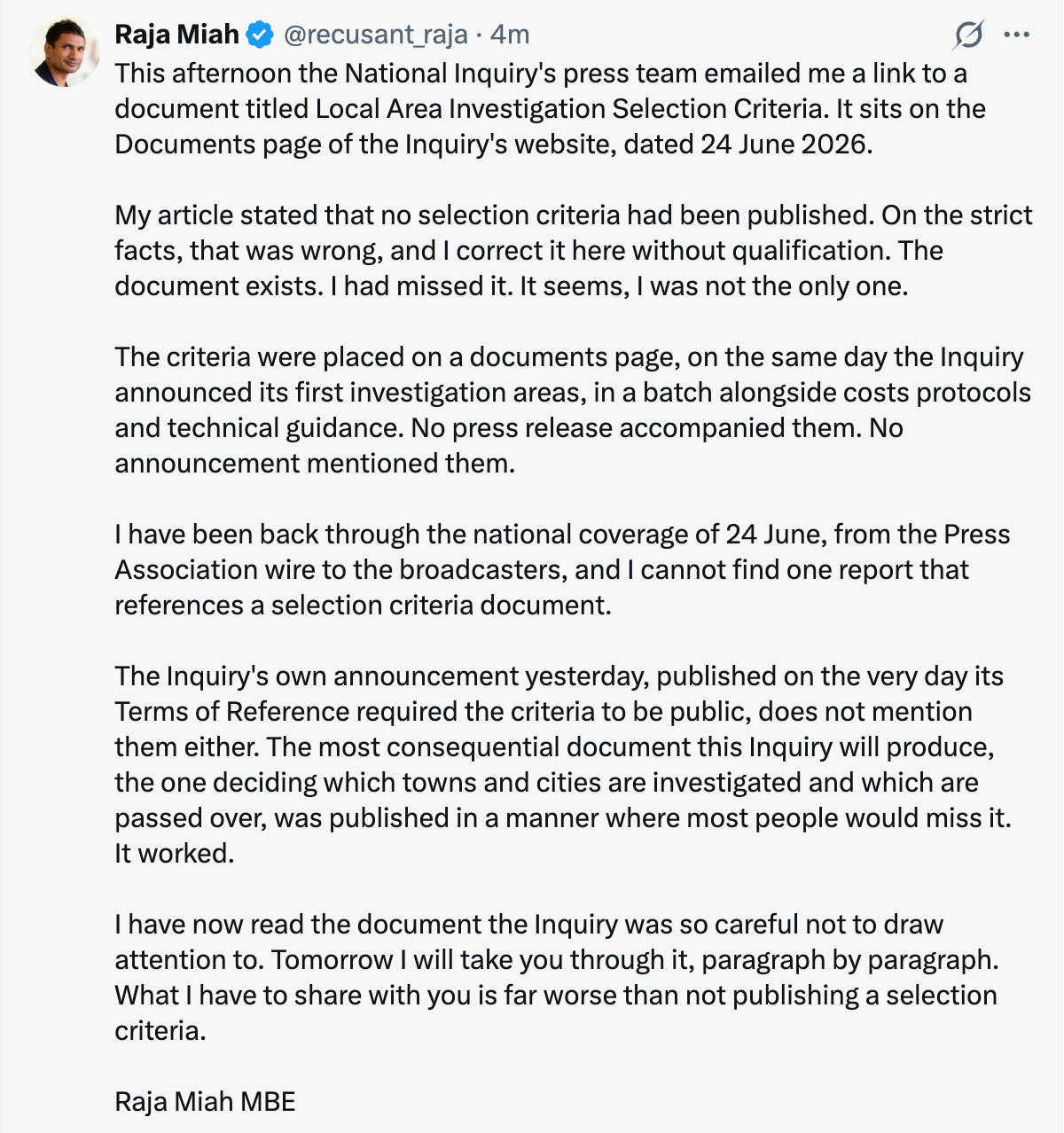
CORRECTION FOLLOWING COMMUNICATION FROM THE NATIONAL INQUIRY PRESS TEAM
I’m Raja Miah MBE. For nearly eight years, I have led a campaign that exposed how senior Labour politicians helped protect Pakistani rape gangs. The people of my town helped force the national inquiry.
You won’t see me on the BBC. You won’t read my work in the legacy press. That’s not an accident. I take this to a place from where there is no coming back.
I document everything in my newsletter. It’s 100% free to read. If this work matters to you, if you believe it must continue, I need your backing.
If you can’t commit to a regular subscription, a one-off contribution genuinely helps keep this alive. You can support me using one of these links;
👉 http://BuyMeACoffee.com/recusantnine
👉 http://paypal.me/RecusantNine
We’re up against a machine, politicians, police, officials, and media, working together to shrink, sanitise, and bury the truth. This work survives because of you.
If you’ve ever shared my posts, learned something, or felt less alone reading them, stand with me. I need your help.
Raja 🙏