The Survivors. The Donors. The Declaration. And The Political Party That Described The Inquiry As Its Own.
PART TWO
Part One answered one question. Does what Lowe announced on 26 April fall within the framework of the company he incorporated to deliver it? The answer, on the documents, is no. It then set out what that means in practice. The ultra vires challenge. The abuse of process risk from parliamentary naming. The CPS override power. The adverse costs exposure if the prosecution fails.
Part Two examines what that tells us about the company itself.
- Who made every decision inside this company and under what authority.
- What the Regulator has done on this company and what it has declined to do.
- Whether the declaration signed at incorporation, the document that is the legal foundation of the community interest status, the asset lock and the framework under which the money was raised, can still be true given what the public record now shows.
These three things are not separate questions. They are three layers of the same one: was this company ever genuinely independent of the political party whose sole director also controls it?
The governance structure answers that question first. One man made every decision with no check on his judgment. No co-director examined whether the CIC's activities were drifting toward the political party he also ran. No independent governance body asked whether the relationship between the two organisations was consistent with the declaration he signed. No such structure was ever built into the company.
The Regulator's record answers it second. Presented with evidence that the company was political on two separate occasions, it instructed a reclassification on the first and closed the matter on the second, neither time addressing the question of whether the CIC was operating as a subsidiary of a political party despite the evidence being there and the question being the most consequential one available to it.
The declaration answers it third and in its sharpest form. Lowe signed a document stating the company is not a subsidiary of a political party while the public record shows every operational characteristic of one. Both things cannot simultaneously be true, and the problem is not any one of those three failures taken alone but that all three point toward the same answer, an answer with consequences for every pound raised, every decision made, and every prosecution now being planned with money that donors gave for something else entirely.
One Director. Every Decision.
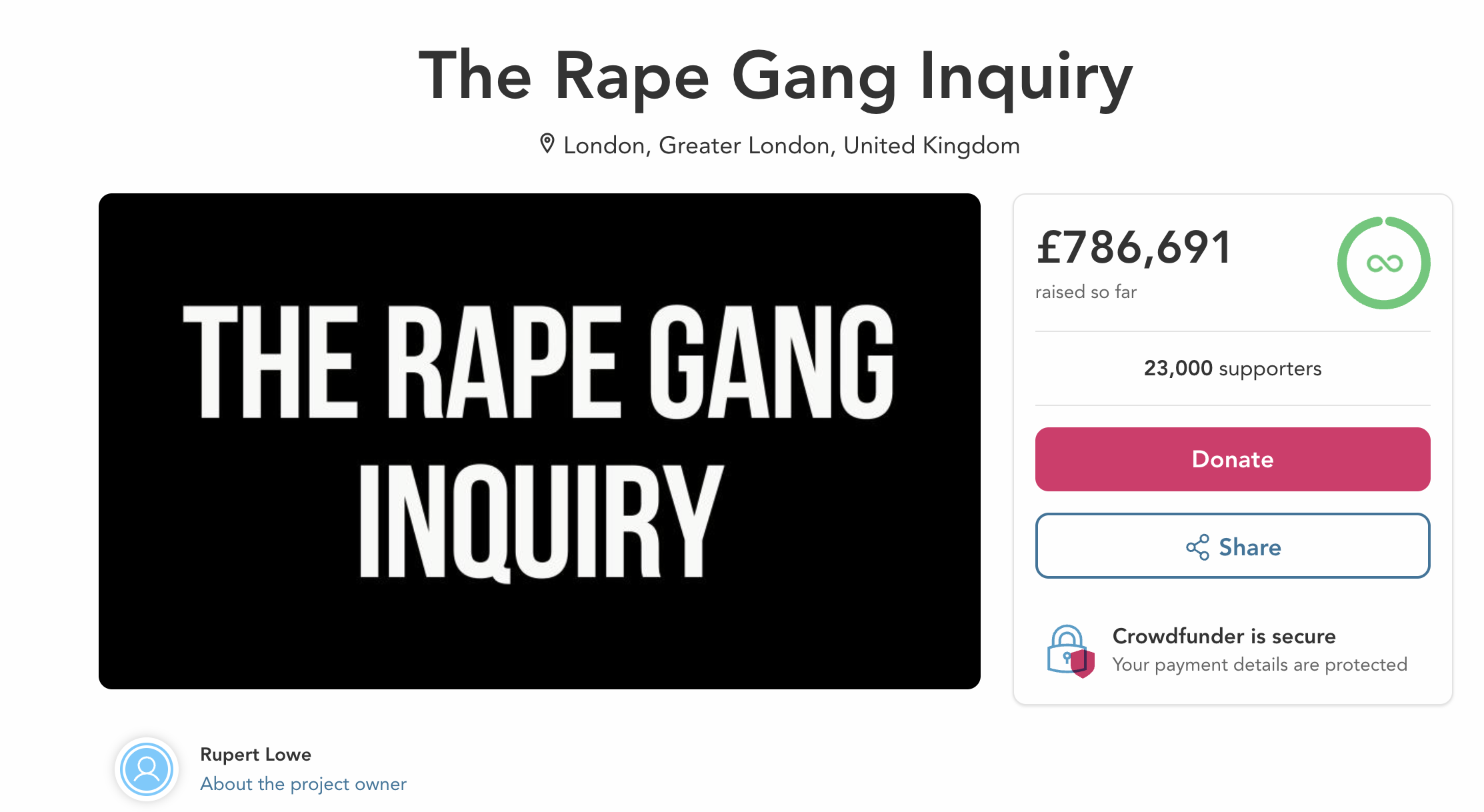
Rupert Lowe is the sole director, sole member and sole person with significant control of the Rape Gang Inquiry CIC, holding 75% or more of the voting rights and the right to appoint or remove directors.
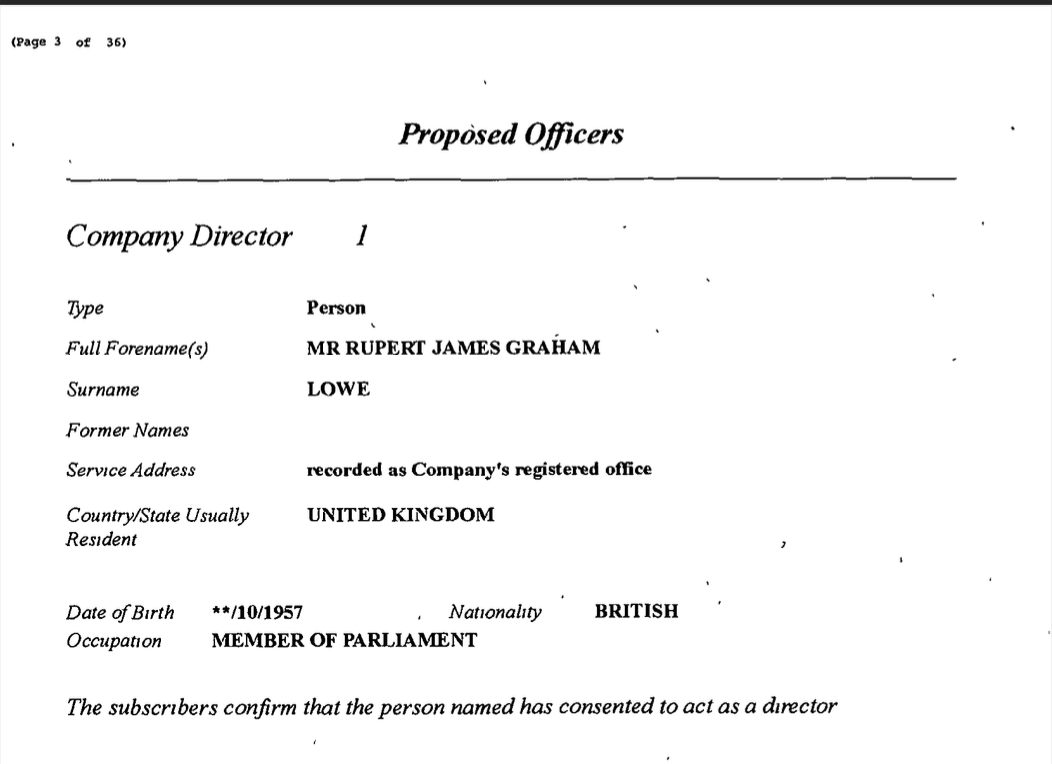
The registered office is his home address in Cheltenham. The company's filed structure contains no co-director, no independent governance body and no requirement to consult anyone before committing funds to any purpose.
The model articles at Article 15.2 require that the quorum for directors' meetings must never be less than two. With one director that requirement cannot be met. The articles resolve this through a footnote to Article 12: in the event of the company having only one director, a majority decision is made when that single director makes a decision. Every decision about how nearly £786,691 of public money is spent is therefore made by one person, alone, with no structural check.
Pursuing private prosecutions, holding the report pending an election, setting aside the surplus funds declaration, returning Ben Habib's £5,000 without being asked. Every one of those decisions was made by one person. No co-director challenged it. No governance body approved it. No published record of any decision exists.
The CIC Regulator's own guidance strongly recommends independent governance for companies of significant public profile. To understand why that matters here, it helps to understand what good governance actually does and what happens when it is absent.
Consider a company that raises money from the public for a specific purpose. Good governance means that no single person can decide unilaterally how that money is spent.
Principle One: Multiple Directors With Relevant Expertise
When one person controls all the decisions, there is no internal mechanism to catch mistakes, identify legal risks, or challenge a course of action before it becomes irreversible. Multiple directors with relevant expertise exist precisely to provide that mechanism. A director with legal expertise asks whether a proposed use of funds is within the company's filed powers before it is announced. A director with financial expertise asks whether the asset lock permits the transaction. A director with governance expertise asks whether the Regulator's consent has been obtained. Each one is a check on the others. Together they create the conditions under which a public promise can be kept, because there are multiple people inside the organisation whose job it is to ensure that what happens matches what was said.
Principle Two: Separation of Fundraising From Financial Control
The person who raises the money should not be the same person who decides how it is spent, without any independent check on that decision. The reason is practical. A single individual who both raises funds on a public promise and controls how those funds are deployed is in a position to change the deployment without anyone inside the organisation being able to stop it. They can fundraise on the promise of a published report and a donation to victim charities, and then redirect the money to private prosecutions, without a co-director, a governance body or an audit function ever having the opportunity to ask whether that change is consistent with what donors were told. The separation exists to make that kind of unilateral redirection structurally impossible. Without it, the only protection donors have is the continued goodwill of the single person who made the promise.
Principle Three: Transparency Through Regular Published Reporting
A community interest company is required to file a community interest report with its annual accounts, setting out what activities it has carried out, how its assets have been used, and how those activities have benefited the community it was incorporated to serve. That report is the mechanism by which the public, including the donors whose money the company holds, can verify that what is being done with the money matches what they were told. It is not a bureaucratic formality. It is the only formal transparency mechanism that exists between a CIC and the people whose money it holds. Without it, donors have no way of knowing whether the asset lock is being respected, whether the surplus is being directed where they were told it would go, or whether the activities being carried out are the ones filed at Companies House. The report is what makes the promise auditable rather than merely stated.
Lowe understands all three of these principles.
When he launched the crowdfunder he stated explicitly that every penny spent would be published, a voluntary transparency commitment made before a single pound was raised. He described a structured three-stage process with a defined mandate and a specific destination for surplus funds so that donors were trusting a process rather than simply a person. He presented the inquiry as survivor-led and independently chaired by a barrister, with a panel, a victim engagement officer and an evidence process, because he understood that credibility required visible structure beyond one man's judgment.
He knew what good governance looked like, described it to donors and committed to it publicly. The gap between what he promised and what he built into the legal structure of the company is where every legal failure in Part One became possible.
Good governance is the structural mechanism that turns a public promise into an enforceable commitment. Without it the promise is only as reliable as the judgment of the single person making it, judgment that cannot be examined, challenged or overridden by anyone outside the company before the money is spent.
Lowe may genuinely believe that private prosecutions serve the community interest this CIC was built to pursue, that the surplus funds are being deployed consistently with what donors were promised, and that the declaration he signed is accurate. Genuine belief is not a substitute for governance. A sole director who genuinely believes something that turns out to be legally wrong is still a sole director who made a consequential legal decision with no structural check to catch the error before it became irreversible.
If Lowe genuinely believes that declaration is accurate while simultaneously being the sole director of a political party that describes the inquiry as its own founding asset, commissioned polling from its unpublished research, and embedded its Director of Investigations in its hearings, then he does not regard those things as constituting political ownership or operational control of the CIC. That is a question of judgment rather than honesty, and it is precisely the kind of judgment that independent governance exists to check.
A co-director with relevant legal expertise would have examined the relationship between the CIC and Restore Britain before the declaration was signed. An independent governance body would have examined the asset lock before the April 26 announcement. An audit function would have identified that the Regulator's consent had not been obtained before the decision was announced as settled policy.
One person made every judgment call without any of those checks in place. If those judgment calls turn out to be legally wrong, no governance structure inside the company was ever positioned to catch them before the money was spent.
A Regulator That Has Already Had to Act
The CIC Regulator is not a passive body and it has form on this company. When the Rape Gang Inquiry CIC was incorporated in May 2025, Lowe selected SIC code 94920 as the company's classification. SIC codes are the standard industrial classification codes that every company files at Companies House to describe what type of organisation it is. Code 94920 denotes activities of political organisations.
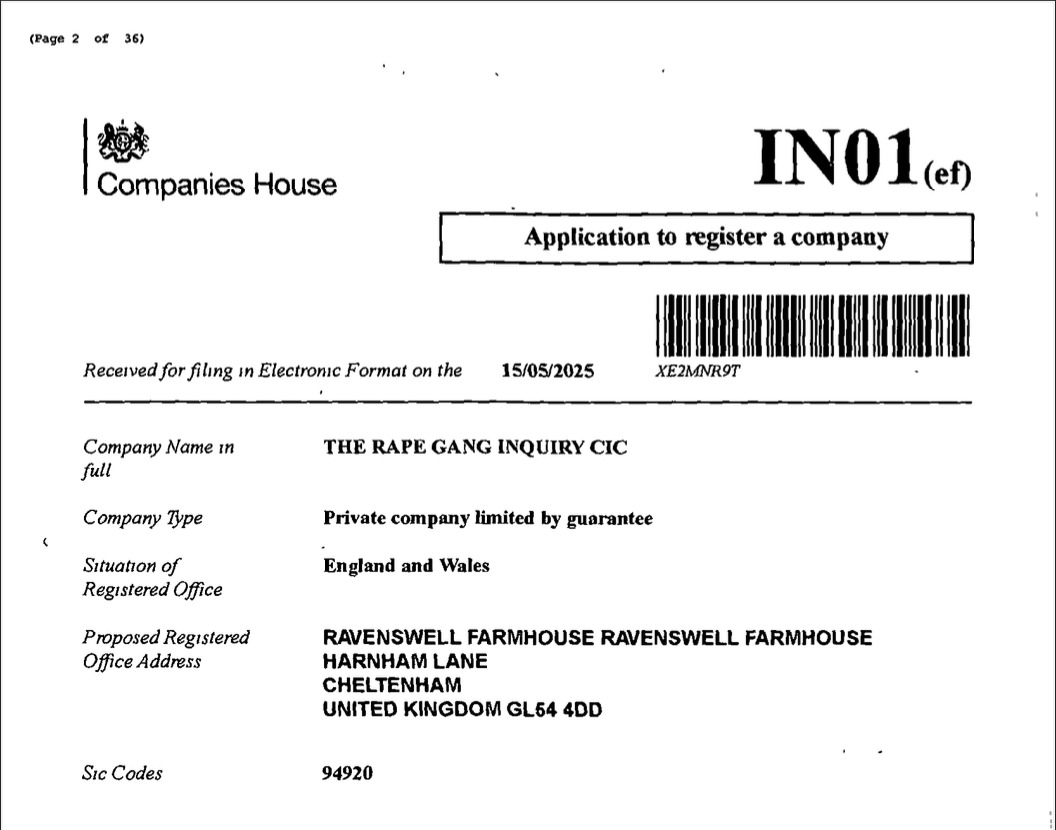
That is the code Lowe chose for a company he had declared, on the CIC36 form filed at the same time, was not a political organisation. A community interest company cannot meet the community interest test if it operates as a political organisation. The two are legally incompatible, and a CIC that classifies itself as a political organisation is on its face a CIC that should not exist.
Researcher Dr Alex May identified this contradiction and raised it formally with the Regulator.
 notactualsize2013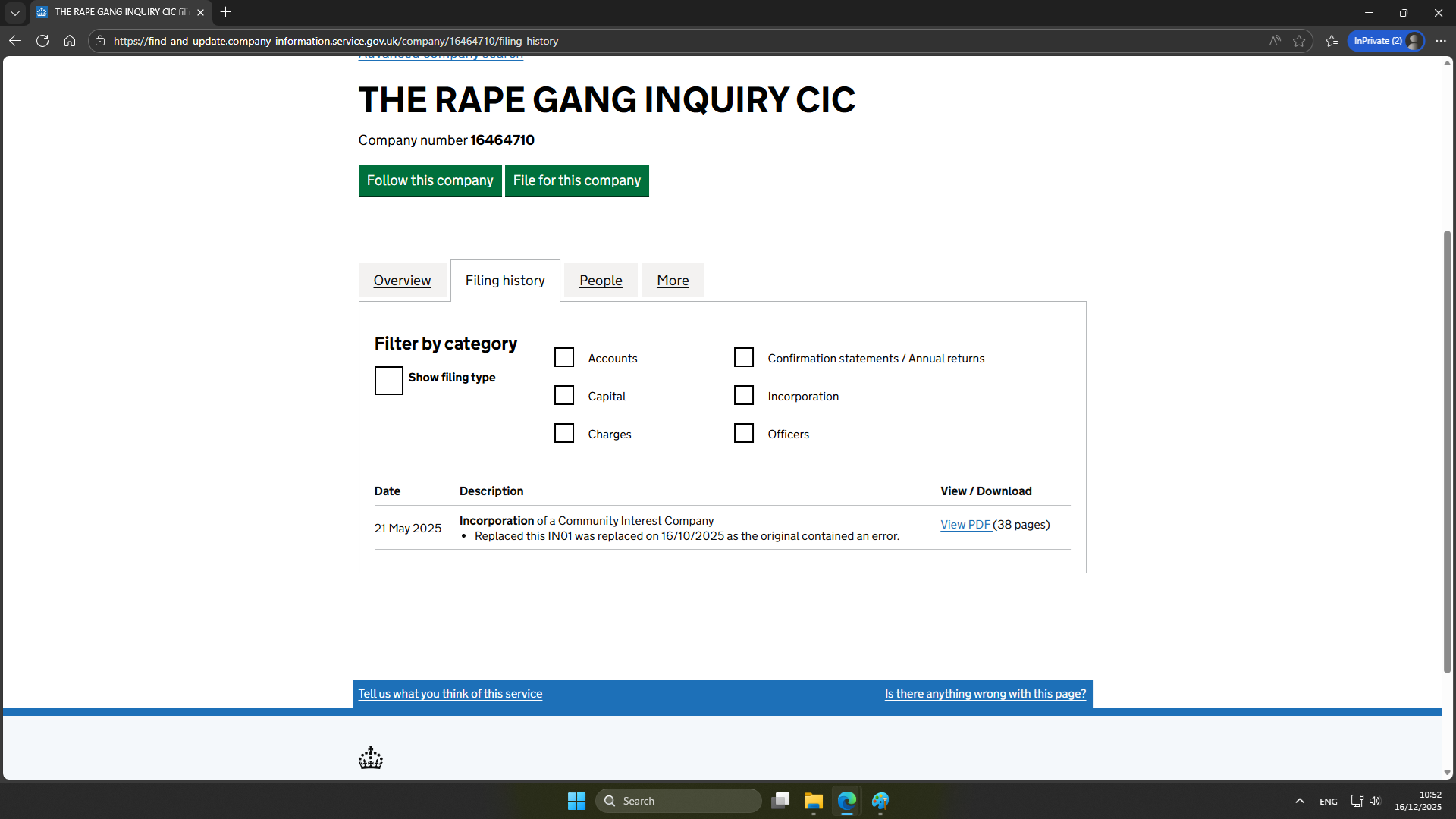
The Regulator instructed Lowe to reclassify. An RP01 replacement filing appeared at Companies House in October 2025, replacing the political organisations code with 88990, denoting other social work activities without accommodation not elsewhere classified.
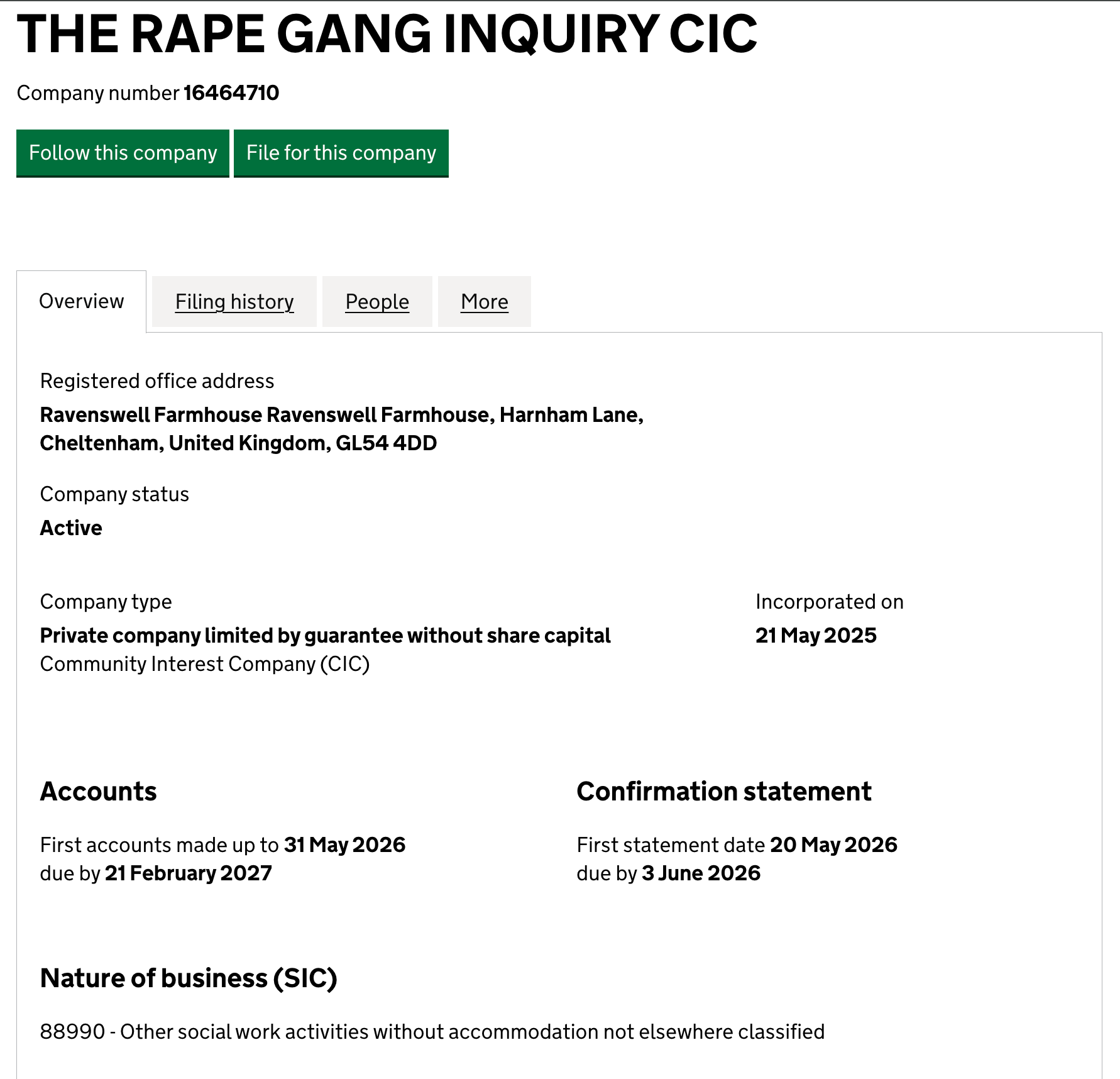
The original filing was described in the replacement as containing an error.
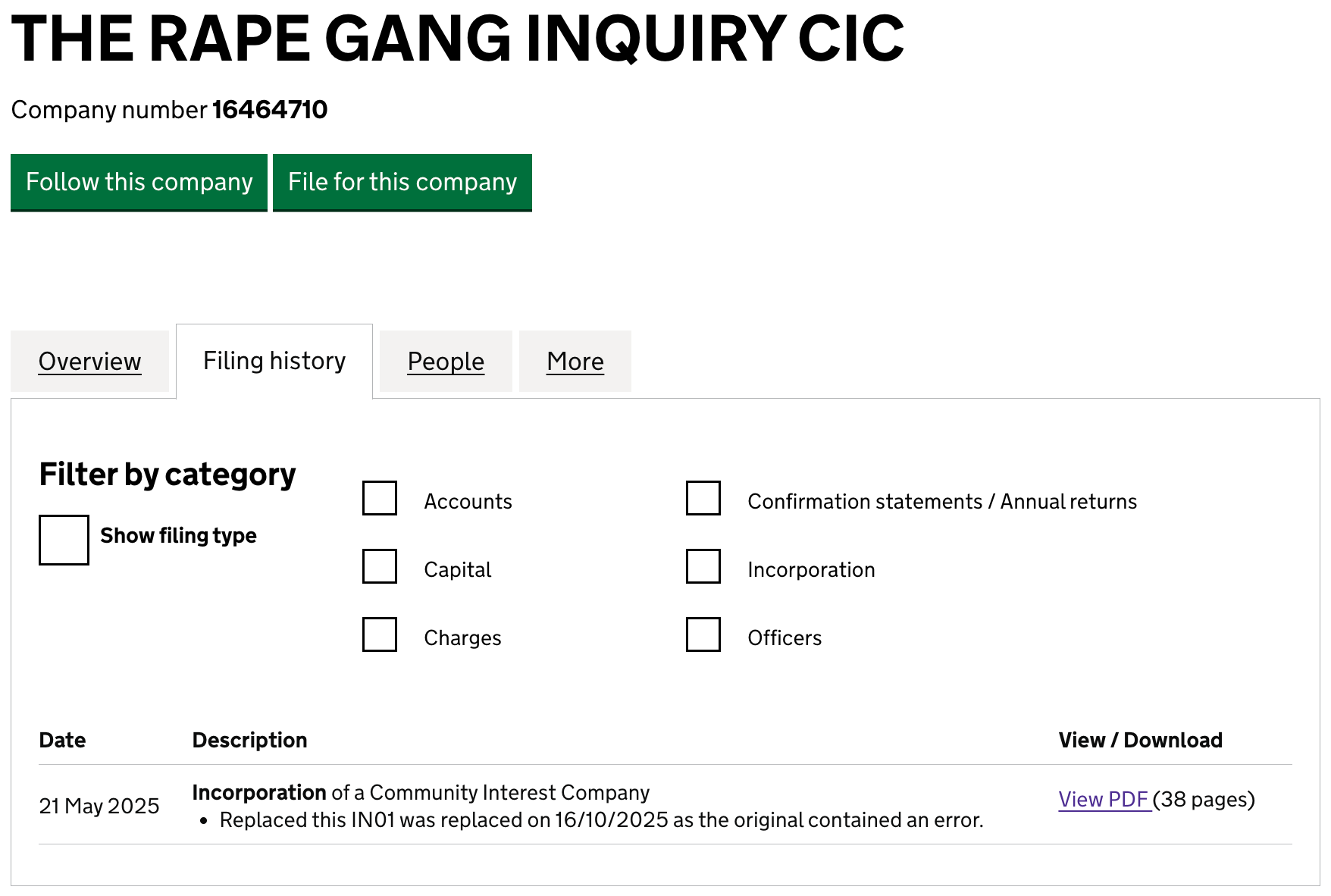
What the original actually contained was Lowe's own description of what the organisation was. Code 94920 classification stands for "Activities of political organisations". It is used to categorise businesses or organisations involved in promoting the interests of political parties or candidates, including fundraising and policy formulation.
The subsequent actions of Restore Britain make that plain. The party commissioned polling in August 2025, while the inquiry was still gathering evidence, using the inquiry's unpublished research as the evidential base for its policy positions on deportation, dual nationality stripping and community accountability, research that the 23,000 donors who funded it and the survivors who gave testimony to produce it had not been permitted to see.
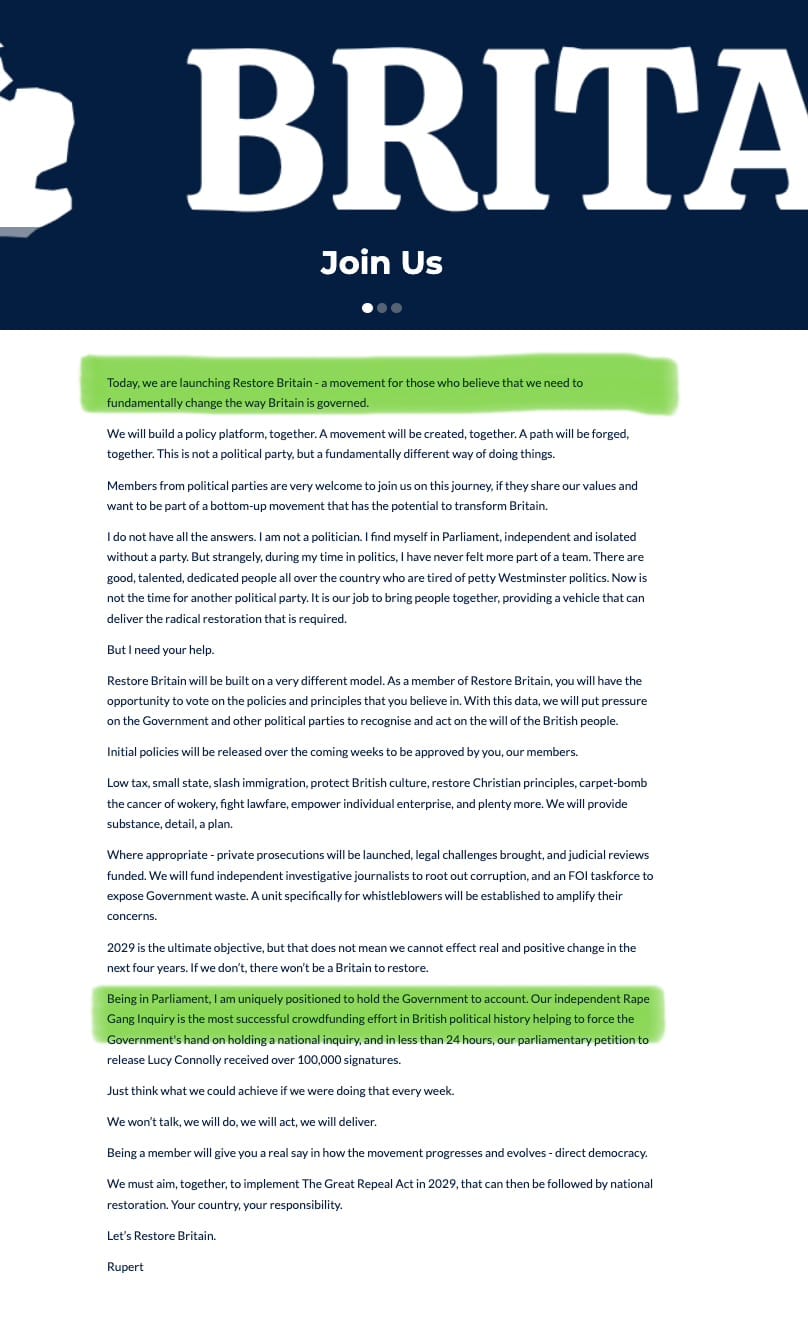
Its policy page describes the inquiry as its own founding asset, and its Director of Investigations was embedded in the inquiry's work during the hearings themselves.
The inquiry that was reclassified away from political organisations in October 2025 was being operated as the research and policy foundation of a political party throughout that same period.
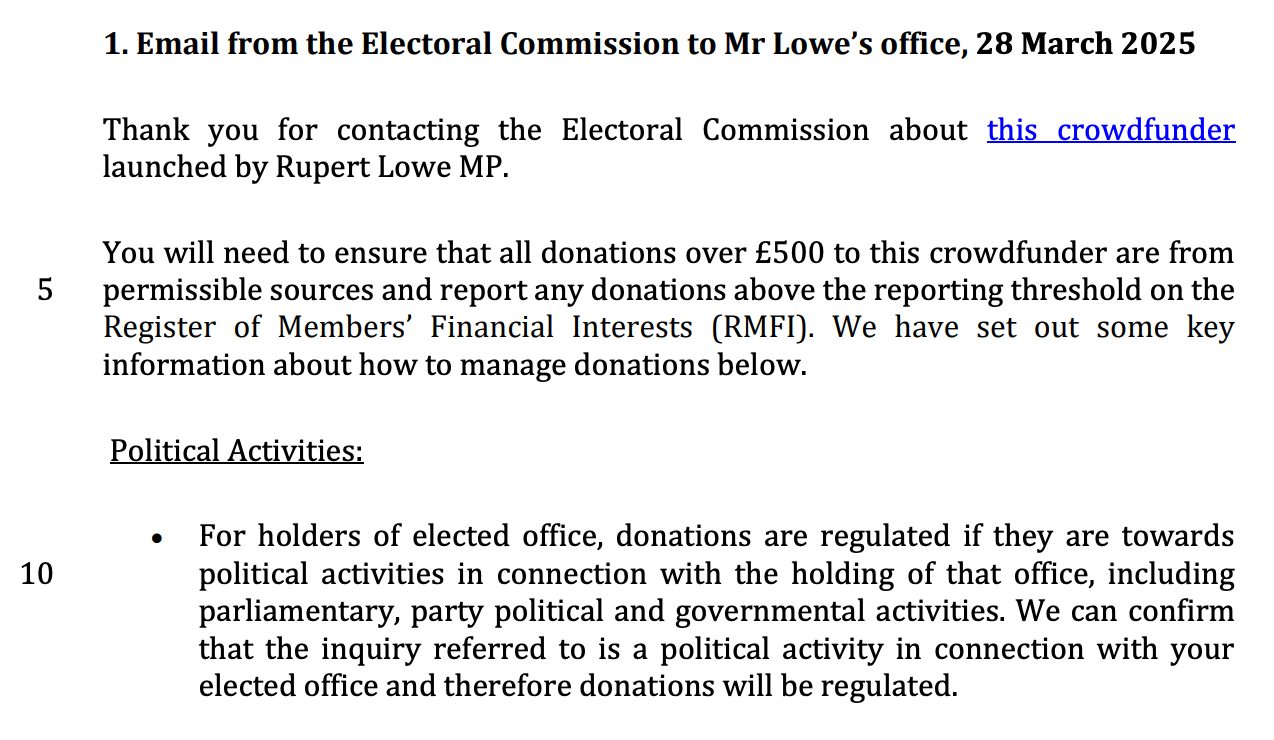
Dr May provided the Regulator with independent determinations from both the Electoral Commission and the Parliamentary Commissioner for Standards confirming the CIC was a political activity.
Mr Greenberg (Parliamentary Commissioner for Standards) required Mr Lowe to disclose donations to the CIC above the registration threshold, £1.5k, on the register of MP’s financial interests, under Category 2(b). This is because “these donations have been made in support of your activities as a Member of Parliament”. Thus the Parliamentary Commissioner for Standards agrees with the Electoral Commission that the Rape Gang Inquiry CIC undertakes political activities.
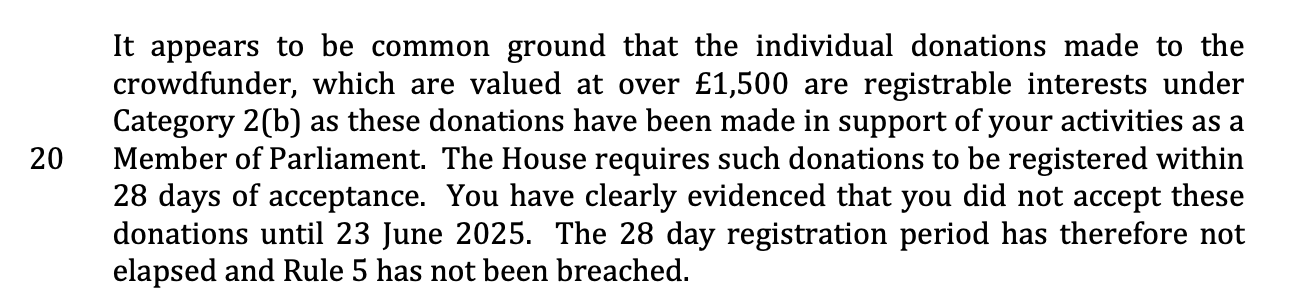
The Regulator received both findings and closed the matter without further action. The Regulator has been given every opportunity to examine this company and has declined to ask the questions that matter most.
“… as the declaration on the form CIC36 confirmed the company is not a political party, political campaigning organisation or a subsidiary of either, the Regulator concluded that the SIC code given on the application for incorporation (activities of political organisations) was factually inaccurate.”
You are not yet a paid subscriber to Red Wall and the Rabble, please upgrade your subscription and join us. Now, more than ever, I need you.
The Most Serious Question Has Never Been Asked
The question of whether using crowdfunded assets for private prosecutions constitutes a breach of the asset lock is a materially more serious question than a SIC code classification. It goes directly to whether this company is operating within its legal mandate and whether the funds it holds are being deployed for the community interest purposes under which they were raised.
But it is not the most serious question the Regulator has never been asked.
The most serious question is whether this company should have been incorporated as a community interest company at all. Restore Britain's own website describes the inquiry as its founding asset. The CIC36 declares it is not a subsidiary of a political party. Both cannot be true. If Restore Britain's description is accurate, the declaration is false, the community interest status was obtained on a false basis, and the legal framework under which 23,000 people gave £786,691 was never valid from the day the company was incorporated.
Was The Inquiry Ever Anything Other Than The Party?
The question that sits beneath everything documented in this series is not whether Rupert Lowe set up a political party off the back of the Rape Gang Inquiry. That is documented and visible. The hearings closed on 13 February 2026 and Restore Britain launched as a registered national political party the same evening.
The deeper question is whether the inquiry was ever genuinely independent of the political party at all, or whether it was always the founding infrastructure of that party, dressed as a community interest company, incorporated under a legal declaration stating it was not political, and funded by 23,000 people who were never told that is what they were financing.
If the research was always going to become Restore Britain's policy platform, if the Director of Investigations was always embedded in the work, if the crowdfunder was always going to be the financial foundation of a political movement, then the activities of the CIC and Restore Britain since June 2025 do not raise a question about the declaration signed on 7 May 2025. They answer it.
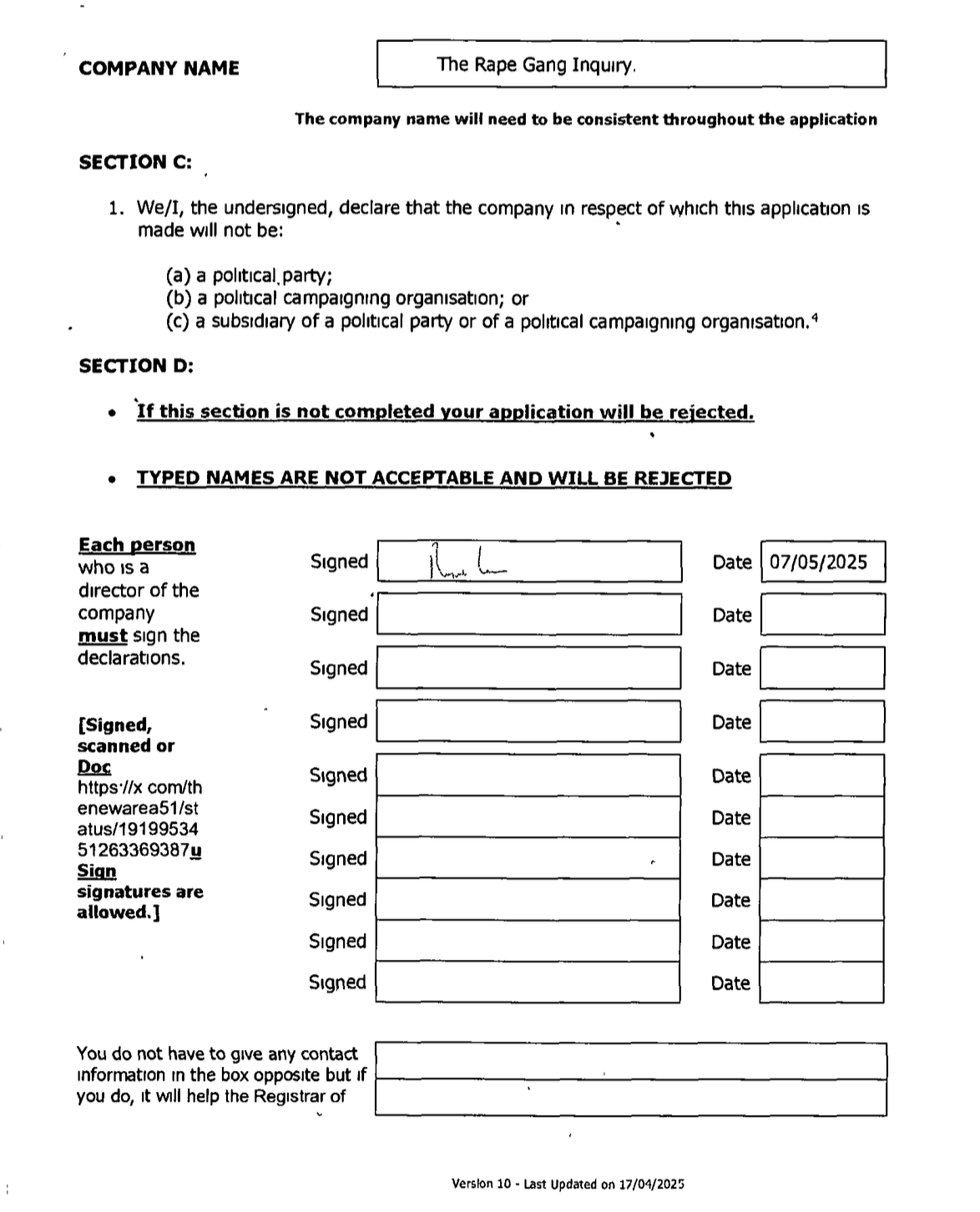
That declaration states, word for word, that the company will not be a political party, a political campaigning organisation, or a subsidiary of a political party or a political campaigning organisation. It was signed at incorporation and has never been amended.
When Lowe authenticated the RP01 filing on 16 October 2025, three things were already publicly documented.
- Restore Britain had launched as a political movement on 30 June 2025, forty days after the CIC was incorporated, with the inquiry described as its founding asset.
- Restore Britain had commissioned polling from the inquiry's research in August 2025, in its own published words, before a single piece of that research had been seen by the donors who funded it or the survivors who produced it.
- Restore Britain's own website was describing the inquiry as its own, and Lowe was commenting on its polling results as Restore Britain's leader.
The declaration could not be amended to reflect a subsidiary relationship with a political party. Doing so would have invalidated the company's community interest status and ended the CIC entirely. So it stayed in place. Unamended. While £786,691 of public money continued to sit inside a company whose entire legal framework depended on that declaration being true. And whose sole director was simultaneously running the political party that was publicly describing the inquiry as its own.
The CIC36 filed at Companies House on 7 May 2025 contains a declaration in Section C that is the legal foundation of the Rape Gang Inquiry CIC's community interest status. Rupert Lowe signed it, and it states, word for word, that the company will not be a political party, a political campaigning organisation, or a subsidiary of a political party or a political campaigning organisation. That declaration is what allowed the CIC to be incorporated. Without it the Regulator could not have approved the application, and the community interest status, the asset lock and the legal framework under which 23,000 people gave £786,691 depend entirely on that declaration being true.
Restore Britain is a registered political party whose sole director is Rupert Lowe. Its law and order policy page, under the heading Crush the Rape Gangs, states that Restore Britain would embark on a national strategy working from the findings of its rape gang inquiry.

On 27 August 2025, while the inquiry was still gathering evidence and five months before the hearings opened, Restore Britain published polling commissioned from Find Out Now. The page, now removed from Restore Britain's website, stated in their own words that the polling was commissioned following research by the Rape Gang Inquiry and covered three policy positions on deportation, dual nationality stripping and community accountability.
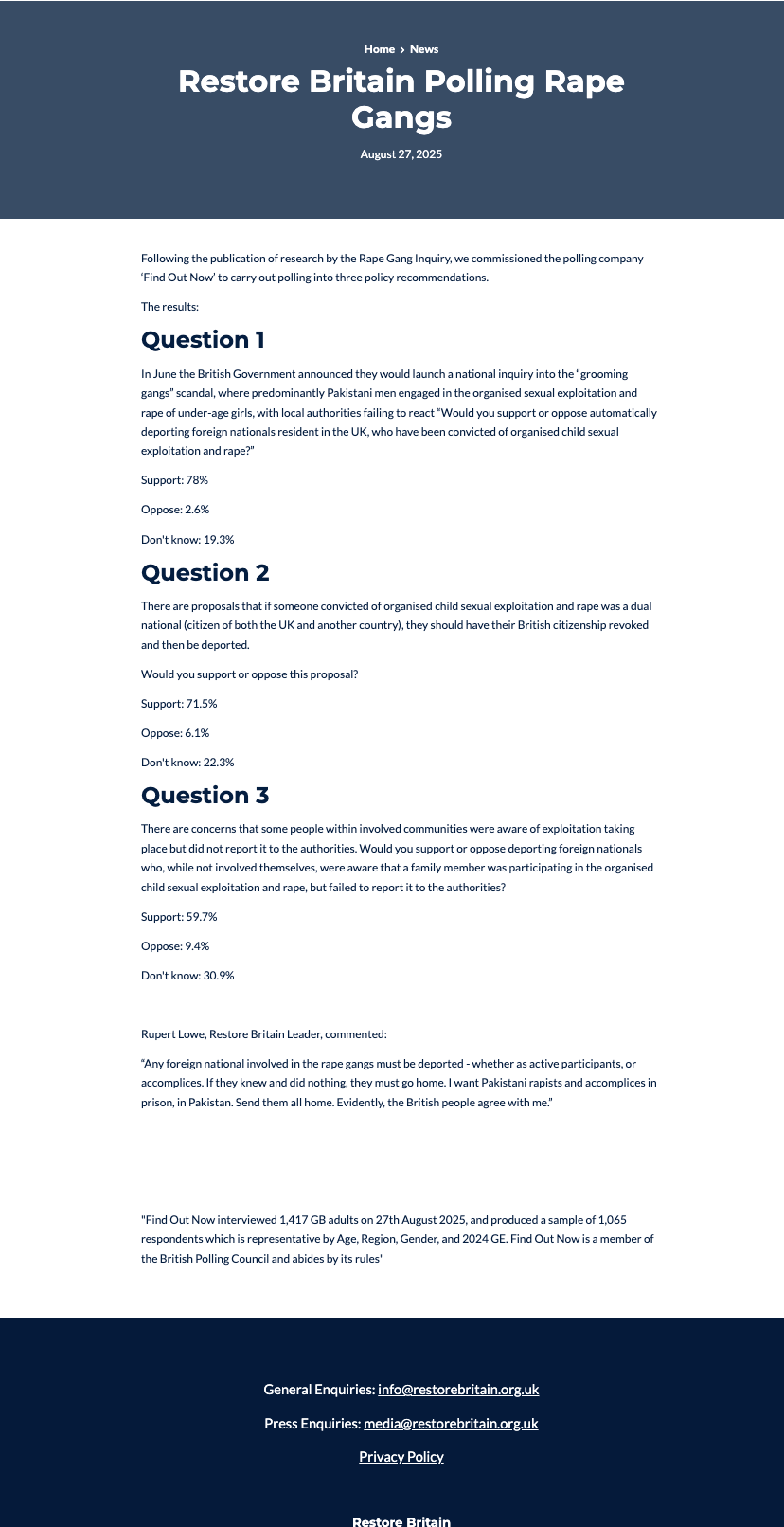
I can find no research from the inquiry that had been published at that point. The 23,000 donors who funded the inquiry and the survivors who gave testimony to produce it may have seen something I have not that led to the commissioning of this polling.
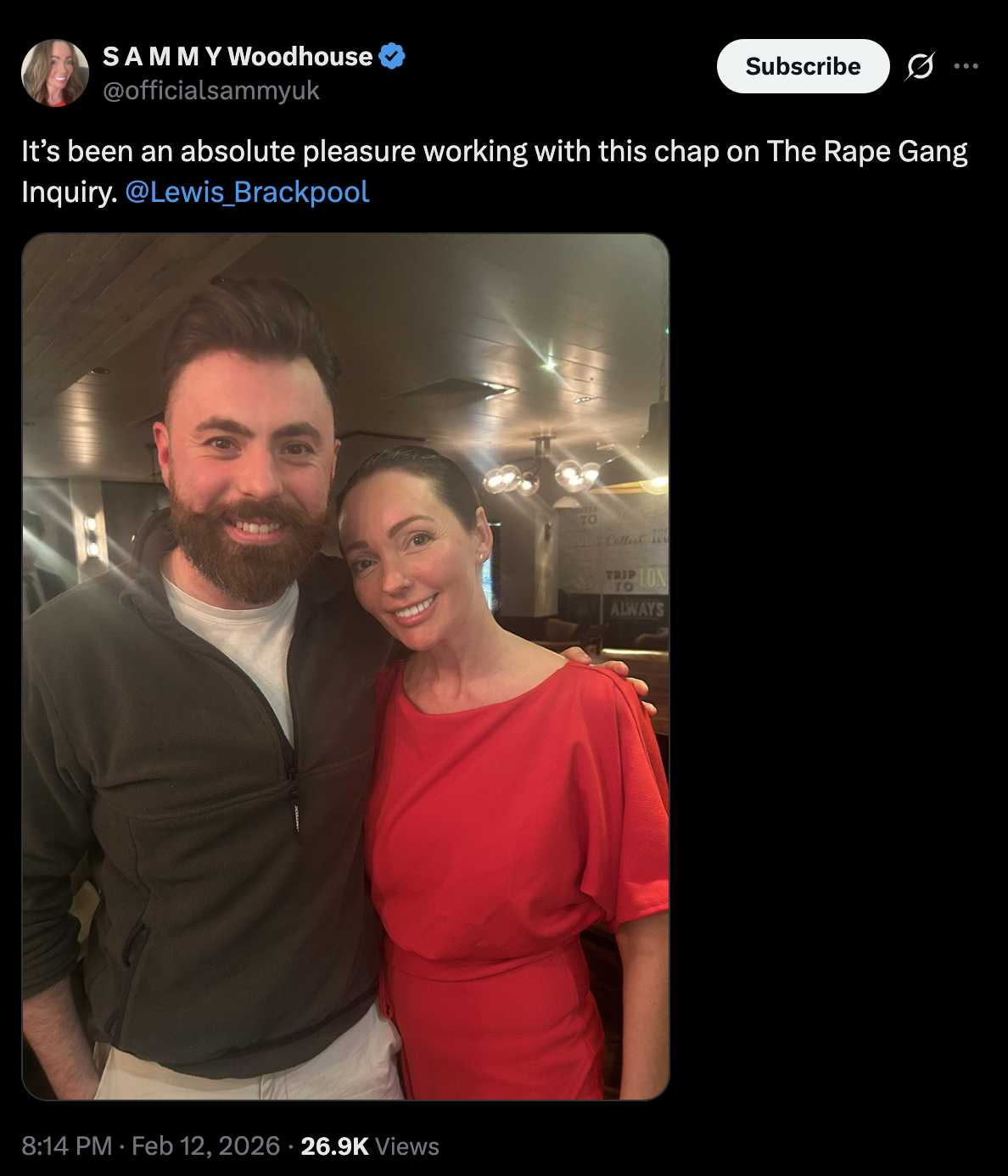
What we do know is that Restore Britain's Director of Investigations was working on the inquiry with Sammy Woodhouse during the hearings themselves. What we do not know is when he started working on the Rape Gang Inquiry.
One Man Controls Both. The Law Has A Name For That.
A subsidiary relationship in company law can be established through:
- Common directorship
- Common control
- Operational dependence without requiring a formal shareholding
Lowe is the sole director of both the Rape Gang Inquiry CIC and Restore Britain, holds 75% or more of the voting rights in the CIC, and the inquiry's research is being deployed as Restore Britain's political platform by a party whose own investigative officer was embedded in the inquiry's work during the hearings. Every operational connection between the two entities that would establish a subsidiary relationship is present in the public record.
If the Rape Gang Inquiry CIC is operating as a de facto subsidiary of Restore Britain, the declaration signed on 7 May 2025 is called into question not by the signing but by everything that followed it. A false CIC36 declaration does not merely expose a director to regulatory sanction. It potentially invalidates the community interest status of the company from the point at which the subsidiary relationship was established, meaning the legal protections donors were told governed how their money would be used, including the community interest test and the asset lock itself, may not have been valid throughout the period in which the relationship developed.
Three bodies have now been given evidence that bears directly on this question.
- The Electoral Commission told Lowe on 28 March 2025 that the CIC was a political activity in connection with his elected office.
- The Parliamentary Commissioner for Standards required donations to be registered as support for his parliamentary work.
- The CIC Regulator was provided with both determinations and closed the matter without addressing the subsidiary question directly.
You Were Told You Were Funding An Independent Inquiry. Were You Deceived?
That question must now be put to the Regulator formally. It must also be put to the Parliamentary Commissioner for Standards. The Commissioner already determined that donations to the Rape Gang Inquiry CIC required registration as support for Lowe's parliamentary work because they were made in connection with his elected office. That determination sits alongside the Electoral Commission's finding that the CIC was a political activity. Neither body addressed the subsidiary question directly.
If the CIC has been operating as a de facto subsidiary of Restore Britain from the point at which Restore Britain launched in June 2025, both determinations take on a different significance. The donations were not merely registrable as parliamentary support. They may have been donations to a political party's research operation made under a legal framework that described it as something else entirely.
If that is what happened, the declaration in Section C of the CIC36 is false, the community interest status of the company may be invalid, and the public was asked to donate to an independent inquiry when what they were actually financing was a political party's research operation.
A declaration signed on 7 May 2025 by the sole director of a company that within forty days became the founding asset of a political party he also controls, stating that the company is not a subsidiary of a political party, cannot be simultaneously true of both organisations he controls.
A political party whose senior policy fellow was publicly advocating re-migration on GB News days after the inquiry's research was used to commission polling. A political party whose Director of Investigations was embedded in the inquiry's hearings while his colleague was making those arguments publicly. A political party whose positions on race, demographics and national cohesion were being developed and articulated at the same time survivors were sitting in a room in central London and trusting that what they said would be used for justice rather than politics.
The survivors were not told any of that. They were not asked whether they consented to their testimony being used in that context. On the evidence of the public record, they were not given the information they needed to make that decision at all.
What Part Two Establishes
Part One showed that the April 26 announcement falls outside what the CIC36 authorises, what the asset lock permits, and what the surplus declaration specifies. Part Two shows why that was always possible, and raises a question that goes further than anything in Part One.
The sole director made every decision alone with no co-directors, no governance body and no structural check on how the company's assets were deployed. The Regulator that has already intervened once has never been asked the four questions that matter most, leaving the governance failures in Part One entirely unexamined. The declaration signed at incorporation stating this company is not a subsidiary of a political party was signed by the same man who is the sole director of the political party that publicly describes the inquiry as its own founding asset, commissioned polling from its research before the hearings opened, and embedded its Director of Investigations in its work throughout.
On the evidence of the public record, that declaration may never have been true.
If it was not true, the question is not whether the April 26 announcement to use funds held by the CIC to pursue private prosecutions falls outside the CIC's legal framework. The question is whether the CIC's legal framework was ever valid at all. That is the question the Parliamentary Commissioner for Standards, the Electoral Commission and the CIC Regulator have each been given the evidence to ask, and none of them have asked it.
Part Three was meant to set out what must now happen before it is too late. That may now have to wait.
Because before the governance is fixed and before the Regulator is asked and before the prosecutions are examined and before the report is published, there is something more fundamental that must be addressed.
The donors who gave £786,691 deserve clarity on what they were actually funding. But the survivors and those who gave testimony deserve something that goes beyond clarity. They gave evidence about the most intimate and devastating experiences of their lives. They did so because they were told they were contributing to an independent inquiry.
- They were not told the inquiry's research was being used to inform the policies of a political party before the hearings opened.
- They were not told the party's Director of Investigations was embedded in the work while his colleague argued for re-migration on national television.
- They were not asked whether they consented to any of that.
What they need is the truth. Not a legal determination. Not a regulatory finding. The truth, stated plainly and publicly by the people who ran this inquiry. About what it was. What it was for. And who it served.
If you believe what I am detailing, my reasoning makes sense to you, and my findings are accurate, the survivors were not just failed again. They were exploited again. Their pain was used. Their courage in coming forward was used. By different people, for different ends, with different language. But used.
They deserve to know whether they gave evidence to an independent inquiry or whether they were manipulated into providing testimony that fitted a pre-established political viewpoint. That question must be answered first. Everything else comes after.
I’m Raja Miah MBE. For seven years, I led a campaign that exposed how senior Labour politicians helped protect Pakistani rape gangs. The people of my town helped force the national inquiry.
You won’t see me on the BBC. You won’t read my work in the legacy press. That’s not an accident. I take this to a place from where there is no coming back.
I document everything in my newsletter. It’s 100% free to read. If this work matters to you, if you believe it must continue, I need your backing.
My work is free. No paywalls. No gatekeeping. No exclusions. Because the truth shouldn’t belong only to those who can afford it. If you can afford to do so, supporting me costs as little as 75p a week (£30 a year).
If you can’t commit to a regular subscription, a one-off contribution genuinely helps keep this alive. You can support me using one of these links;
👉 http://BuyMeACoffee.com/recusantnine
👉 http://paypal.me/RecusantNine
We’re up against a machine, politicians, police, officials, and media, working together to shrink, sanitise, and bury the truth. This work survives because of you.
If you’ve ever shared my posts, learned something, or felt less alone reading them, stand with me. I need your help.
Raja 🙏