THE BIGGEST POLITICAL CROWDFUNDER IN BRITISH HISTORY IS IN SERIOUS DANGER. SO ARE THE PEOPLE IT WAS BUILT TO PROTECT.
PART ONE
The Plan To Put Them In Prison Could Set Them Free Instead.
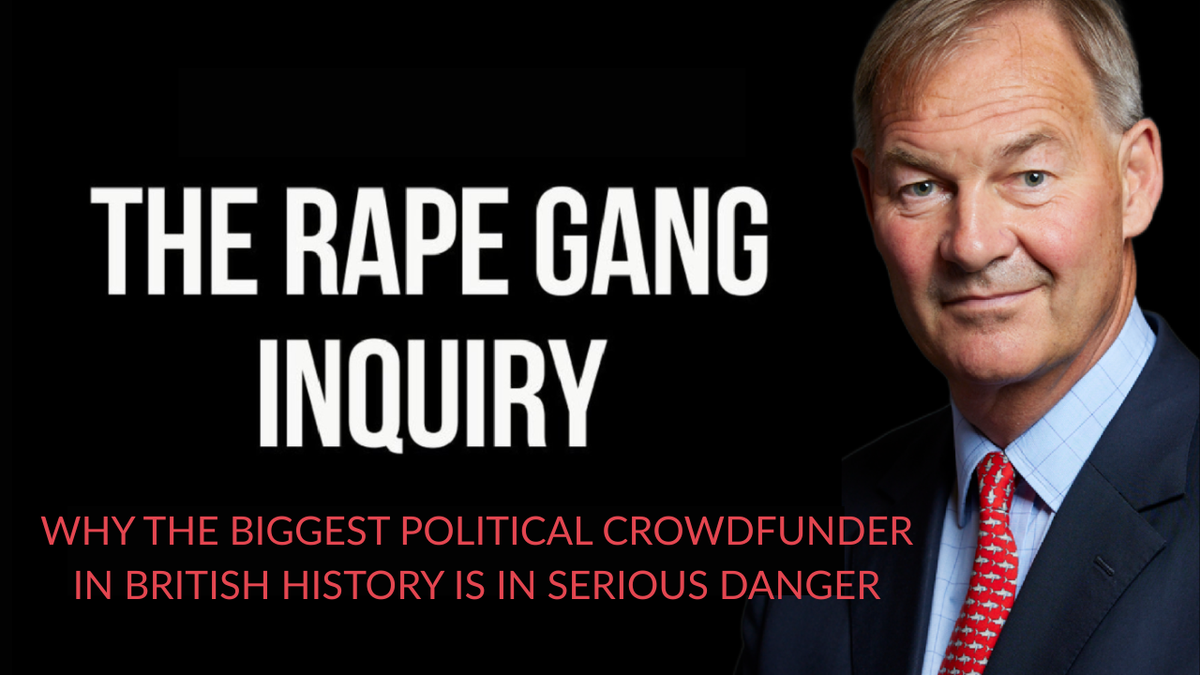
On 26 April 2026, Rupert Lowe MP announced he would use parliamentary privilege to name perpetrators and officials in the House of Commons, then pursue private prosecutions using the money raised through the Rape Gang Inquiry crowdfunder, with the stated goal of putting them in prison.
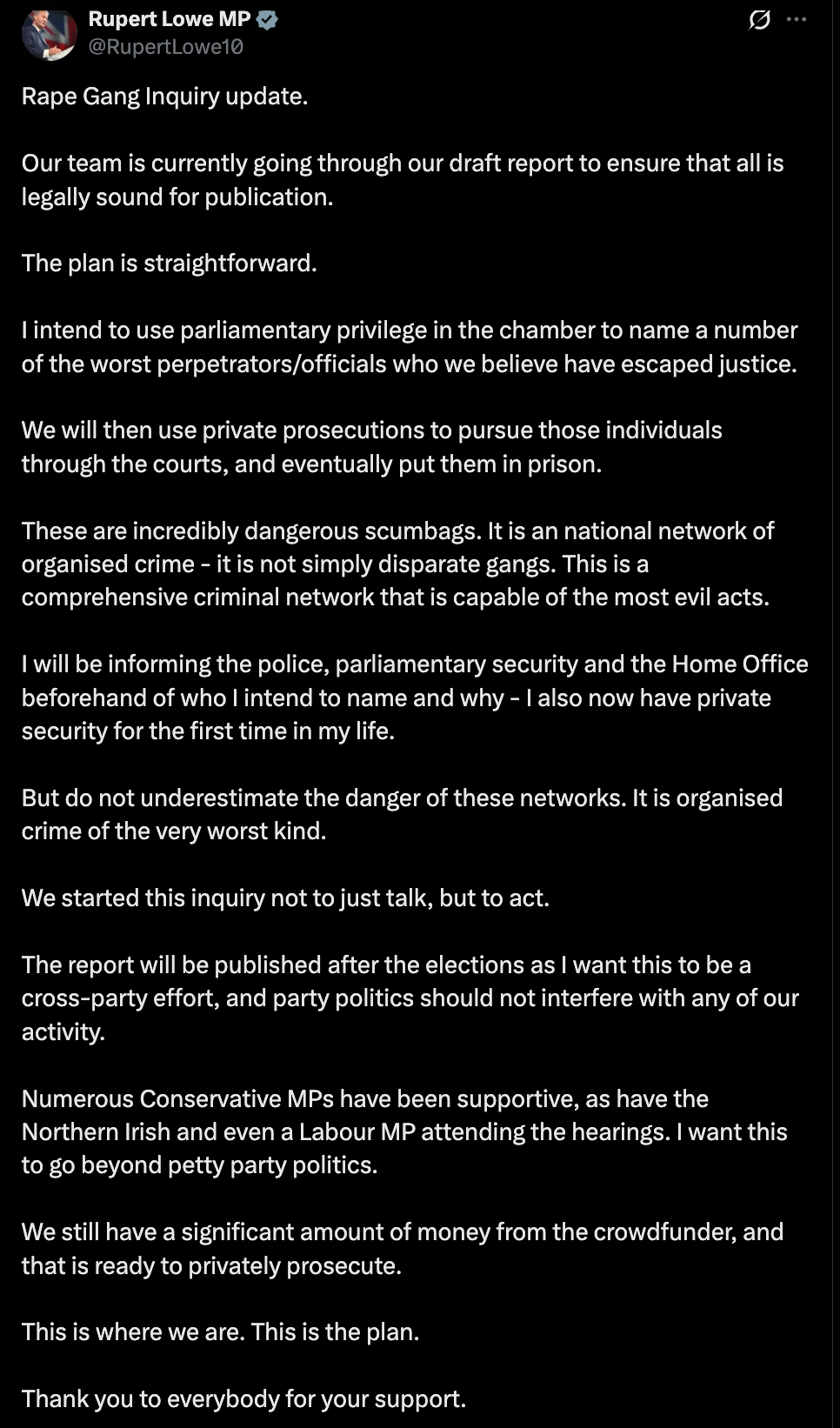
The Rape Gang Inquiry CIC is registered at Companies House. The authority to do what Lowe announced on 26 April is not.


The company was incorporated for specific purposes under a rigid legal structure with specific constraints on how its assets can be used, and what was announced falls outside that structure in ways that carry serious legal and financial consequences for the 22,995 people whose money sits inside it.
Before anything else, one thing needs to be stated plainly. The evidence this inquiry gathered is real. The hearings produced testimony of serious gravity. The 85 local authority mapping is the most significant independent documentation of the scale of this scandal this country has produced. Nothing in what follows diminishes that. What follows is about the legal framework governing how the money raised to produce that evidence can be used, whether what was announced on 26 April falls within it, and what the consequences are if it does not.
The starting point is the document that defines what this company can legally do, not what its director says it will do or what the crowdfunder described. That document is the CIC36, publicly available, signed by Rupert Lowe on 7 May 2025, and the foundation on which every other question in this investigation rests.
What the CIC36 Actually Authorises
A Community Interest Company cannot do whatever its director decides. Its activities are defined at incorporation on the CIC36 form, filed at Companies House and on the public record. The Rape Gang Inquiry CIC's CIC36 was signed by Rupert Lowe on 7 May 2025 and authorises four activities.
- Data collection from public bodies on the nature of child sexual exploitation, its scale and current safeguarding measures, combined with a call for evidence collecting stories from survivors, friends and families, public body officials, charities, journalists and concerned citizens.
- Victim liaison support through a dedicated officer, helping survivors access mental health services and specialist charities and process what they experienced.
- Supporting survivors in obtaining information from councils, NHS Trusts and police forces through Data Subject Access Requests, and advising them on how to pursue legal action in their own names.
- The fourth activity is the one that matters most for what Lowe announced. The CIC36 states that the company will facilitate a sense of justice by placing stories with newspapers and media outlets, raising public awareness of events that took place, actions and decisions taken by public bodies, and documenting what remedies have now been put in place.
This is the legally filed definition of justice for this CIC, word for word, signed and on the public record.
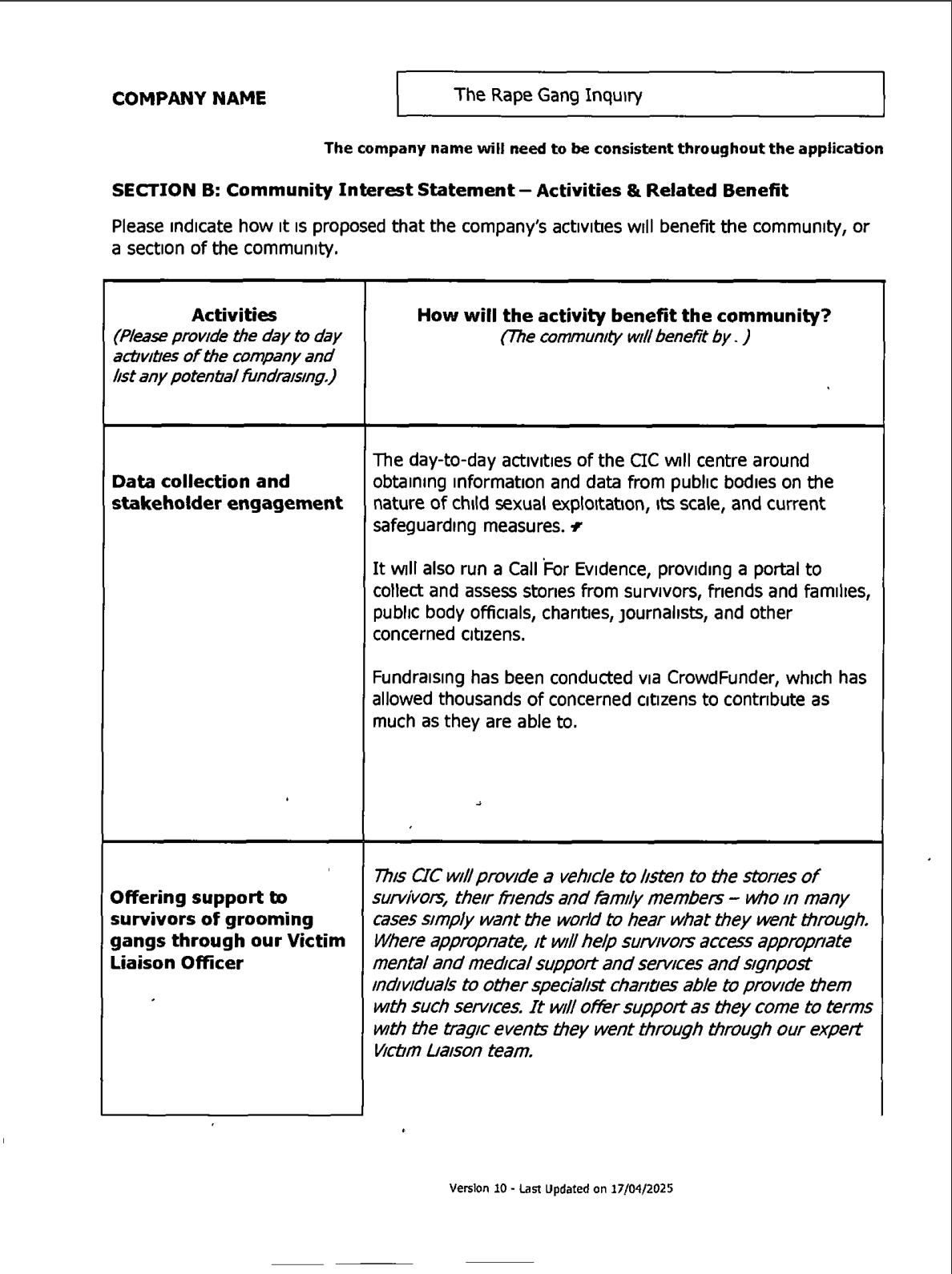
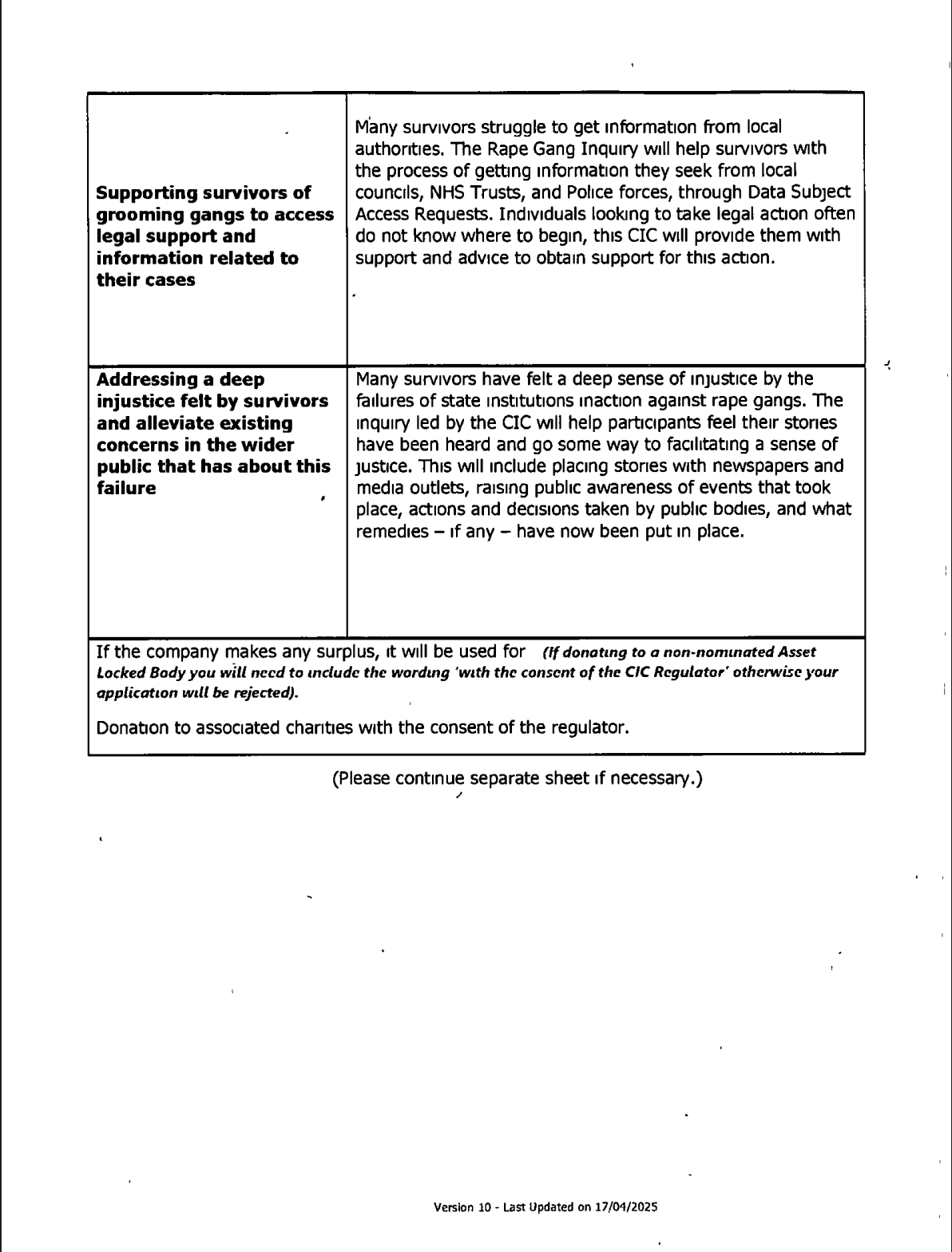
Those four activities are the complete authorised scope of this company, not a summary or a selection. As can be seen, pursuing private prosecutions appear in none of them. Parliamentary privilege naming appears in none of them. Criminal litigation of any kind appears in none of them. The gap between that list and what Lowe announced on 26 April is what the rest of this piece documents.
Ultra Vires: What It Means and Why It Matters
Parliamentary privilege naming followed by private prosecutions is not placing stories with newspapers. It is initiating criminal litigation using a company with no filed authority for criminal litigation. The legal term for acting beyond a company's filed powers is ultra vires, meaning beyond powers, and in the context of a criminal prosecution the consequences are significant and specific.
When a company acts ultra vires, any action it takes in doing so can be challenged as having no legal basis. In the context of a private prosecution, that challenge takes the form of an abuse of process application. A defence barrister identifies that the company bringing the prosecution had no legal authority under its own constitution to act as a prosecutor, and argues that allowing the prosecution to continue would itself be an abuse of the court's process. If that argument is accepted, the prosecution ends, the defendants are discharged, and the money spent on the case is gone.
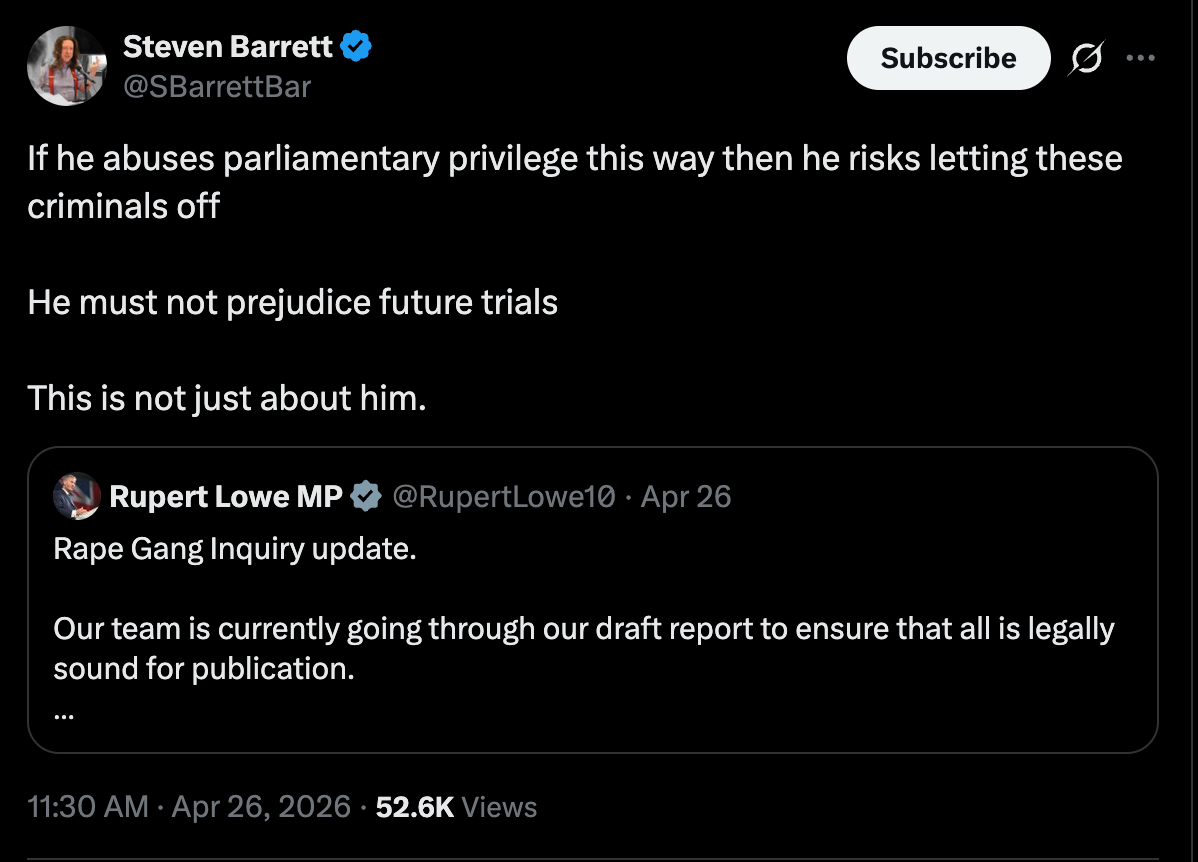
Barrister Steven Barrett identified the pre-trial prejudice risk from parliamentary naming within hours of Lowe's announcement. His point was precise and correct. Naming individuals under parliamentary privilege, amplified nationally overnight, contaminates the evidential record and makes a fair trial significantly harder to guarantee. A defence barrister does not need to prove that specific jurors were influenced. Demonstrating that a fair trial can no longer be guaranteed is sufficient, and judges have granted such applications before in high-profile cases.
Barrett's abuse of process argument is the one that has been publicly discussed since the announcement. The ultra vires argument is the one that has not, because nobody had yet read the CIC36 word for word when he raised it.
Both arguments are now on the table, and a prosecution that begins with parliamentary privilege naming and is brought by a company whose own filed constitution contains no authority for prosecution faces two independent and compounding abuse of process arguments before a single piece of evidence has been heard.
That is the legal exposure created by the gap between what the CIC36 authorises and what was announced on 26 April. The ultra vires question is not the only legal problem the announcement created. The money used to fund the prosecution carries its own set of constraints, and those constraints point in a different direction from what was announced.
As always, the work I do is only possible with your support. If you are on a free subscription, and can afford to do so, please upgrade here. I seem to have lost a number of subscribers for my focus here.
The Asset Lock and the Surplus Promise
Every CIC is subject to an asset lock requiring that its assets, income and surplus be used for the community interest activities it was incorporated to pursue. Data collection, victim liaison, legal access support and public awareness raising are what the asset lock protects. Private prosecutions are absent from all of them, which means any use of the CIC's assets to fund prosecution falls immediately into question under the asset lock framework.
The surplus funds declaration on the CIC36 specifies one destination. Donation to associated charities with the consent of the Regulator. The consent requirement is not a formality. It means the Regulator must actively approve any deployment of surplus funds to a non-nominated asset-locked body. The Regulator has not been asked to consent to anything. The asset lock body fields in the articles of association were left blank at incorporation, meaning no charity is formally nominated to receive the surplus at all.
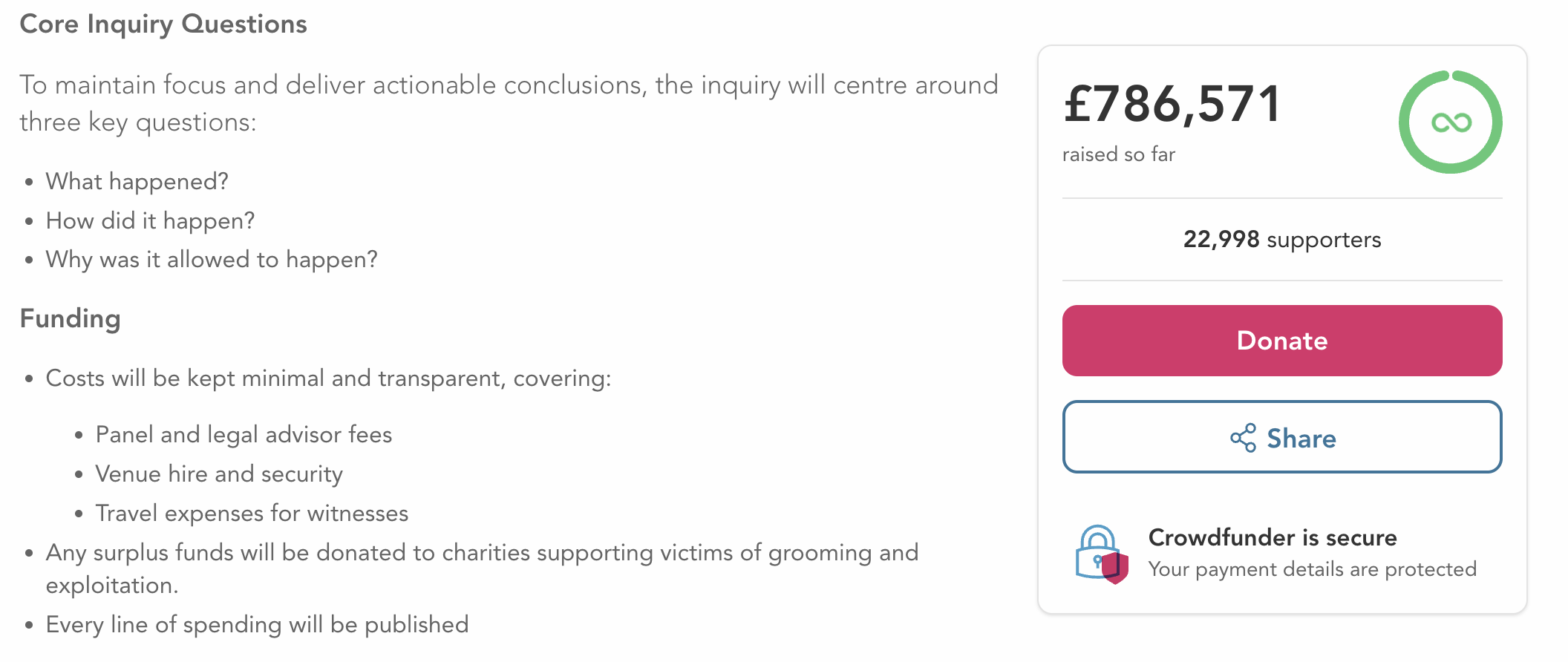
The crowdfunder told donors the surplus would go to victim charities. The CIC36 specifies charities with the Regulator's consent. The April 26 announcement proposes private prosecutions. Three documents, three different destinations for the same money, and the one that matters legally has been set aside without the regulatory consent it specifically requires. There is nothing on the public record to explain how or when that consent was obtained.
It is worth being precise about what the asset lock actually prevents. The company cannot transfer its assets other than for full consideration, to a specified asset-locked body, or for direct community benefit. Private prosecutions are not an asset-locked body. Whether they constitute direct community benefit under the terms of the CIC36 is a question that requires the Regulator's determination, not the sole director's. Neither determination has been sought nor published. The decision to deploy the funds in this way was made by one person, without regulatory approval, and announced to donors as a settled plan.
The financial exposure that creates is real and it compounds the ultra vires risk. If a private prosecution fails, the court can order the CIC to pay the defendant's legal costs, which in a complex case could run to six figures. If it happens here, the prosecution funds are unrecoverable, the defendants walk free, and the charities promised the surplus receive nothing. The survivors whose testimony is being used to justify the prosecution are left without the victim support Activity 2 was filed to provide. The donors who gave money to an inquiry that promised surplus would go to victim charities find that their money funded a prosecution that failed, produced adverse costs, and left the charitable purpose they were told their surplus would serve entirely unfulfilled.
The crowdfunder was not a political campaign or a litigation fund. It was a public fundraising vehicle for a community interest company whose filed purposes are data collection, victim liaison, legal access support and public awareness. What the April 26 announcement describes falls outside what the CIC36 authorises and what the asset lock permits. There is one further mechanism that could bring the whole structure down, and it sits entirely outside Lowe's control.
The CPS Override
Under Section 6(2) of the Prosecution of Offences Act 1985, the Crown Prosecution Service can take over any private prosecution and discontinue it. No court hearing is required and no defence challenge is needed. The CPS exercises its statutory power and the case ends. This mechanism has received almost no public attention in the days since the announcement, but it is the one that connects every legal failure identified above into a single catastrophic outcome.
The grounds for exercising that power include:
- a finding that the prosecution is not in the public interest
- that the evidential threshold has not been met
- or that the case has been contaminated by pre-trial publicity
Parliamentary privilege naming, amplified nationally overnight by every major outlet, provides the pre-trial publicity argument directly and immediately.
- The ultra vires question provides a further public interest ground
- The governance failures documented in the CIC's own filings, a sole director deploying assets for purposes not listed in the CIC36 without regulatory approval, provide additional grounds for a determination that the prosecution is not being conducted in a manner consistent with the public interest.
The CPS also has a long institutional memory of grooming gang prosecutions and the political pressures that have surrounded them. The institutional context of a private prosecution brought by a company associated with a political party, using money raised through a public crowdfunder, preceded by parliamentary privilege naming and announced before the report those funds were raised to produce has been published, is one the CPS will examine carefully before deciding whether the public interest is served by allowing it to proceed.
If the CPS discontinues the prosecution, every pound spent up to that point is gone. An asset lock breach, if the Regulator subsequently determines one has occurred, does not become lawful retrospectively because the CPS intervened. The funds were committed. The community interest mandate may have been violated. The legal question of whether that expenditure was authorised under the CIC's filed purposes remains regardless of how the prosecution ends. The 22,995 donors who funded a report answering three questions are left with neither that report nor the prosecution their money was redirected to fund.
What Part One Establishes
The CIC36 lists four authorised activities. Data collection. Victim liaison. Legal access support. Facilitating a sense of justice through placing stories with newspapers and media outlets, raising public awareness, and documenting what remedies have been put in place. Private prosecutions appear in none of them. The asset lock requires assets to be used for those four activities and nothing beyond them. The surplus declaration specifies charities with the Regulator's consent, no charity is named in the articles, and no consent has been obtained or published.
A prosecution brought under these circumstances faces an ultra vires abuse of process challenge, a pre-trial prejudice abuse of process challenge from parliamentary naming, and a CPS discontinuation power that requires no court hearing to exercise. If it fails, adverse costs could run to six figures and the asset lock breach question remains live regardless of the outcome.
Every word of that case is grounded in the documents filed at Companies House and the statutes that govern them. The CIC36 is on the public record. The articles are on the public record. Section 6(2) of the Prosecution of Offences Act 1985 is law.
What the documents cannot answer is why these decisions were made, who made them, under what constraints and answerable to whom. Understanding that requires examining the governance structure that produced them, and the declaration at the legal foundation of this company that the public record now calls into question. That is what Part Two addresses.
Politicians protected the rape gangs. They sold children for votes and sacrificed little White girls on the altar of multiculturalism. Networks of politically protected Pakistani men gang-raped girls and trafficked them across the country on an industrial scale.
Reads like a far-right conspiracy? There is now a National Inquiry underway to investigate this very scandal.
My name is Raja Miah. In a previous life, I helped safeguard children and keep this country safe from violent extremists. For the last eight years, some of the most powerful politicians in the country have tried and failed to silence me. Because I exposed what really happened and helped force the national inquiry.
With the help of ordinary people like you, we have forced this into the open. What happens next is not controlled by the government. It will be determined by our resolve.
My work is free because the truth has to circulate. But truth without numbers is easy to crush. Every subscriber is a number they can't erase.
Subscribe to my newsletter . If you can afford it, support me with the equivalent of 75p a week. If you can't, read for free, get educated and just share the work.
My work is 100% community funded. It is the small acts of kindness that keep me going. Please buy me a coffee. It makes all the difference.
👉 https://buymeacoffee.com/recusantnine
👉 https://paypal.me/RecusantNine
I have no millionaire sponsors. No political parties dare support me. It makes no difference. I have you. And look just how far we've come.
Raja Miah MBE