THE INQUIRY HAS THE POWERS. THE QUESTION IS WHETHER IT DARES USE THEM.
The powers are statutory. The language is passive. We know what comes next. Unless…
In January 2025 Keir Starmer accused politicians calling for a national inquiry into the rape gangs of jumping on a far right bandwagon. Five months later he was on a plane to the G7 telling journalists he had read every single word of Louise Casey's audit and would accept her recommendation for a national statutory inquiry. He was keen to explain this was no U-turn. He had merely asked Baroness Casey to double-check whether the thing he had smeared people for requesting was necessary, and she had come back and told him it was.
That announcement was made on 14 June 2025. Everything that follows should be measured from that date.
A FULL YEAR WAS LOST BEFORE THE INQUIRY EXISTED
By the summer of 2025 the victim liaison panel was falling apart. Four women resigned. By October the last two candidates to chair the Inquiry had walked away from the process. The state then reached for one of its own.
Baroness Anne Longfield was appointed on 9 December 2025, with Zoë Billingham and Eleanor Kelly alongside her. Starmer had sent Longfield to the Lords as a Labour peer. She dropped the affiliation on the day she was handed the inquiry. A demonstration, should we believe it, of her independence.
Longfield's career runs in an unbroken line from Tony Blair's Downing Street, where she helped shape the children's agenda from inside No.10, to the Children's Commissioner's Office, to Starmer's inquiry.
The office she took over in 2015 had already done the scandal's narrative work. Under her predecessor, with Sue Berelowitz as Deputy Commissioner, it produced the reports that dissolved organised networks of predominantly Pakistani men targeting White girls into a race-neutral category called child sexual exploitation in gangs and groups.
Longfield inherited that work and owned it. When Berelowitz left in May 2015, the official statement issued under Longfield's leadership declared the office proud of the work Sue led. Longfield then rehired her as a consultant on a day rate of up to £960, an arrangement the Department for Education later ruled had broken government rules. The contract was cancelled and public money repaid. The Department's ruling concerned the arrangement. No finding of dishonesty was made against either woman.
The woman now chairing the national inquiry into the cover-up praised the cover-up's central document, then broke the rules to keep its author on the public payroll.
The Inquiry she leads was not formally established until 13 April 2026. Ten months passed between the announcement and the existence of the body announced. That is the time than it took the British state to open an office.
THE INQUIRY COUNTS LETTERS AS ACTION
Last Friday, the National Inquiry published its first newsletter. It is a perfect specimen of how institutions perform activity while doing nothing.
This Inquiry holds statutory powers. It can compel witnesses under oath. It can serve Section 21 notices and demand every file that Greater Manchester Police, West Yorkshire Police, Oldham Council and the rest have spent twenty years sitting on. Refusing those notices without reasonable excuse is a criminal offence.
The newsletter reports what has been done.
- A Charter was launched in June.
- A Hub was built.
- A Listening Project began in July, the first stage of which is "now live," with voice notes promised "soon" and one-to-one conversations beginning "in the autumn."
More than a year after the announcement, the Inquiry is still preparing to begin conversations.
The Core Participant deadline has been extended by two weeks. The newsletter does not explain why. The Core Participant Protocol has been updated "to provide further clarity," which is the official way of admitting the first version confused everyone. An extended deadline also suggests lack of interest.
Survivors told the panel about the distress of learning that the men who raped them were up for early release. The Inquiry responded by writing to the Home Secretary. It wrote that letter after Shabir Ahmed, the ringleader of the Rochdale nine, walked out of prison in July. The precise thing survivors were begging the Inquiry to prevent had already happened in the most notorious case in the country, and the Inquiry answered with correspondence dispatched after the man was free.
What its first newsletter does not identify is a single witness compelled, a Section 21 notice served or a hearing date fixed.
EVERY AREA ON THE LIST ARRIVED THROUGH REFUSAL, DENIAL OR RESISTANCE
When the Home Secretary announced this Inquiry to Parliament, she promised that no area would be able to resist a local investigation. The founding assumption of the entire exercise, stated on the floor of the House of Commons, was that the guilty would run.
She was right. Oldham, Bradford and Keighley, and London were selected in June. Not one of them arrived because of the government.
In July 2024, after a six year campaign removed Labour's majority, Oldham Council wrote to the Home Secretary requesting a public inquiry into what happened here. In October 2024 Jess Phillips refused, writing that it was for Oldham to review itself, as though the institution that presided over the failure could be trusted to mark its own homework. The one town that put its hand up was told to put it back down. Eighteen months later the same government that refused Oldham selected it and to this day, there is no indication of when the investigation will start.
Bradford's obstruction came from inside. For years the Labour leadership of the council refused to call for an inquiry and said one would bring nothing of additional value. Ann Cryer had been asking since 2003. Fiona Goddard stood in that council chamber in January and presented 5,000 signatures. Labour's answer did not change.
Then in May the voters removed them. Labour lost control of Bradford Council, Reform took the leadership, and Stephen Place's first act as Leader was to write to Baroness Longfield requesting Bradford and Keighley's inclusion. No Bradford Council leader had ever asked before.
Even then the Inquiry did not move. It moved when the extraordinary meeting was called. A meeting of full council was requisitioned for 4pm on 24 June with a single motion on the agenda, so that every councillor in Bradford would have to vote, in public, on whether their district should be examined. The Inquiry announced Bradford's inclusion that morning. The criteria appeared the same day. Hours before the vote could be cast, the decision the Inquiry had sat on for weeks was suddenly ready.
Twenty years of survivors asking changed nothing. Five thousand signatures changed nothing. Bradford got onto the list only after Labour had been removed at the ballot box and a council vote was hours away. The Inquiry did not select Bradford. Bradford cornered the Inquiry.
Then there is London, where the man in charge denied the crime existed.
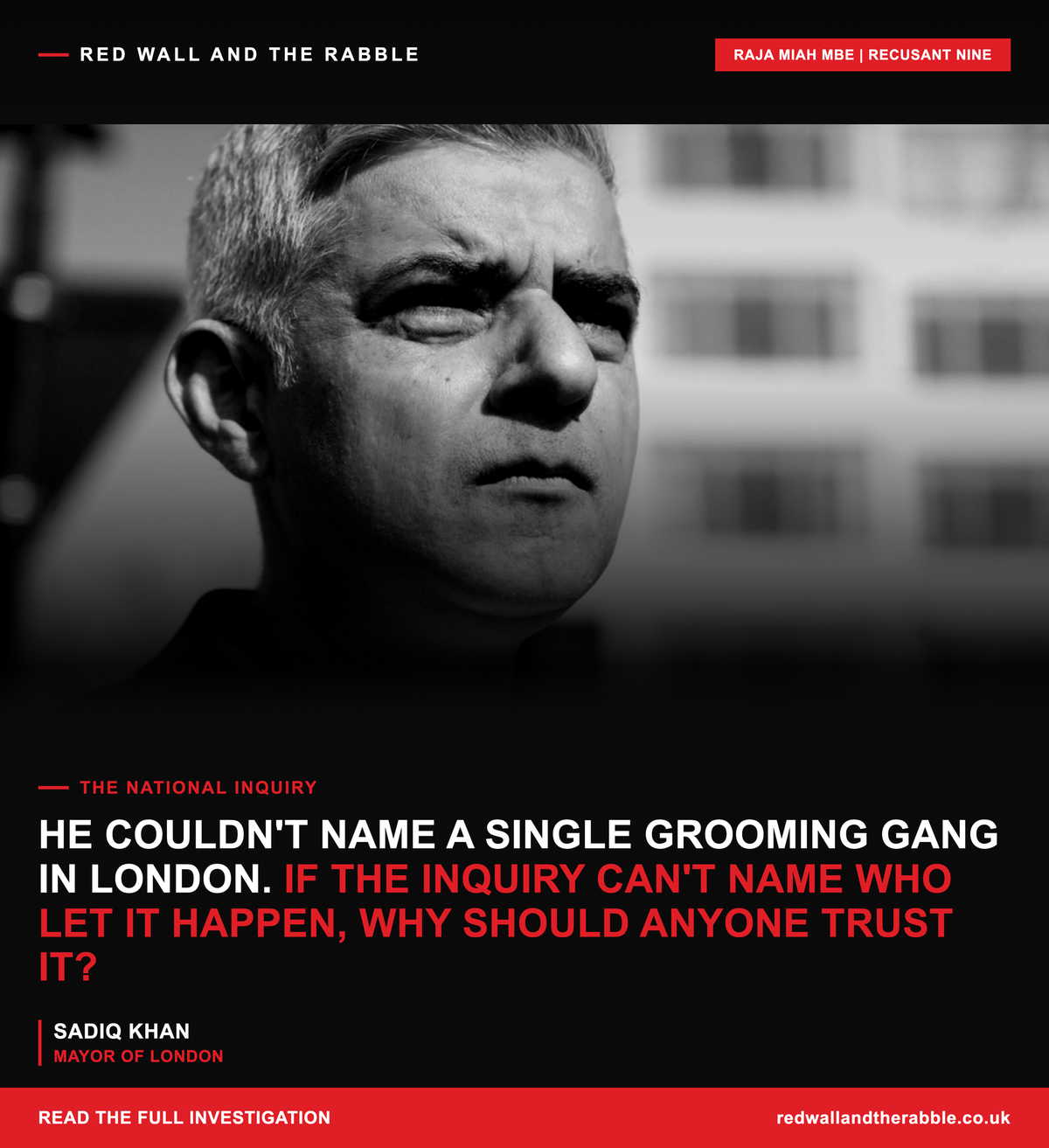
Sadiq Khan had insisted there was no indication grooming gangs were operating in the capital. When Susan Hall asked him at the Assembly in January 2025 how many rape gangs were operating in London, he repeatedly asked her to clarify what she meant. The Mayor who oversees Britain's largest police force, briefed on organised crime for eight years, could not understand the question. By June this year he had refined the position. London has issues with child sexual exploitation, he told the Assembly, but its cases were different from those in other parts of the country.
Four days after London was named, the answer to Susan Hall's question arrived.
The Met's review of around 12,000 child sexual exploitation reports dating back to 2010 flagged more than 4,000 cases for potential reinvestigation. Roughly one in every three. Cases closed after the police or the Crown Prosecution Service decided to take no further action. All 4,000 have been referred to the National Crime Agency under Operation Beaconport. Khan's response is that he has always supported leaving no stone unturned.
Four thousand closed cases in one city, and its Mayor still in office having told the chamber that scrutinises him that he did not know what a grooming gang was.
- The town that asked was refused by the government.
- The district that asked was blocked by its own council until the voters and an extraordinary meeting broke the blockade.
- The city that denied everything was named over its Mayor's denials.
Refusal, denial and resistance, at every level of the Labour state.
What would you say if I told you that yesterday, out of 14,288 members, just 2 of you signed up as paid supporters? What signal do you think that sends to the people facilitating a cover up? What signal does it send to the victims who look to this platform as their only hope?
We set out to build a core base of 2,000 paid subscribers and 20,000 members of Red Wall and the Rabble. From that base we can effectively fight back against the government. Today we are 62 paid supporters away from the first 1,000.
If you have ever taken hope from the work I do, return some of that hope now. Sign up or upgrade to paid today.
BIRMINGHAM ASKED. THE INQUIRY HAS NOT ANSWERED
On 29 June a letter went to Baroness Longfield requesting Birmingham's inclusion in the local area investigations.
Sir Andrew Mitchell, former Cabinet minister, signed it. So did Councillor Robert Alden, leader of the Conservative group on the council. So did Jess Phillips, the MP for Birmingham Yardley who as Safeguarding Minister refused Oldham's request and told this borough to investigate itself.
The minister who spent her career explaining why the state should not intervene is now a private signatory pleading with the state to intervene in her own city.
That letter did not come from nowhere.
- Birmingham City Council commissioned the Jesson research into the rape of girls in its care in 1990, received the findings, and destroyed the copies.
- In December 1995 its Social Services Committee voted down an enquiry into what had happened to the report.
- In 2015 a West Midlands Police problem profile identifying more than 700 children at risk in three months, with 372 suspects, was forced into the open by a newspaper FOI after five years in a drawer.
Britain's second city carries a documented evidence chain running for a quarter of a century. It is formally requesting examination, with a former Cabinet minister and a former Safeguarding Minister attached to the request.
The letter was sent six weeks ago. The Inquiry has not answered it. Birmingham is not on the list.
Birmingham is not alone. Barrow's MP has asked for her town's inclusion after three brothers were jailed for raping girls as young as six. In Blackpool, where Charlene Downes' family have waited twenty-two years, the motion asking for inclusion was voted down while campaigners booed from the public gallery. The resistance is still live, still voting, still winning in council chambers this year.
The Inquiry can leave all of them waiting without explanation, because it built itself the right to. I wrote about the selection criteria when they were published on 24 June.
The operative word throughout is may.
Nothing in that document creates an entitlement to investigation, however strong the evidence, and paragraph 3.7.1 hands the panel a deliverability veto no town can challenge. No reasons are published for who is selected and who is refused.
Under that document there is nothing Birmingham could show that would guarantee an investigation. None of that is accidental.
Having helped force the national inquiry, I now scrutinise every word this Inquiry publishes.
We all know, left to it's own devices, the National Inquiry will be a cover up.
What I hope can be achieved through my analysis, with your support in amplifying me, is to limit the cover up and force from the National Inquiry at least some of the truths it was designed to bury.
I'm eight years in to this work. It is not something I chose to do. I spent three years on police bail whilst the authorities tried to put me in prison to stop the truth of the cover up from coming out. Read my work, listen to my analysis, and you will understand why even the Prime Minister ran away from facing me.
I take this to a place from where there is no coming back.
FIFTEEN-YEAR-OLD FINDINGS ARE BEING PRESENTED AS DISCOVERIES
The newsletter's centrepiece is a section on what victims and survivors have told the panel. Common themes, it reports, have emerged. Survivors were not believed. Survivors were criminalised for their own exploitation. Support vanished after trial.
Sara Rowbotham logged 181 alerts and 103 referrals in Rochdale and was ignored. Operation Augusta identified 97 persons of interest and 57 victims in Manchester and was shut down in 2005 with seven outcomes. Alexis Jay put the criminalisation of victims on the record in 2014. Casey repeated all of it in 2025.
These themes did not emerge in a listening session last month. They have sat in published reports for over a decade while the Inquiry's staff built a Hub. An investigation presenting the file it was handed on day one as fresh discovery is not investigating. It is rereading, slowly.
On the quashing of survivors' criminal convictions, the single most concrete injustice in the entire document, the Inquiry offers one sentence. It is an important issue which will be considered at the hearings. The newsletter contains no hearing dates, no witness lists and no notices served. The National Accountability Hearings exist in this document purely as the place where difficult questions are sent to wait.
Nothing in this Inquiry's structure requires those hearings to reach the top of the Crown Prosecution Service.
I reported in April that the CPS appears in the Terms of Reference only within the local investigations, in section 4.6.3, alongside the police forces and councils of individual towns. There is no national examination of the CPS. What gets examined in any local area is decided by the Chair and Panel, and nothing obliges them to reach the decisions taken at the top of the CPS between 2008 and 2013, when the Director of Public Prosecutions was Keir Starmer.
The Met's 4,000 flagged London cases date from 2010. Whether the prosecution decisions in those years are ever examined rests entirely on the discretion of a panel appointed under the government Starmer led, working to terms of reference signed off while he was Prime Minister.
THE INQUIRY CANNOT SAY WHAT HAPPENED, WHO ALLOWED IT OR WHY
Near the end of its first newsletter, under "Looking ahead", the Inquiry tells survivors what it is "laser-focused" on.
"The Inquiry is laser-focused on finding answers to the question of why this was allowed to happen, and continue to happen, and ensuring it cannot be allowed to happen in the future."
Little White girls were drugged, raped and trafficked by organised networks of predominantly Pakistani men. In two thousand words written to their survivors, the Inquiry does not once come anywhere near saying so. They call it "this".
Even the Inquiry's own Terms of Reference do better. That document names grooming gangs, requires examination of the role of ethnicity, religion and culture, and speaks of cover-ups and holding individuals to account. Writing directly to victims and survivors, the Inquiry retreats from its own founding document into a single word.
"Allowed" appears twice in that sentence, "happen" three times, and not once is a single name attached. The politicians, the police commanders, the council officers, the media outlets, the communities the men come from. They all have names. We get none of them.
And why was it allowed? Because the children were traded for votes, and because community relations mattered more than the screams of little girls. The Inquiry cannot answer its own question without naming that bargain. It dare not.
Fundamental to every cover up is the language it uses. Language that names no crime, no perpetrator and no decision protects everyone who took a decision. They had fourteen months and £65m to write one honest sentence. They chose this one instead.
THE PEOPLE WHO HEARD THEM DECIDED THE MEN WERE WORTH MORE
The man who announced this Inquiry is gone. Starmer resigned in July and the country is now run by Andy Burnham, who held police and crime powers over Greater Manchester through the entire period Operation Hexagon was hunting whistleblowers instead of rapists.
I wanted this Inquiry. Oldham fought for it. Survivors and campaigners died waiting for it.
The women who carried this for twenty years did not need a listening project. They have been speaking clearly, on the record, since before some of the Inquiry's staff finished school. They were heard. The people who heard them had decided the men were worth more.
Watch the verbs in the September newsletter. Launched, listened, met, wrote, considered. The day you read served, compelled, seized and named, the Inquiry will have started work.
Until then, this is where fourteen months and £65m have got us. A Charter. A Hub. An extended deadline nobody explains. Letters written to ministers after the men walked free. And Birmingham's letter, sitting unanswered on the Chair's desk.
The stories that expose them are the stories they tried and failed to imprison me for sharing.
Even the mainstream media blacklist has failed to censor this campaign. Millions now know the truth of the grooming gangs, and who covered up what took place.
What comes next is the National Inquiry, and forcing it to go where it does not want to go. The only way to do that is pressure. We got it this far. Now help push it further, to a place where politicians are forced to testify.
That includes the Prime Minister.
My name is Raja Miah. I led the campaign that helped force the National Inquiry. I need your help to make sure it is not a whitewash. If you believe the truth should be followed wherever it leads, please stand with us and subscribe to my newsletter.
If you cannot afford the £3 a month or £30 for the full year, just sign up for free. There are no paywalls to access any of my work. I publish everything for free.
A one-off contribution genuinely helps keep this alive. You can support me using one of these links;
👉 http://BuyMeACoffee.com/recusantnine
👉 http://paypal.me/RecusantNine
Should we succeed, politicians will go to prison. Even if there is only the smallest chance of this happening, isn't it worth your support?
Raja Miah MBE