PART 4: THE BARGAIN
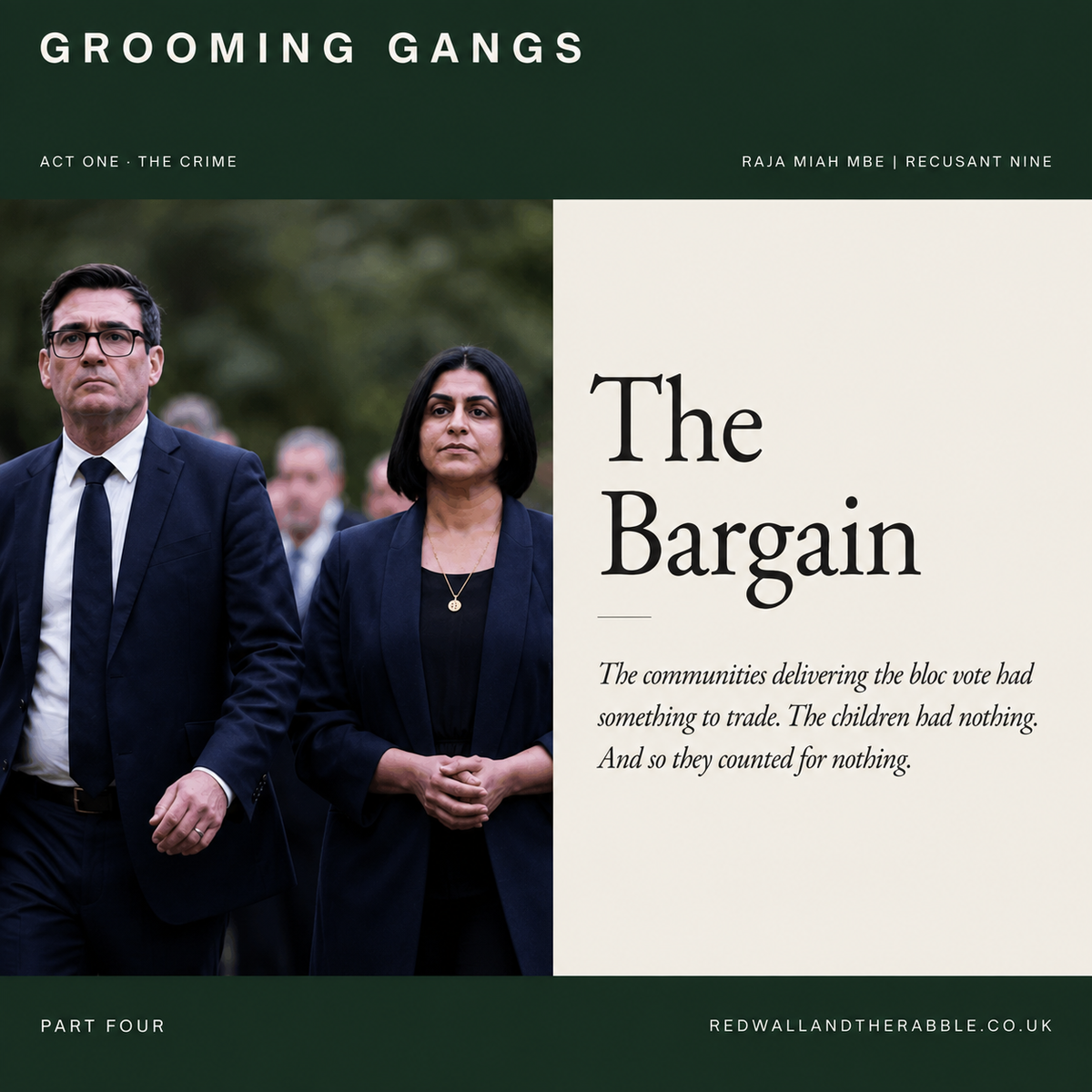
They Sold The Children For Votes. The Cover-Up Was Political. It Still Is.
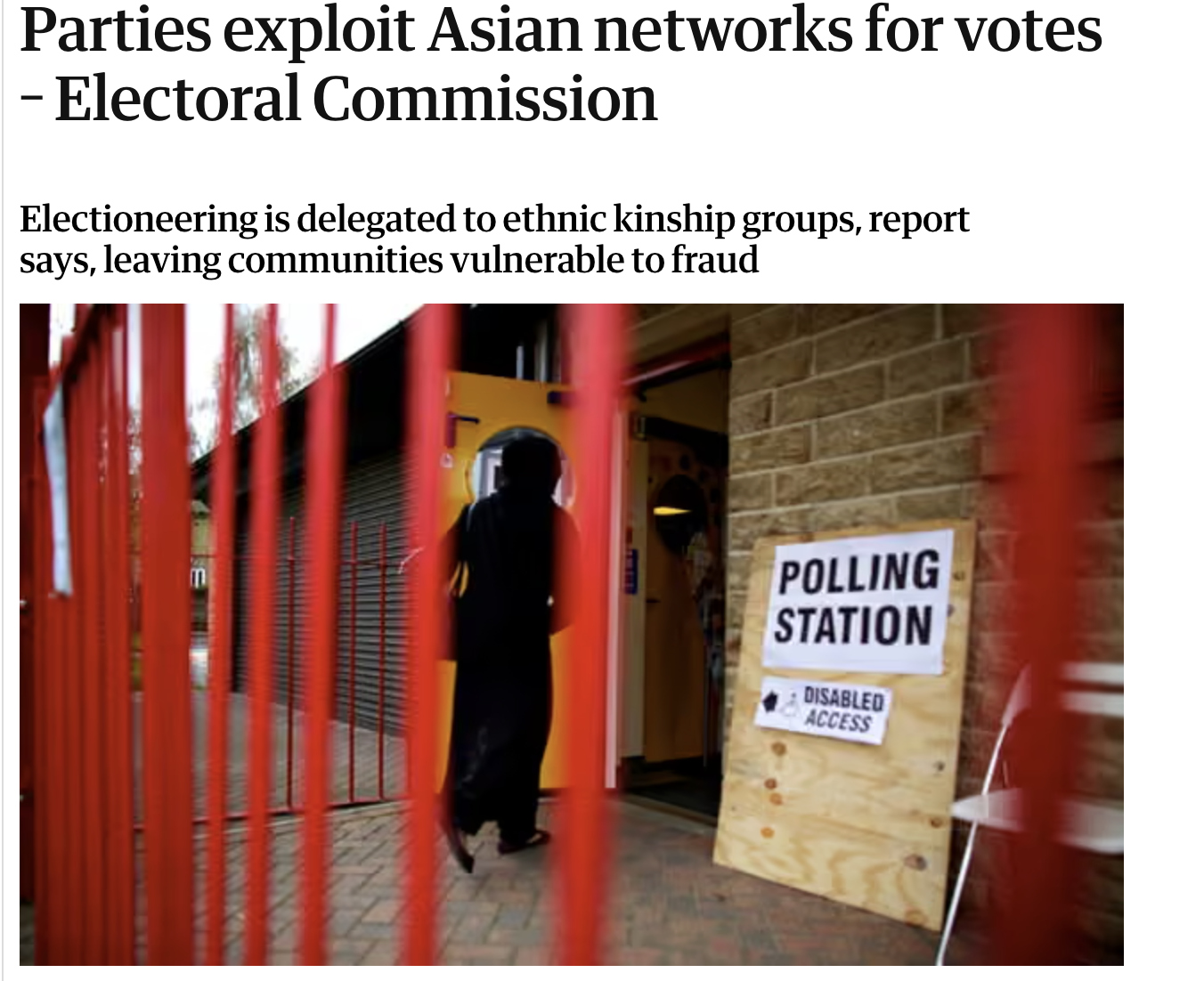
THE TABLE COVERED IN BALLOTS
In the early hours of 9 June 2004, the day before Birmingham voted, police entered a warehouse in the city and found men around a table piled with postal ballots. Three Labour candidates for the Aston ward were among them. After the election they became councillors, until the courts took the seats away.
The judge who tried the resulting petitions was Richard Mawrey QC, sitting as an election commissioner. His judgment, delivered on 4 April 2005, voided the elections in two wards, Aston and Bordesley Green, for corrupt and illegal practices. He found six Labour councillors personally guilty. One, Muhammed Afzal, was later cleared by the Court of Appeal, though the voided election stayed void.
Mawrey concluded that corrupt practices were widespread in Birmingham in June 2004. And he addressed the Government's claim that the systems in place to deal with electoral fraud were clearly working. Anybody who had sat through the case he had just tried, he said, and listened to evidence of electoral fraud that would disgrace a banana republic, would find that statement surprising. The systems were not working well or badly. There were no systems to deal realistically with fraud, and there never had been.
Mawrey found that “there were corrupt and illegal practices committed by the Labour Party Respondents and their agents”, saying the wrongdoing would “disgrace a banana republic”. Mawrey voided the elections of six Labour councillors, including three in Bordesley Green, where Mahmood’s father was the party’s election agent.
That judgment does not prove a single grooming gang warning was buried for votes. It proves that in one of the cities at the centre of this series, organised electoral power was real, measurable and corruptible, and that the party operating it was Labour. The machinery existed. The rest of this article is about what the machinery cost.
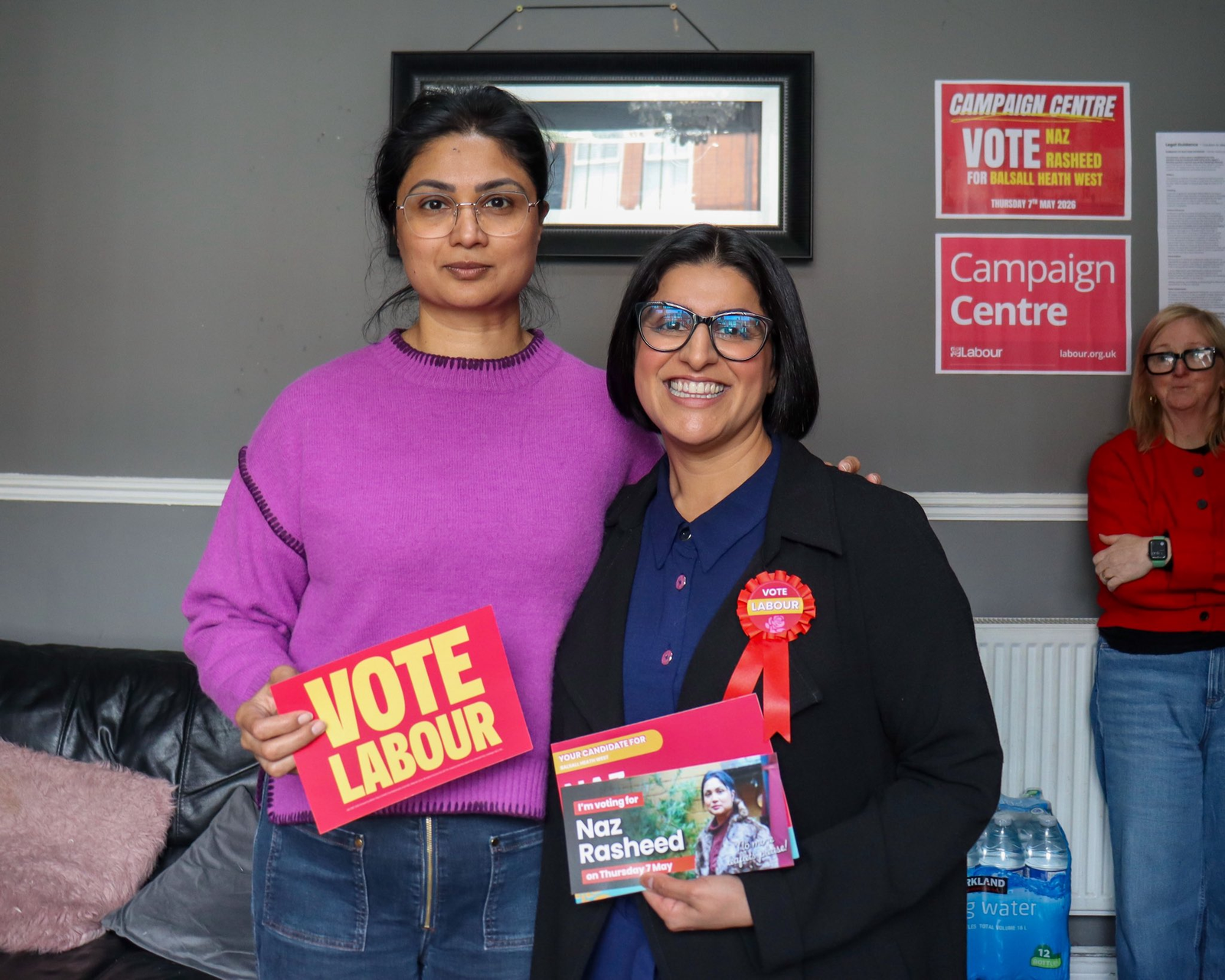
THE HOME SECRETARY'S FAMILY FILE
The minister now in charge of the national response to the rape gangs is Shabana Mahmood, Home Secretary, daughter of Birmingham Labour politics. Her father, Mahmood Ahmed, was Labour's election agent in Bordesley Green, one of the two voided wards, and, the Birmingham Dispatch reports, later chairman of the Birmingham Labour Party.
No court has ever found Shabana Mahmood guilty of any electoral wrongdoing. In May this year, the Dispatch published her own postal vote documents from the 2004 election, her application and her declaration of identity, carrying two markedly different signatures, documents that were examined in the vote-rigging case. She was 23, an Oxford law graduate training as a barrister. Her father witnessed declarations of identity, including hers, that became evidence in the trial.
The court transcript, as the Dispatch reported it, shows the petitioners accusing her father of being party to the forgery of declarations certifying his own family's postal ballots, his barrister arguing the court could not be satisfied of it, and Shabana Mahmood named in court, with a witness statement submitted in her name.
The Home Secretary's spokesman says both signatures are hers, written differently on different occasions, and that all allegations against her father were dismissed with no adverse finding.
The Dispatch found her father is not named in the final judgment at all, and that the judgment neither addresses nor dismisses any allegation against him. Mawrey himself, asked this May about the family's account, told the Dispatch he was aware they would claim to be cleared, and it appears they still do, when in reality his judgment makes clear the frauds were orchestrated by the Birmingham Labour Party, not just a local effort by the individual respondents. His words, this year, about the party, not the family.
And when the Dispatch prepared to publish, the Home Secretary's special adviser sent legal threats the night before the story ran, from his government account, signed as Special Adviser to the Home Secretary, saying the Home Office would be examining the lawful basis on which the outlet held the information. Challenged afterwards, he said he had been acting for Mahmood personally, not for the Home Office.
A government adviser reached for the apparatus of the state against a local newspaper holding court documents, then, when caught, explained that the apparatus was not really in the room.
We got this far because ordinary people refused to stay silent to an atrocity. And be in no doubt that what took place is an atrocity.
No political party funds my work. No institution stands behind it. And no mainstream media channel dare interview me despite Queen Elizabeth II putting a medal on my chest.
Every attempt to silence me has failed. Dawn raids by the police, false arrests, fabricated charges and 3 years on bail. Pakistani gangsters have followed me home and Islamists have incited my murder. Yet here I still stand. And as each day passes, our numbers grow and the truth reaches more people.
What I do exists because ordinary people choose to sustain it. Sign up to my newsletter and support my work.
THEY SOLD THE CHILDREN FOR VOTES
Yesterday I asked why every warning was buried. The people burying them were not stupid and they were not squeamish. They read the reports. They knew what the men were doing to the children. They buried the warnings anyway, in every town, in every decade, because acting on them carried a price they refused to pay.
For eight years I have named that price, and for eight years they raided my home, arrested me and dragged me through the courts for saying it. So I will say it again.
They sold the children for votes.
In the brokered wards, the bloc vote decided everything that mattered. It decided who stands in the ward and then who won the ward. The wards decided who ran the council. The council decided who sat on the licensing committees, who received the grants, and how hard anyone looked at a report about taxi drivers and takeaway workers. And the same delivered votes sat underneath parliamentary majorities, which is why the silence never stayed local. Careers, seats, salaries and power, resting on votes that could be organised. The children's families could organise nothing.
In 2014, the Electoral Commission named sixteen local authority areas where there could be a higher risk of allegations of electoral fraud. Birmingham is on it. Bradford, which includes Keighley, is on it. Derby, Oldham, Peterborough, Kirklees with Huddersfield, Calderdale with Halifax. Town after town from the grooming map, on the fraud-risk list.
Rotherham and Rochdale are not on it, and I am not going to pretend they are, because the overlap that exists is damning enough without inventing identity. The Commission separately researched vulnerability to electoral fraud in Pakistani and Bangladeshi communities, which is the state's own polite acknowledgement of what I have spent years documenting. Where the gangs operated, organised electoral power was repeatedly present, and one party depended on it.
THE BLOC VOTE
I have spent years documenting it. Biraderi. Clan networks carried from Pakistani kinship politics into British municipal elections. Presented to outsiders as community, as culture, as family loyalty. Operating as electoral delivery.
Sir Eric Pickles, commissioned to examine electoral fraud after Tower Hamlets, reported in 2016 that pressure was being put on vulnerable members of some ethnic minority communities, particularly women and young people, to vote according to the will of the elders, especially in communities of Pakistani and Bangladeshi background, and recorded concerns that state institutions had turned a blind eye because of politically correct over-sensitivities about ethnicity and religion. His words, in an official review, to a Prime Minister.
Where household pressure operates, the household's ballots follow the elder. Postal vote applications cluster. Completed ballots can be gathered before they reach the returning officer. An organised bloc against an unorganised electorate, in wards where a few hundred delivered votes decide the seat.
In 2000, Parliament handed the brokers their instrument. Postal voting on demand, available from the 2001 elections, no reason required. Mawrey found the reform had laid the electoral system wide open to massive and well organised fraud, and that the warnings had been blithely ignored. At the 2005 general election, a record 5.4 million postal votes were issued and almost 4 million returned. Later governments bolted on identifiers, signature checks and handling limits, and the on-demand principle survived every one of those repairs. The bloc vote no longer needed to march households to a polling station. It could gather them at the mosque, community centre, taxi rank, take away, and kitchen table.
And the bloc vote's first product is not the vote. It is the candidate. Selections in safe wards turn on small numbers of party members, which is to say, on whoever organises the memberships. Bradford Labour politics has been described in exactly these terms by its own participants, and when George Galloway took Bradford West from Labour in 2012, he campaigned openly against the biraderi politics of the seat. The machine was not a secret. It was, and remains to this day, the sitting arrangement.
WHEN PUBLIC MONEY BECAME POLITICAL CURRENCY
A broker who delivers expects payment, and one version of the payment has been proven in court.
In 2015, Mawrey sat again, on Tower Hamlets, and found the elected mayor, Lutfur Rahman, guilty of corrupt and illegal practices. Rahman had left Labour by then and won under his own banner, and that detail matters, because the case is not proof of a Labour bargain. It is proof of the model. The court found bribery in the administration of council grants, public money directed to community groups in return for electoral support, established as fact in an English election court.
Contemporaneous reporting of the Pickles review recorded that council money had also paid a Bangladeshi-language television station providing favourable coverage.
Public resources, converted into bloc maintenance. Rahman was removed and barred. The model was not. And now Rahman is back in power. Such is their power.
The currency circulates more widely, and mostly legally. Candidacies. Council positions. Grant streams. Planning outcomes. Public appointments. Access. And one further commodity, the most valuable of all, rarely written down. Protection from scrutiny.
ROTHERHAM: WHERE INFLUENCE REACHED THE TAXIS
Casey's 2015 inspection of Rotherham found a council in denial. She found Pakistani heritage councillors exercising disproportionate influence, particularly on issues such as the taxi trade. She recorded interviewees speaking of Jahangir Akhtar, Labour's deputy leader, with a level of fear, worried that what they said would find its way back to him.
She recorded licensing staff saying some councillors made representations on behalf of taxi drivers. She recorded staff saying discussion was suppressed for fear of upsetting community relations. And she recorded a police officer describing councillor pushback when police discussed targeting particular taxi drivers, particular families and the Pakistani heritage community in relation to child sexual exploitation.
Read that list again as one sentence. In the town of the 1,400, elected members of the party that ran the council pressed on taxi licensing, were feared by officials, and pushed back when police talked about targeting the men. The taxis of Part 1, the vehicles that collected girls from children's homes and moved them between cities. Casey does not say why the influence was exercised. She documents that it was.
THE SALE
The communities containing the offenders possessed organised electoral value. Households that could be delivered. Elders who could be dealt with. Brokers who could deliver or withdraw a ward. Community organisations with the ear of the party.
The girls possessed nothing. No bloc. No elders. No organisations. Their families were the poorest White households in the poorest wards, the people whose votes were assumed or written off. A girl in care could not deliver a polling district. Her father, arrested at the door of the house she was inside, could not threaten a majority.
So the girls were sold. Not in a single meeting, not by a single signature, but repeatedly, locally, deniably, every time a report was shelved, a referral was filed, an operation was defunded and a licensing question went unasked. Each burial was a payment. The asset was kept happy, the seat was kept safe, and the children were the currency.
And the arrangement had an enforcement arm. The accusation of racism was not a fear that happened to hover over these towns. It was a weapon, and it was fired at exactly the people who threatened the arrangement.
Ann Cryer carried the mothers' names and it was fired at her, from inside her own party and from the community organisations her party depended on. The researcher recorded the ethnicity of the men and was sent for retraining. Casey found Rotherham staff silenced by the fear of the word. The weapon did not protect a community. It protected a transaction. In thirty years it was never once fired at the men.
THE RIOTS AND THE COHESION INDUSTRY
In the summer of 2001, the arrangement caught fire. Oldham, Burnley and Bradford saw the worst racial disorder in a generation, in some of the same towns later central to this series. The state commissioned Ted Cantle to explain it. His report found communities living parallel lives, and out of the response, community cohesion became a national policy framework, backed by programmes, partnerships and funding.
I watched what happened next from inside, because I was already there. I founded PeaceMaker in Oldham in 1997, four years before the riots. When the towns burned, cohesion became an industry, and my organisation stood in the middle of the response. I hold an MBE for that work. I gave evidence to the Home Affairs Committee. I advised government on cohesion and preventing extremism. I sat in the rooms where the language was spoken fluently, and I understood it.
In the rooms I was in, community leaders meant the brokers. Engagement meant the relationship that kept the wards delivered and the streets quiet. Sensitivity meant the questions that were never asked. The riots had proven the arrangement produced segregation and disorder, and the rational response was to break it. What I watched instead was the arrangement being funded. The gatekeepers were rebranded as partners and contracted. The failure was upgraded into a budget.
That language then did its work in every burial this series has documented. The report suppressed for community relations. The documentary pulled to protect cohesion. The researcher's retraining, badged as diversity. Nobody had to say the true sentence, that the children were being weighed against the arrangement, because the doctrine supplied a false sentence that meant the same thing and sounded like decency.
I know what the word cohesion was used to buy. It bought the silence.
THE THREE LAYERS
If the silence was bought with a bloc vote, why did towns without one behave the same way? And why did towns under Conservative administrations behave the same way? Oxford's exploitation ran while a Conservative-led county council held safeguarding. Aylesbury's under Conservative Buckinghamshire. Telford's council resisted its inquiry while the town's police answered to Conservative oversight.
And then there is Blackpool. No biraderi networks. No brokered wards. A Labour town where, in November 2003, fourteen-year-old Charlene Downes vanished. Blackpool police's own child protection project at the time identified dozens of girls being drawn into exploitation around the town's takeaways. Two men connected to a town centre takeaway were tried for Charlene's murder. The jury could not agree, the retrial collapsed over botched covert surveillance evidence, the police watchdog criticised the investigation, and the men were acquitted and compensated. Nobody has ever been convicted. Charlene has never been found. A child gone, a documented exploitation problem around the takeaways, an investigation in ruins, and not one official held to account for any of it. No bloc vote required.
The answer is three layers, and each layer has an owner.
The first layer is the transaction, and it belongs to Labour. In the brokered towns and cities, votes for blindness, directly, locally, countable. The evidence of the machinery fills this article. The evidence of what it protected fills this series.
The second layer is the write-off, and I lay it at the Conservatives' door. The girls were the daughters of the poorest White families in northern wards the Conservatives neither held nor seriously contested. No electoral upside in fighting for them, real risk in touching anything labelled race. In March 2019, Boris Johnson told LBC, speaking about police spending on historic child abuse investigations, that an awful lot of money and police time was going into these historic offences and all this malarkey, that £60 million was being spaffed up a wall on some investigation into historic child abuse, and what on earth was that going to do to protect the public now.
Malarkey. Spaffed up a wall. The NSPCC called his remarks an affront to victims. Four months later he was Prime Minister. His party held the Home Office for fourteen years, and fourteen years of Conservative Home Offices did not leave this country with a dataset capable of answering the basic question Casey was asked in 2025. That is the write-off, measured by its result.
The third layer is the doctrine, and it belongs to the state itself. Race relations, multiculturalism, diversity, cohesion. The language became part of the national policy environment in which every police force, council and safeguarding body operated, whoever held the rosette. An official in Conservative Oxfordshire breathed the same air as an official in Labour Rotherham, feared the same accusation, and buried the same warnings. The doctrine is why the silence needed no conspiracy and no instruction. It made doing nothing the professional choice.
Three layers. The transaction built the silence. The write-off declined to break it. The doctrine made it respectable. My argument is that each layer made earlier intervention less likely, and together they made inaction durable for thirty years, which is why the same choice appears in towns that share nothing except the British state.
BIRMINGHAM, NOW
In 1991, the city did not publish Jesson's report, and in December 1995 its committee voted down an enquiry into the suppression while minuting that the report revealed nothing that was not public knowledge. In 2004, its Labour wards produced the banana republic judgment. In 2026, a daughter of Birmingham Labour politics runs the Home Office.
Jess Phillips, Birmingham Yardley, was the Safeguarding Minister who in January 2025 told Oldham it was for the council alone to commission an inquiry, rather than for the Government to intervene. That same week, the Prime Minister accused politicians newly demanding a national inquiry of jumping on the bandwagon of the far right. In April the local inquiries approach was loosened. In June, Casey reported, the Government reversed course into the statutory national inquiry it had resisted, and the earlier local framework was discontinued.
When survivors on the inquiry's own panel said the Government was diluting it, Phillips wrote to the Home Affairs Committee calling the claim untrue. Four panel members resigned, accused her of calling them liars and demanded she go, and Fiona Goddard's solicitors wrote alleging her statement was defamatory. Other survivors defended her. In May this year she resigned from government, in the revolt against Starmer's leadership rather than over the inquiry.
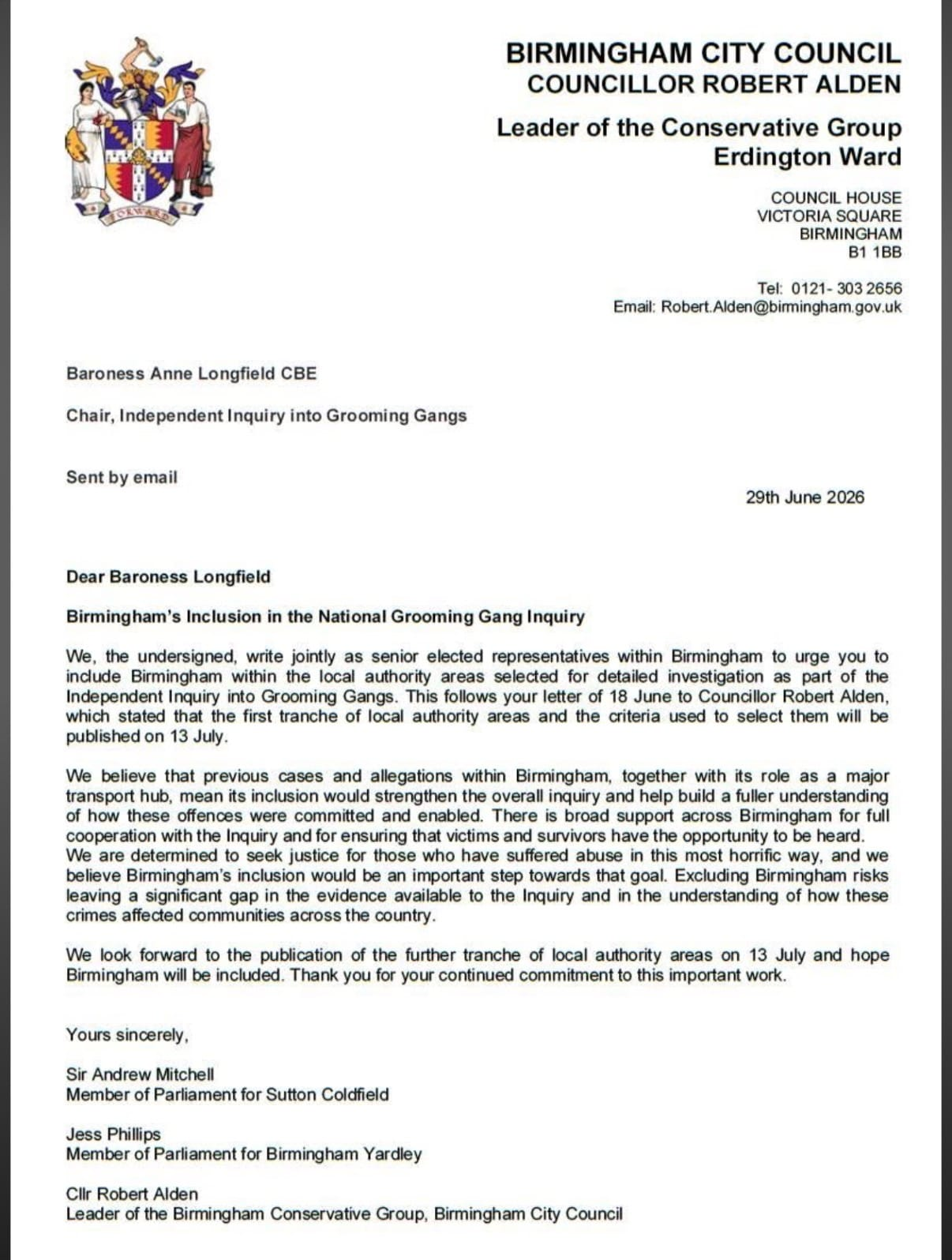
Then, in June, a letter went to Baroness Longfield, chair of the inquiry. I obtained it and published it. Three names at the bottom. Sir Andrew Mitchell, Conservative, Sutton Coldfield. Councillor Robert Alden, leader of Birmingham's Conservative group. And Jess Phillips. They ask for Birmingham to be included in the areas selected for detailed investigation, citing the city's previous cases and its significance to the wider network.
The minister who resisted the inquiry, then fought the survivors, now petitions it to investigate her own city.
Both parties on one letterhead, which should surprise nobody who has read this far. The concession is real, and it is narrower than it looks. Birmingham's political leadership accepts, in writing, that the city warrants detailed investigation. What that concession is worth, and what the inquiry's terms have been built to keep out of sight, is dealt with later in this series.
WHAT THE RECORD PROVES
The record proves the machinery existed.
- Mawrey proved organised electoral fraud, orchestrated, he says now, by the Birmingham Labour Party.
- Pickles recorded household pressure in some Pakistani and Bangladeshi communities and a state that turned a blind eye to it out of over-sensitivity about ethnicity and religion.
- Tower Hamlets proved public money can be converted into electoral support.
- Casey found Pakistani heritage councillors with disproportionate influence in Rotherham, reaching into the taxi trade, officials speaking of the deputy leader with fear, and police describing councillor pushback when they discussed targeting the men.
- And again and again, alongside every other failure the reviews list, one factor returns. Fear and sensitivity around race, ethnicity and community relations, treated, in account after account, as an emotion that happened to officials rather than an incentive that moved them.
None of those documents contains the sentence, protect the gangs for votes. Institutions do not write that sentence down. My conclusion comes from laying the decisions beside the incentives, for eight years, in the towns where both sit in plain sight. The organised communities had something to withdraw. The children had nothing. The people in power did the arithmetic, and the arithmetic never once favoured the child.
That is the bargain I say was made. They sold the children for votes, and everything in the record above is what the sale looks like when nobody signs it.
Tomorrow, what happened to the people who threatened it. I was one of them.
For eight years I have exposed how politicians, police and public bodies failed working class White girls who were systematically raped by Pakistani grooming gangs. Together, with the support of the people of Oldham, we forced the Government to concede a National Statutory Inquiry after years of resistance.
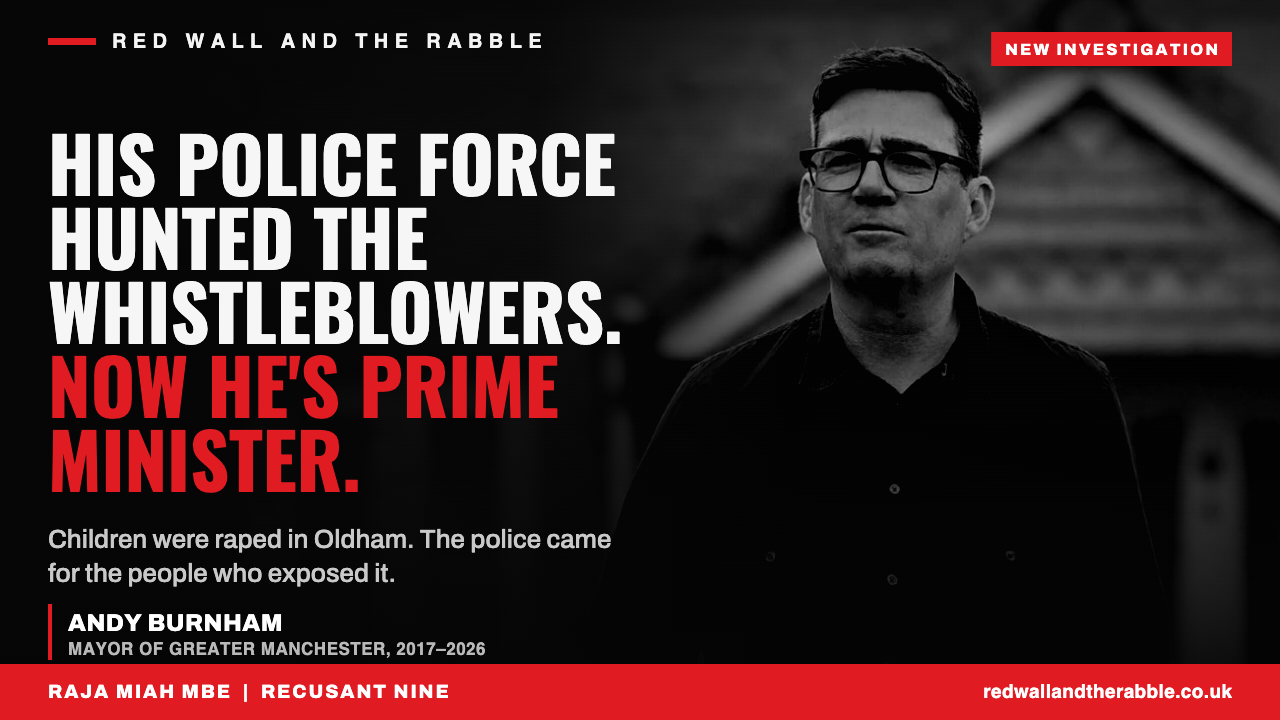
Now the harder fight begins.
Andy Burnham is no longer the Mayor of Greater Manchester. He is the Prime Minister. That does not place him beyond scrutiny. If anything, it makes scrutiny more important than ever.
As Mayor, Burnham commissioned a series of Assurance Reviews across Greater Manchester, including one in my hometown of Oldham. They were presented as a search for the truth. They were nothing of the sort. They were cover ups of cover ups that allowed those responsible to escape proper accountability.
Don't take my word for it. Even former Greater Manchester Police detective Maggie Oliver has described what happened in Oldham as 'nothing short of a cover up'.
Despite every effort to stop us, we forced a National Inquiry. Now Burnham and others are attempting to rewrite the history of what happened under their watch.
At present, the inquiry has made no commitment to examine Burnham's own role or the decisions taken during his time as Mayor. That must change before the Oldham investigations begin.
The pressure to protect a serving Prime Minister will be immense. The institutions that failed these girls will have every incentive to avoid putting the country's most powerful politician under oath. Much of the media will once again find reasons to look the other way.
That is why this campaign cannot slow down now.
For too long this has been a one man operation. It needs to become something much bigger. We need the resources to build a genuinely independent investigative organisation with:
- A professional website capable of reaching far larger audiences.
- Video production that takes our investigations to millions more people.
- Research support so no lead is left unexplored.
- Live events to educate, organise and train others.
- The resources to investigate, travel and expose institutional failure wherever it is found.
Over the last six weeks we have secured over 800 paid supporters towards our target of 2,000. That is an incredible achievement. Every new supporter strengthens this campaign, increases our voice and makes it harder for those in power to ignore the evidence.
If you believe the truth should be followed wherever it leads, please stand with us.
If you cannot afford the £3 a month or £30 for the full year, just sign up for free. There are no paywalls to access any of my work. I publish everything for free.
If you can’t commit to a regular subscription, a one-off contribution genuinely helps keep this alive. You can support me using one of these links;
👉 http://BuyMeACoffee.com/recusantnine
👉 http://paypal.me/RecusantNine
Should we succeed, politicians will go to prison. Even if there is only the smallest chance of this happening, isn't it worth your support?
Raja Miah MBE