PART 3: THE WARNINGS
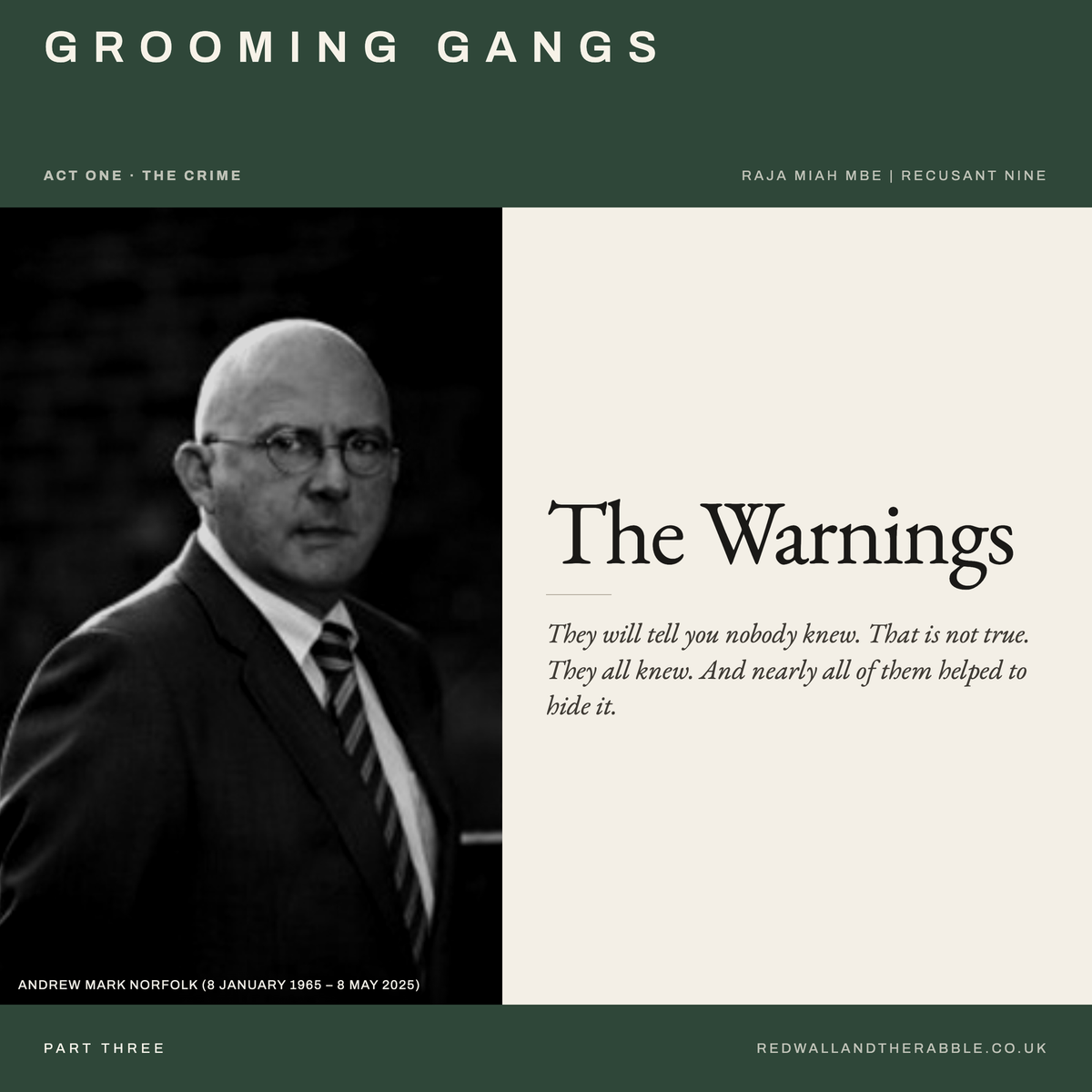
‘Asians pick me up. They get me drunk, they give me drugs and have sex with me. I want to move’
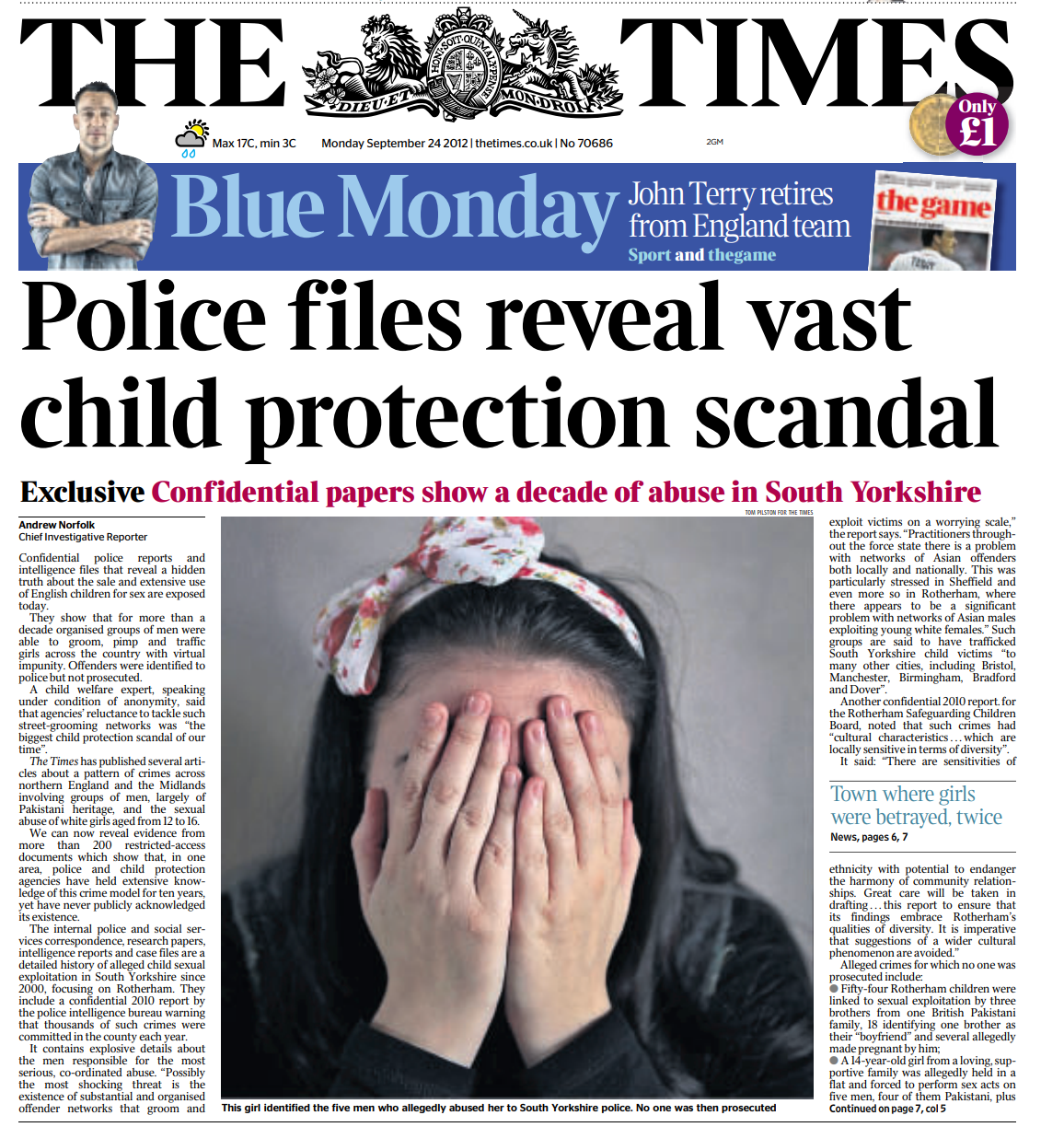
THE DAY "NOBODY KNEW" COLLAPSED
On 26 August 2014, Professor Alexis Jay published her report into Rotherham. She estimated, conservatively by her own account, that at least 1,400 children had been sexually exploited in one town between 1997 and 2013. Girls doused in petrol. Girls threatened with guns. Girls trafficked between northern cities while the men were left alone.
The country received it as a revelation. Rotherham became shorthand for a hidden horror suddenly dragged into the light.
Nothing about it was hidden. Jay did not uncover a previously invisible crime. She assembled and tested what South Yorkshire Police, Rotherham Council and the agencies around them already held in their own records, and had held for years. The scale was estimated in 2014, from files that had been accumulating for two decades.
Rotherham was not the day Britain found out. Rotherham was the day the claim that nobody knew became impossible to sustain.
Jay's inquiry was commissioned under pressure created in large part by a journalist's front page three years earlier. And what Andrew Norfolk printed in 2011 was not new either. The warnings behind it went back twenty years.
1991: THE REPORT BIRMINGHAM DID NOT PUBLISH
Birmingham, 1990. The city council commissioned Dr Jill Jesson to research the prostitution of girls in its own care.
Jesson found twenty girls, aged 13 to 17, every one of them in the care of Birmingham social services. There was no word for what was happening to them in 1991. The label on the files was child prostitution, and Jesson knew the label was wrong. These were not girls selling themselves on the streets for money. Each girl believed she belonged to a man who loved her. Her account of it, given to the Birmingham Mail in 2014, is the grooming model in a single line.
'You're my girl and I love you and you do as I ask.'
The girl would be driven somewhere in his car, and several men would be waiting. And the blame, in the files and the meetings, landed on the girl's behaviour, not the men's.
Jesson found the link to the private hire trade. She found the ethnicity of the men. In 1991, in Britain's second city, inside the council's own care system, she had documented the entire model this series set out in Part 1. The courtship. The handover to the waiting men. The child recorded as the problem.
Jesson says that when she presented her draft, she was instructed to remove all reference linking ethnicity and the private hire trade, and that copies of the report were to be destroyed. The council did not publish it in 1991. Its own later account is that the full report was finally put before the social services committee in December 1995, where a motion was tabled expressing concern at the suppression and calling for a full enquiry. The council debated that motion and voted it down. The minutes, by the council's own description, record members reassuring themselves that the report revealed nothing that was not public knowledge.
Nothing that was not public knowledge. In 1995. Whichever account of the report's fate is right, the committee record admits it. They already knew.
Jesson watched the next twenty years from the outside. Every time a news item came on about the grooming of girls in care, and the link to private hire drivers, she thought the same thing. I told them about that in 1991, and they did not want to acknowledge it.
THE REPORTS THAT COULD NOT HAVE BEEN CLEARER
From the late 1990s, the Rotherham youth project Risky Business worked with the girls the gangs were using. Its workers logged the men's names, the nicknames, the car registrations, the addresses, and passed the intelligence to South Yorkshire Police and the council, year after year.
In 2002, a Home Office funded researcher working alongside the project produced a draft report laying out the scale of the exploitation. Jay found it was effectively suppressed. It was never published. Data connected to the research went missing from the project's office. The council's own later audit concluded, on balance, that files were likely removed or computer records impaired, and could not identify who was responsible.
Failure does not remove files. Somebody does. The audit could not name them, and nobody has ever been held to account for it.
The researcher told Parliament what happened to her next. Hostility, attempts to discredit the work, and being directed onto diversity training after she recorded the ethnicity of the men.
Jay found two further reports, in 2003 and 2006, that put the situation squarely in front of senior police and council officers. Her ruling on the three reports gives this section its title. They could not have been clearer. The abuse ran on for another decade, to the 1,400.
We got this far because ordinary people refused to stay silent to an atrocity. And be in no doubt that what took place is an atrocity.
No political party funds my work. No institution stands behind it. And no mainstream media channel dare interview me despite Queen Elizabeth II putting a medal on my chest.
Every attempt to silence me has failed. Dawn raids by the police, false arrests, fabricated charges and 3 years on bail. Pakistani gangsters have followed me home and Islamists have incited my murder. Yet here I still stand. And as each day passes, our numbers grow and the truth reaches more people.
What I do exists because ordinary people choose to sustain it. Sign up to my newsletter and support my work.
THE MOTHERS AND THE ALERTS
In 2002, mothers in Keighley began arriving at their MP's surgery. Their daughters were being groomed and raped by gangs of local men, and the mothers brought names, addresses and descriptions. Ann Cryer MP took their evidence to West Yorkshire Police and to social services, and in 2003 she stood up and said publicly what no MP had ever said, that gangs of local Pakistani men were grooming and raping White girls in her constituency.
The investigation that followed produced arrests, charges and convictions. It did not produce a response on the scale of what the mothers described, and the abuse in the town continued for years, as the trials of the following two decades would prove. What the response did produce, immediately and in force, was punishment for Cryer. She was branded a racist, from inside her own party and from the community organisations her party depended on. She received threats serious enough that a police panic alarm was installed in her home.
In Rochdale, Sara Rowbotham ran the crisis intervention team that dealt with the girls the men were passing around. Her evidence to Parliament is exact. From 2004, 181 alerts to Children's Social Care. Between 2005 and 2011, 103 young people referred. The independent review of Rochdale, published in 2024, found her information should have triggered a major investigation. It did not, and the nine men of Part 2 committed their crimes inside those years.
A commissioned report, an MP carrying names, and 181 written alerts.
THE FILM AND THE OPERATION
In 2004 the warning reached television. Edge of the City, a Channel 4 documentary filmed in Bradford, showed the grooming of White girls by Asian men. It was scheduled for May. The Chief Constable of West Yorkshire asked Channel 4 to postpone it, weeks before local and European elections, warning that it risked racial tension and public disorder, and would hand the far right a weapon. Channel 4 agreed. The intervention was aimed at the transmission date. Nothing of equivalent force was aimed at the pattern the film documented.
The broadcast was treated as the danger. The rapes were not.
The film finally aired on 26 August 2004. Jay published on 26 August 2014. Ten years to the day separated the warning Britain was not allowed to watch on schedule from the report Britain could no longer avoid.
In Manchester, the warning had a name. Victoria Agoglia was fifteen, in the care of Manchester City Council, known to be at risk of sexual exploitation. Shortly before her death in 2003 she reported being injected with heroin by an older man. She died after a fifty-year-old man injected her with it.
Her death forced Greater Manchester Police to open Operation Augusta, an investigation into the sexual exploitation of children in care across south Manchester. Augusta was working. It identified 97 persons of interest and 57 potential victims. Then, in 2005, it was closed. The independent review that finally examined the closure found that senior officers removed the resources before the lines of inquiry were completed or exhausted, and could not assure itself that the children it sampled had been appropriately protected.
The men on that list of 97 walked away from an investigation into the gang rape and trafficking of little White girls by Pakistani men.
That review did not report until January 2020. Fifteen years after the closure. The review happened at all because whistleblowers refused to let Augusta die, among them Maggie Oliver, the Greater Manchester Police detective who resigned in 2012 to speak out, and because a BBC documentary in 2017 finally put the allegations beyond containment.
THE FRONT PAGE
On 5 January 2011, Andrew Norfolk of The Times put the pattern on a national front page. A conspiracy of silence. He later described the resistance the investigation met, the scepticism inside his own trade, the agencies that disputed the pattern, the accusations that the reporting itself was dangerous.
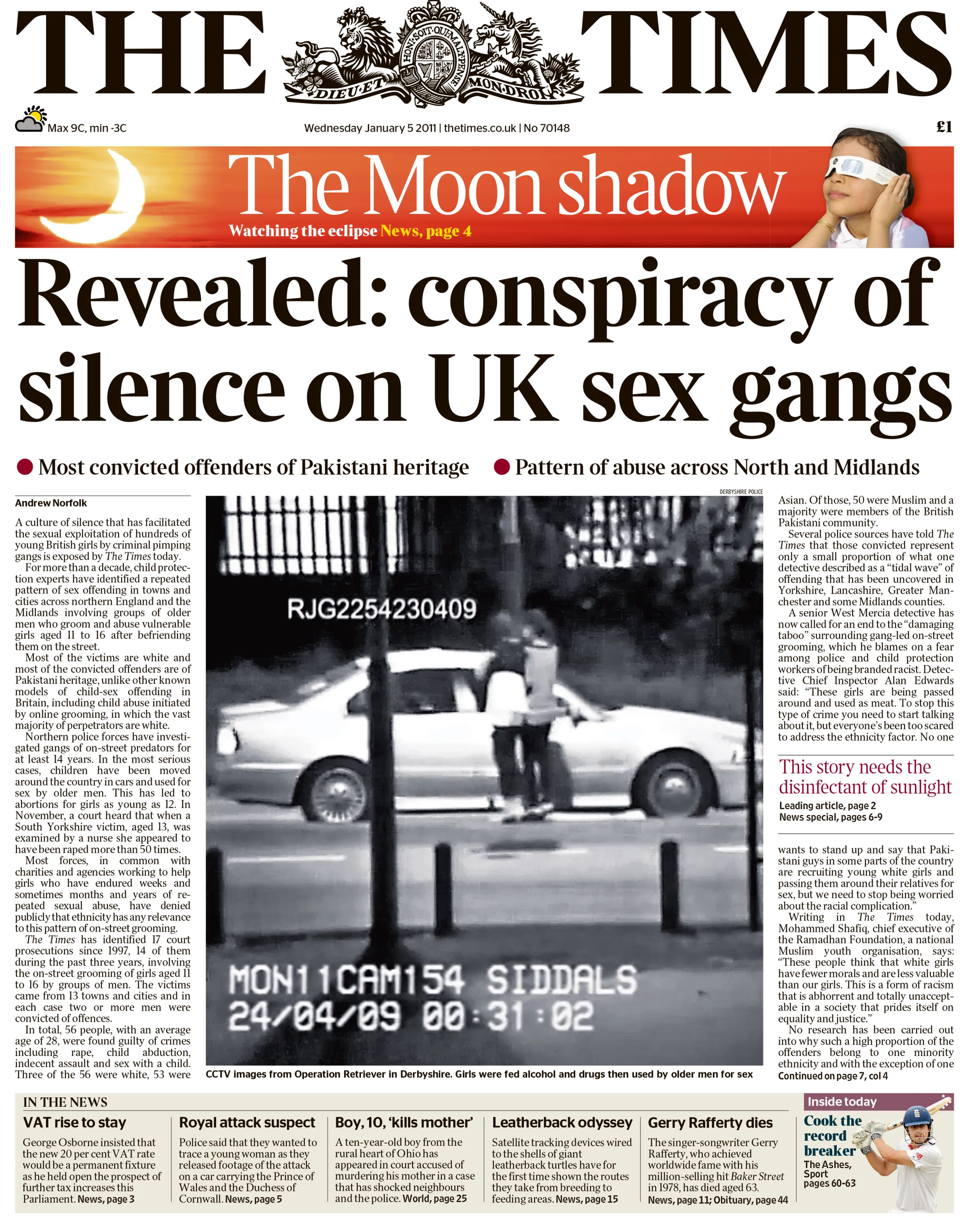
Norfolk had not discovered a hidden crime. Every element of his front page already existed inside the state. The pattern was in the report Birmingham did not publish in 1991. The names were in the Risky Business logs South Yorkshire Police had been receiving for a decade. The scale was in the suppressed 2002 report and the ignored reports of 2003 and 2006. The victims were in Rowbotham's 181 alerts. The suspects were on Augusta's list of 97. The mothers had handed it to an MP in 2002, and a national broadcaster had filmed it in 2004 and been persuaded to postpone it.
His investigation was the first warning placed where no steering group, no chief constable's request and no removed file could contain it. The Rochdale convictions came in 2012. Rotherham commissioned Jay under the continuing pressure of his reporting, and in 2014 the country finally read, in one document, what had been sitting in the files since 1991.
Twenty-three years passed between the report Birmingham did not publish and the estimate Britain could not avoid.
THE WARNINGS DID NOT END IN 2014
In Telford, Lucy Lowe was sixteen when she was killed in 2000, alongside her mother and sister, in a fire set by the man who had made her pregnant at fourteen.
 Lara Brown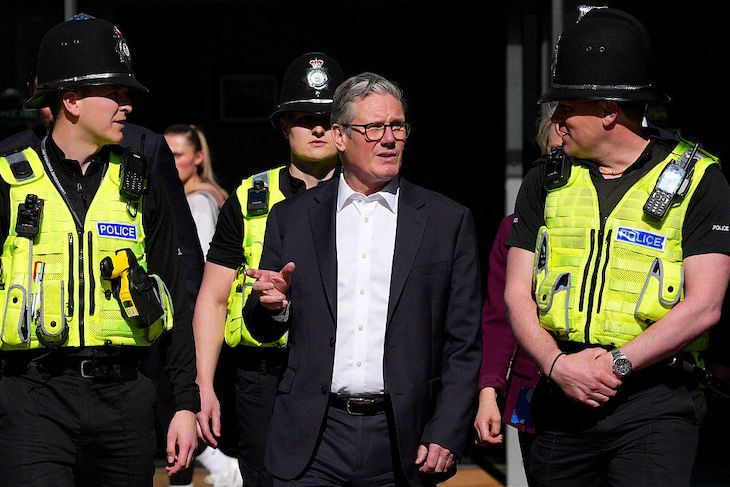
In 2016, sixteen years after Lucy died and two years after Jay, the town's MP, asked the Government for an inquiry. The council's leader, Shaun Davies, and nine other officials wrote to the Home Secretary telling her it was not needed.
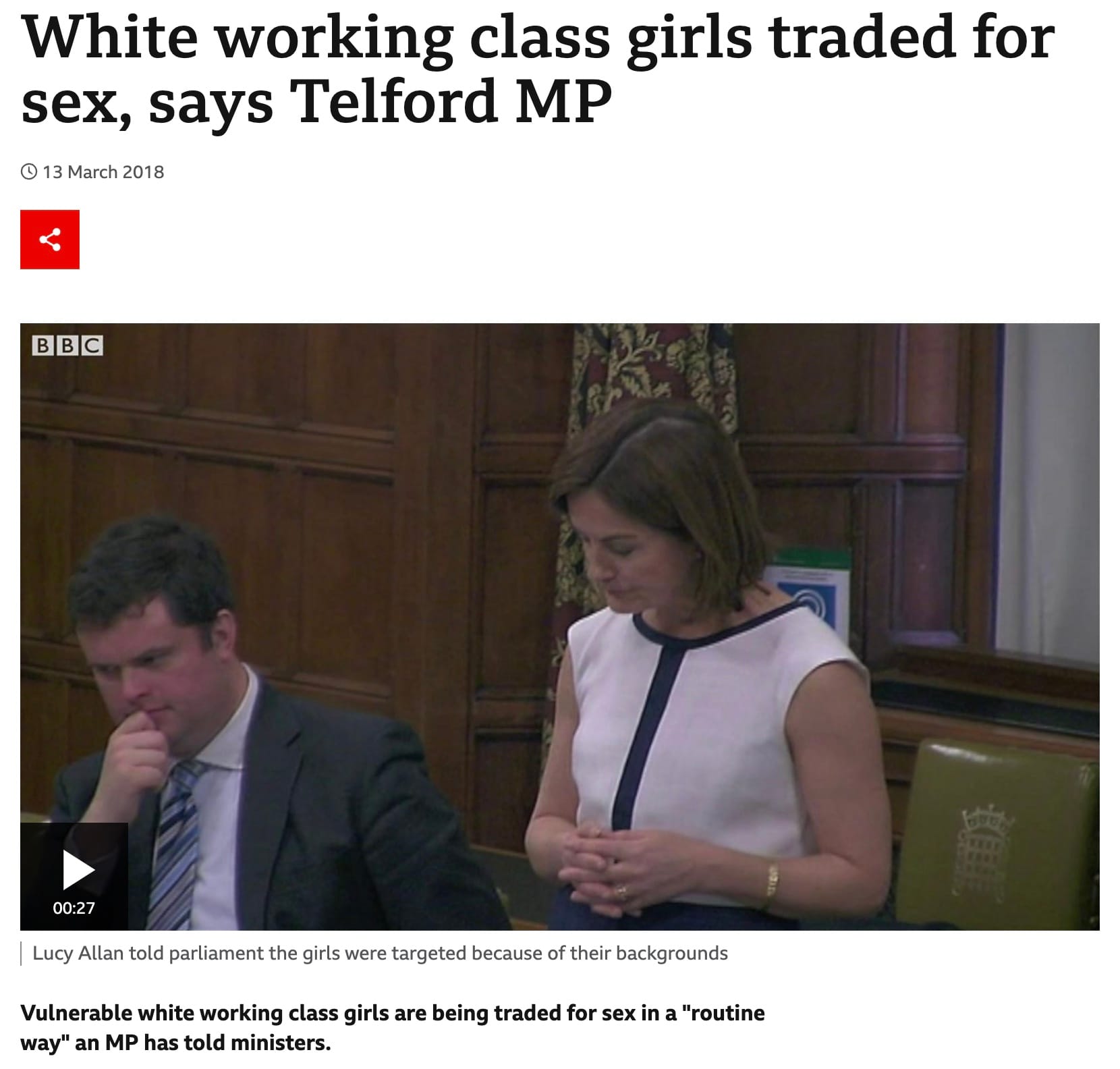
In March 2018, Lucy Allan stood in the Commons and told ministers that vulnerable White working class girls were being traded for sex in a routine way, targeted because of their backgrounds. That month, the Sunday Mirror published its investigation and its estimate of up to a thousand victims across four decades, and the council reversed.
When the council finally met to debate the inquiry it had resisted for two years, it refused to let the MP speak. She stood outside with the survivors instead, their mouths covered, in silence.
The inquiry reported in 2022. It accepted the estimate of more than a thousand victims as measured and reasonable, with evidence it might be conservative, and found obvious evidence ignored for generations. The council leader who had signed the letter against an inquiry responded to the findings by pointing out that he had been three years old when the abuse began. Two years later, Telford elected him as its MP.
In 2019, while that inquiry was under way, West Mercia Police wrote to the family of one Telford victim to warn them that armed men might come to their home. The letter advised alarms, CCTV and bolts on the doors, said the force could not protect them day by day, and suggested they consider leaving the area. Nineteen years after Lucy Lowe died in a house fire, the police response to a threatened family in the same town was a letter recommending they move.
In Manchester, the review establishing why Augusta was closed did not report until 2020. In Oldham, the fight to have the town examined at all took years against resistance, and what was eventually commissioned reviewed fragments of the whole. When it reported in 2022, Oldham's then council leader, Amanda Chadderton, stood in the chamber and said of the survivors, 'you can't say it destroyed their lives, 'cause the people I've spoke to, it hasn't.' Within a year, the voters of Oldham removed her. The Labour Party gave her a job in Yvette Cooper's team. That is the same Yvette Cooper who then tried to block the National Inquiry.
And in 2025, Baroness Casey's national audit found the state still unable to assess the scale, ethnicity still unrecorded for two thirds of perpetrators, grooming gangs still absent from any official dataset. Thirty-four years after Birmingham commissioned its warning, the state still cannot answer the question Jesson was hired to research.
The warnings were not identical. A commissioned report. Intelligence logs. A researcher's data. Mothers with names. 181 written alerts. A television documentary. A live police operation with 97 persons of interest. A national front page. An MP telling the Commons that girls were being traded routinely. And they were not disposed of identically. One was not published. One was suppressed and its files likely removed. One was answered with a smear campaign against the MP who carried it. One was postponed past an election. One was closed with the work unfinished. One was refused in writing by ten signatures. The rest were filed, logged and left.
The effect never varied. Information serious enough to demand action never produced action to match the danger. The children stayed exposed. The men stayed free. The institutions stayed protected from the consequences of what their own files contained. And when the findings finally arrived, the leaders' answer, in Birmingham in 1995, in Telford in 2022, in Oldham in 2022, was that it was nothing new, nothing to do with them, and had not destroyed anybody's life.
Institutions do not produce the same outcome, from different acts, in different decades, for thirty-four years, by accident. The outcome was worth something to the people producing it.
Tomorrow, what it was worth. The bargain.
For eight years I have exposed how politicians, police and public bodies failed working class White girls who were systematically raped by Pakistani grooming gangs. Together, with the support of the people of Oldham, we forced the Government to concede a National Statutory Inquiry after years of resistance.
Now the harder fight begins.
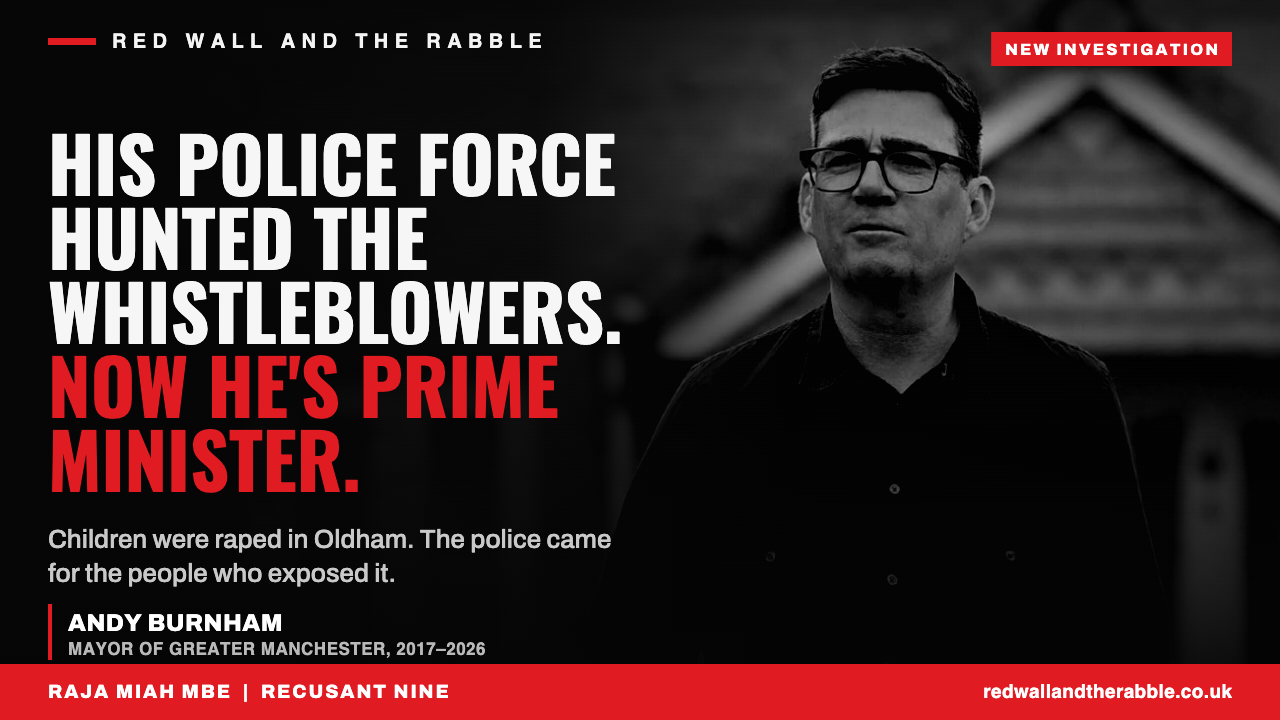
Andy Burnham is no longer the Mayor of Greater Manchester. He is the Prime Minister. That does not place him beyond scrutiny. If anything, it makes scrutiny more important than ever.
As Mayor, Burnham commissioned a series of Assurance Reviews across Greater Manchester, including one in my hometown of Oldham. They were presented as a search for the truth. They were nothing of the sort. They were cover ups of cover ups that allowed those responsible to escape proper accountability.
Don't take my word for it. Even former Greater Manchester Police detective Maggie Oliver has described what happened in Oldham as 'nothing short of a cover up'.
Despite every effort to stop us, we forced a National Inquiry. Now Burnham and others are attempting to rewrite the history of what happened under their watch.
At present, the inquiry has made no commitment to examine Burnham's own role or the decisions taken during his time as Mayor. That must change before the Oldham investigations begin.
The pressure to protect a serving Prime Minister will be immense. The institutions that failed these girls will have every incentive to avoid putting the country's most powerful politician under oath. Much of the media will once again find reasons to look the other way.
That is why this campaign cannot slow down now.
For too long this has been a one man operation. It needs to become something much bigger. We need the resources to build a genuinely independent investigative organisation with:
- A professional website capable of reaching far larger audiences.
- Video production that takes our investigations to millions more people.
- Research support so no lead is left unexplored.
- Live events to educate, organise and train others.
- The resources to investigate, travel and expose institutional failure wherever it is found.
Over the last six weeks we have secured over 800 paid supporters towards our target of 2,000. That is an incredible achievement. Every new supporter strengthens this campaign, increases our voice and makes it harder for those in power to ignore the evidence.
If you believe the truth should be followed wherever it leads, please stand with us.
If you cannot afford the £3 a month or £30 for the full year, just sign up for free. There are no paywalls to access any of my work. I publish everything for free.
If you can’t commit to a regular subscription, a one-off contribution genuinely helps keep this alive. You can support me using one of these links;
👉 http://BuyMeACoffee.com/recusantnine
👉 http://paypal.me/RecusantNine
Should we succeed, politicians will go to prison. Even if there is only the smallest chance of this happening, isn't it worth your support?
Raja Miah MBE