EXPOSED: How The Grooming Gangs National Inquiry Wrote Itself The Right To Exclude Any Town Without Saying Why
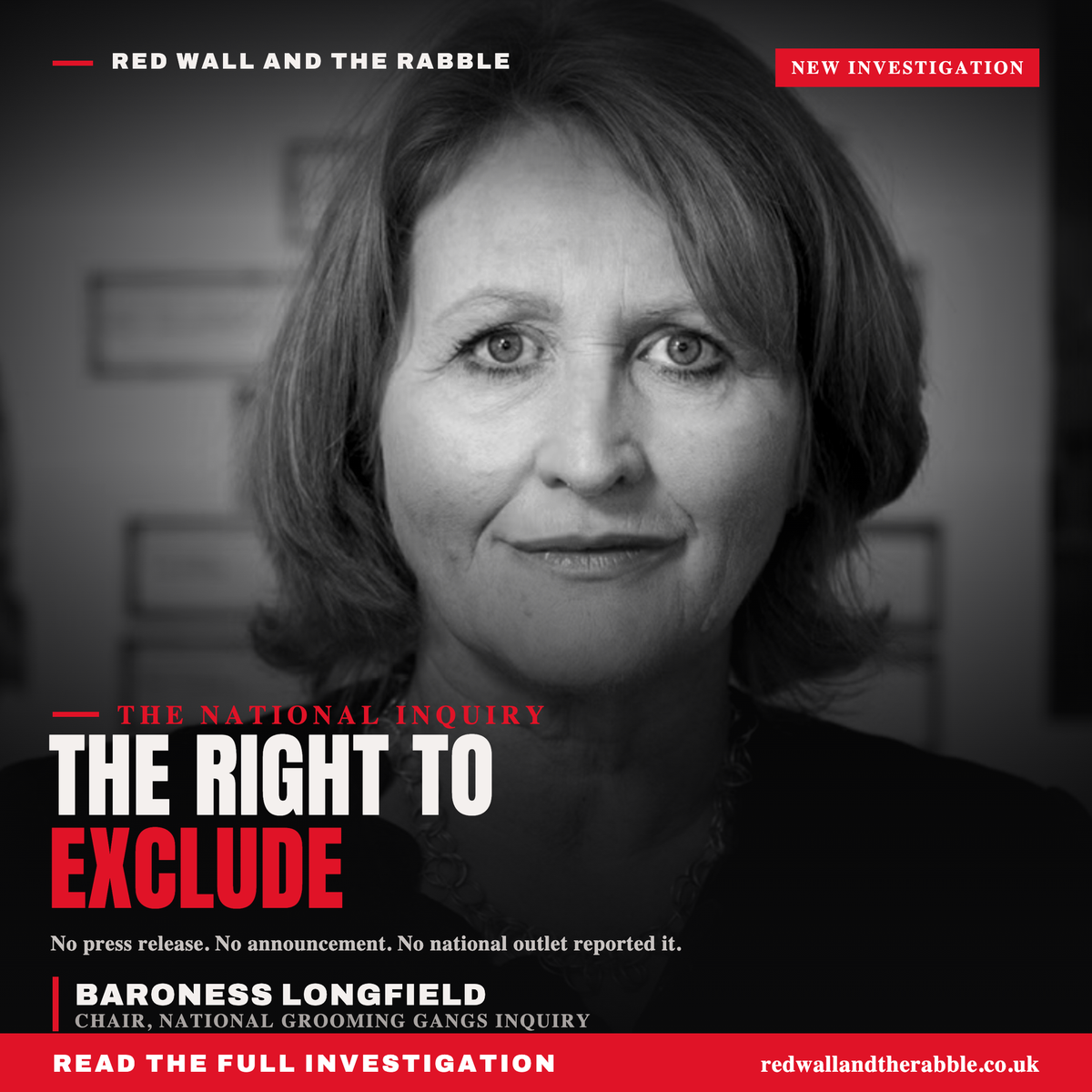
No press release. No announcement. No national outlet reported it
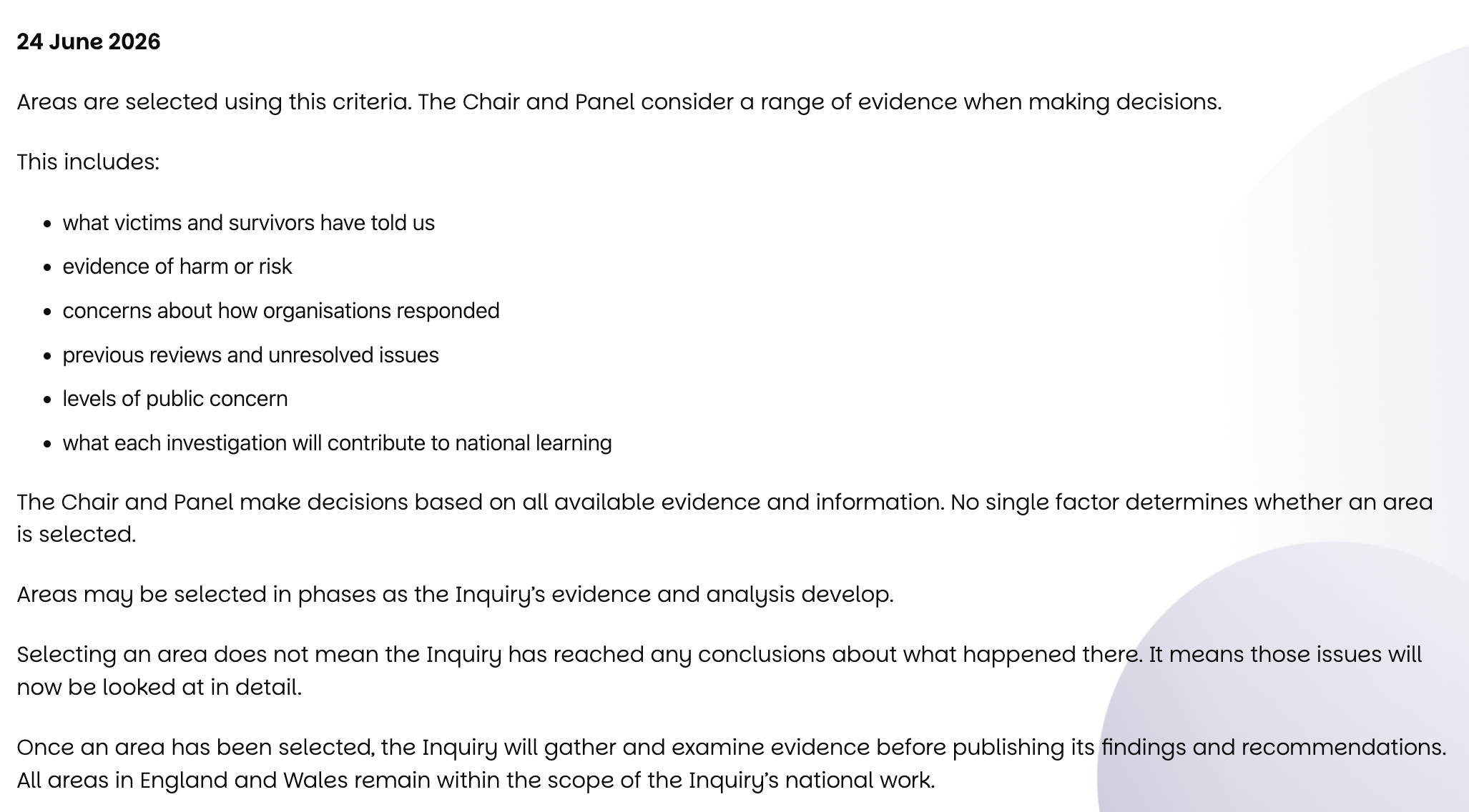
The National Inquiry published its local area selection criteria on 24 June, the same day it announced its first investigation areas. . Read closely, the document contains no test any town can fail, no obligation the Inquiry cannot walk away from, and no way for an excluded town to ever be told why.
There's a document here the Inquiry didn't want you reading.
Local Area Investigation Selection Criteria. Seven pages. One job, supposedly, answer this. How does the Inquiry decide which towns get investigated and which don't?
A real answer gives you a test. Meet it and you're in. Miss it and they tell you why, and you can fight that.
I read this thing four times looking for the sentence that actually ties their hands. Couldn't find it. It isn't there.
Seventeen mays. One must. And the must protects the Inquiry's own timetable. Not a survivor. Not a town. Not one piece of evidence.
Below is the document itself, clause by clause, in their words, not mine. Read it and then ask your MP a simple question. What would our town have needed to show, under this, to be guaranteed an investigation. There's no answer to that question. It was built that way on purpose.
The Criteria Decide Nothing
Paragraph 2.1 opens well enough. The Inquiry will select local areas by applying the criteria set out below. Fine. Then the next sentence takes it straight back. "The criteria are not a rigid scoring system."
What are they instead?
They are intended to guide the Chair and Panel's judgement about where a focused local investigation is most likely to assist the Inquiry in discharging its Terms of Reference.
Read that again. The Inquiry has just told you the criteria don't decide anything, the judgement does. Nobody gets selected for meeting a criterion. They get selected because the Chair and Panel decided to select them, and the criteria sat somewhere in the background while that happened. This document exists to make a choice look like a process.
Any Reason Will Do
Paragraph 2.2, four sentences, worth taking slowly because the third one about balance and deliverability comes back later and does real damage.
No single criterion is determinative. An area may be selected because it strongly meets one criterion, or because it meets a combination of criteria. The Chair and Panel may also take account of the need to ensure that the overall programme of Local Area Investigations is balanced, deliverable and capable of producing meaningful findings and recommendations. The weight given to each criterion may vary from area to area.
First sentence, nothing on the list settles anything on its own. A town can turn up with a mountain of evidence of institutional failure and that still decides nothing, because no single criterion is determinative. Their words.
Second sentence lets a town in on almost nothing too, if the Panel fancies it. So strong evidence doesn't guarantee you a place. Thin evidence doesn't rule you out either. Neither end of the scale matters.
And the fourth sentence is the one that should worry you most. Same suppressed report turns up in two different towns. The Panel can call it decisive in one and shrug at it in the other, and both calls comply, because the document told you in advance the same fact is allowed to weigh differently depending on where it landed. That isn't a rule. Call it what it is, a licence.
Evidence Counts. So Does The Lack Of It.
Paragraph 2.3 is honestly dealing with a real problem. The data on this is bad, everyone in this space knows it.
A lack of recorded cases, convictions or prosecutions does not necessarily mean that abuse did not occur. It may instead reflect under-reporting, under-recording, failures of identification, or weaknesses in institutional response.
True. I've spent years making this exact argument about Oldham's numbers. In an investigation that's wisdom. But this isn't an investigation, it's a sorting mechanism, towns in or towns out, so look at what this sentence does to the sorting. Thick file of recorded cases, points toward selection. Thin file, also points toward selection, because now the thinness itself might be the failure. Whichever way the data runs, it lands you in the same place.
Paragraph 2.4 seals it.
For that reason, quantitative data will inform selection but will not determine it.
Their words again. Data will not determine selection. So something else determines it. And that something else never gets written down anywhere in this document.
3.5 does the same trick with history. 3.5.1, the Inquiry may select areas where previous reviews flagged issues. Fine. Then 3.5.2:
The Inquiry may also select areas where there has been an absence of previous investigation despite significant public concern or evidence suggesting potential risk or harm.
So the towns that got looked at before qualify. And the towns that never got looked at also qualify. Sit with that for a second, because it's the whole document in miniature. Every town qualifies. When every town qualifies, qualifying is meaningless.
These criteria can't exclude a single place in England and Wales, which means they can never be the honest reason a town gets passed over.
Ask them why your town missed out and "it didn't meet the criteria" cannot ever be a true answer, not once, not for anyone. The real reason lives somewhere else. This document is just the wall in front of it.
May. Never Must.
Section 3 is where the actual list sits, and it opens like this.
The Inquiry may consider the following factors when selecting local areas for investigation.
May. Everything under that heading inherits the word. Victim and survivor experience, may consider. Indicators of prevalence, harm or risk, may consider. Significant public concern, may select, and then 3.3.3 rushes in to remind you public concern proves nothing on its own anyway. Evidence of institutional failure, may consider.
I actually counted. Seventeen mays across Section 3. Every criterion the Inquiry says it weighs is optional. Must shows up exactly once in the entire seven pages, and it's not even in this section. It's back in 2.4, and it doesn't owe anything to a survivor or a town or a document that surfaced fifteen years ago. It binds the Inquiry to stay within its own timetable and budget. That is the one thing in this whole framework they cannot walk away from, and it isn't for you.
This is the whole difference between a right and a favour. Must consider survivor testimony, and a survivor who got ignored has something to point at. May consider, and there's nothing to breach, ever. You could hand this Inquiry a thousand survivor statements and a stack of suppressed reports and a police force caught shredding files, and the Panel could set every page of it down and walk away, and no rule in this document would have been broken, because no rule in this document ever told them to pick it up. Nobody drafts may seventeen times by accident. You draft it that many times when the brief was keep every door open while making it look like some of them are shut.
The Two Exits
Two clauses near the back aren't criteria at all. They're exits. This is where that line from 2.2 about balance and deliverability comes back and actually starts biting.
First, 3.6.3.
The Inquiry may also select areas to ensure that the overall programme of Local Area Investigations captures a range of experiences and institutional contexts, rather than only areas with the highest recorded number of cases or convictions.
Read the second half of that again. Rather than only areas with the highest recorded number of cases or convictions. The worst-hit towns in the country can be lawfully skipped in favour of variety. A town with an epidemic loses its slot to a town that just makes a tidier case study, and the word doing the work there is range.
Second, 3.7.1c.
whether the area can be investigated within the Inquiry's timetable and resources
There it is. The quiet one. Any town, no matter how strong its case, can be turned down because it would cost too much time or too much of a £65 million budget. And you will never be able to test that claim, because testing it means seeing their internal costings and their internal timetable, and none of that gets published next to the refusal. They can say this about any town, at any point, and there is no version of the world where you get to check.
They Approved Their Own Homework
One more. Paragraph 4.2.
The Chair and Panel may make initial selections before evidence-gathering has been completed where, applying the criteria in the round, they consider this necessary to enable the Inquiry to begin its investigative work promptly, meet its timetable and discharge its Terms of Reference.
A rulebook is meant to sit in front of a decision, not behind it. This clause reaches backward and blesses decisions that were already made. The rules turned up after the game had already started, with a line inside saying that was allowed all along.
Eight Years Later
We are not where we are by accident. Every column inch, every FOI, every hearing forced into existence, came from years of refusing to stop. From paying a price that most would not.
We will not get where we need to be if we leave the job to the people who built the cover-up in the first place. Stand with me.
This work is free because the truth has to circulate. Anyone can read it, share it, act on it, without paying a penny. But truth without numbers is easy to crush. Governments do not fear facts. Facts get filed, minimised, managed. What governments fear is scale.
Burnham and the Labour Party do not fear one campaigner. They fear thousands of readers, sharing the same work, backing the same investigation, because numbers mean witnesses, numbers mean pressure, numbers mean consequences they cannot manage away.
Every subscriber is a number they cannot erase. Every reader widens a circle they cannot control. A handful of supporters can be dismissed as noise. Thousands cannot. This is how the campaign survives. This is how we see it through to the end. This is how voices like ours stop being managed and start being feared.
Before Burnham reaches Number 10, Red Wall and the Rabble needs 2,000 more paid subscribers. That's the scale of what's coming. Today, we only need you.
Sign Up Now. Help force Andy Burnham testify at the National Inquiry.
The Defence They Will Offer
I'll give the document its due for a second. 2.4 has an answer ready for all of this. The Inquiry must make targeted and informed selection within its timetable and resources, it says, recognising it cannot investigate every area where concerns have been raised. Fair enough. Nobody sane expects them to go everywhere.
But if you can only pick a handful of towns out of dozens with a case, the towns you leave behind are owed a proper explanation.
A shortlist is exactly where politics creeps in, which is exactly where the rules need to be hardest to bend. Instead they took the one decision that most needed locking down and left it wide open.
And look at what isn't in here, because that was drafted too. There's no promise to publish which towns were considered and turned away, or why. There's no route for a rejected town to ask a question and get an actual answer back either. Seven pages on how areas get chosen, and not one sentence in any of it that a town, a survivor, or anyone else could ever hold them to.
They Buried It Because It Works Better Unread
Back to the start. How does the Inquiry decide which towns get investigated? However it likes, that's the honest answer after seven pages. There's nothing they're required to do, and there's nothing stopping them either. Data informs but never decides. Identical evidence can go two different ways depending on the postcode. The worst-affected town in the country can lose out for the sake of range, or get turned down for cost, and neither call can ever be tested by anyone outside the building.
Which is why the burial makes sense now. You don't put a press release out for a document like this one, because any journalist with a spare afternoon was always going to find exactly what I just found. So it went up on a documents page wedged between a costs protocol and some technical guidance, on the same day the Inquiry announced its first investigation areas, with no announcement of its own at all.
Seven pages. Read it yourself, I've attached the link. Then send it to your MP and ask the one question that matters. What would our town have had to show, under this document, to be guaranteed an investigation? There is no answer. That was always the point.
I’m Raja Miah MBE. For nearly eight years, I have led a campaign that exposed how senior Labour politicians helped protect Pakistani rape gangs. The people of my town helped force the national inquiry.
You won’t see me on the BBC. You won’t read my work in the legacy press. That’s not an accident. I take this to a place from where there is no coming back.
I document everything in my newsletter. It’s 100% free to read. If this work matters to you, if you believe it must continue, I need your backing.
My work is free. No paywalls. No gatekeeping. No exclusions. Because the truth shouldn’t belong only to those who can afford it. If you can afford to do so, supporting me costs as little as 75p a week (£30 a year).
If you can’t commit to a regular subscription, a one-off contribution genuinely helps keep this alive. You can support me using one of these links;
👉 http://BuyMeACoffee.com/recusantnine
👉 http://paypal.me/RecusantNine
We’re up against a machine, politicians, police, officials, and media, working together to shrink, sanitise, and bury the truth. This work survives because of you.
If you’ve ever shared my posts, learned something, or felt less alone reading them, stand with me. I need your help.
Raja 🙏