Reviews Without Reckoning
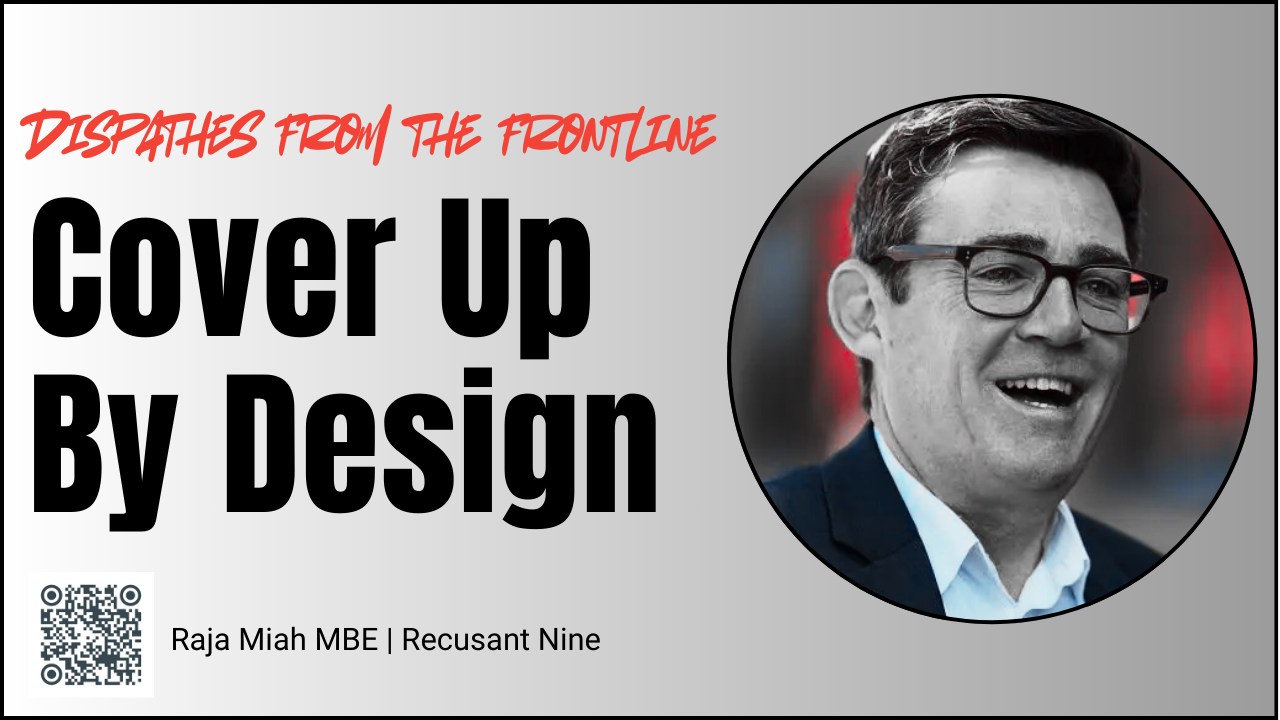
Why Andy Burnham Chose Control Over Truth
This is the first of a series of dispatches examining the decisions taken by Andy Burnham when he commissioned and defended the rape gang Assurance Reviews in Greater Manchester.
Each dispatch focuses on a single decision and follows it through to its consequences, using the public record. Together, they establish how the design of the process shaped what the reviews were able to conclude from the outset.
Dispatch One
The first question matters because everything else depends on it.
Were the rape gang reviews commissioned by Andy Burnham ever investigations in any meaningful sense?
They were not, and that was understood at the point of commissioning.
Every review Burnham commissioned into child sexual exploitation in Greater Manchester was non-statutory. They had no power to compel witnesses or force the production of documents. Without sanctions for refusal, the process could be blocked at any point by anyone with something to hide.
What Burnham commissioned worked only with willing cooperation. It spoke to those who agreed to be interviewed and assessed whatever documents institutions chose to provide. When individuals declined to cooperate, the review moved on and reported its conclusions without accounting for what was missing.
Burnham knew this when he commissioned the reviews.
That knowledge matters because these reviews concerned organised child sexual abuse and institutional failure on a massive scale. The most damaging evidence sits with those least willing to disclose it. Relying on voluntary cooperation meant relying on the goodwill of people with every reason to protect themselves.
Burnham chose to remove compulsion entirely, with the effect that those with the most to hide could control what the reviews discovered.
He did so despite the existence of statutory inquiries, which are used precisely when institutions cannot be trusted to cooperate voluntarily. Statutory inquiries compel witnesses, demand documents, and preserve evidence before it disappears. They are also politically dangerous because they expose what reviews cannot.
Burnham rejected that route.
Instead, he commissioned "Assurance Reviews". The name reflected the limits of what was being commissioned. These processes were framed as a response to public concern, but they were not equipped to force confrontation or overcome resistance. At a push, they were capable of reassurance moving forward. They were not capable of investigation of the failures of the past.
Burnham never corrected this publicly at the time. Faced with reports of rape gangs and institutional failure, many people assumed that a mayor announcing reviews was initiating a process with the authority to demand evidence and require cooperation. No such authority existed.
Without statutory powers, those under scrutiny decided how far the reviews could go. They even decided the terms of reference of what would be reviewed.
Police forces and councils were able to choose whether to participate. Former officials could refuse interviews. Retired officers could withhold documents. Anyone could disengage entirely. There was no sanction for doing so and no obligation to explain refusal publicly. That arrangement removed any obligation on those under scrutiny to account for themselves.
Accountability requires pressure. It requires the testing of accounts against records and the ability to confront refusal. None of that was possible within the framework Burnham chose.
Burnham was not inexperienced. He had lived through Hillsborough, where non-statutory reviews, limited scope, and managed processes were used to delay truth for decades. He understood how institutions exploit procedure, language, and timing to avoid exposure. That history makes any claim of inadvertence difficult to sustain.
The sequence of decisions is visible.
- He selected a process that could be completed without forcing confrontation.
- He commissioned reviews that allowed institutions to cooperate on their own terms.
- He created a framework in which missing evidence could later be treated as absence instead of obstruction. That outcome followed directly from how the process was constructed.
Burnham knew from experience the limits of non-statutory reviews. Witnesses can refuse with no consequences. Documents can be withheld with no remedy. Evidence can disappear with no mechanism to recover it. The process proceeds regardless, drawing conclusions from what remains. Those conclusions were then defended as accountability.
That defence collapses the distinction between review and investigation. It treats limitation as adequacy and silence as neutrality. It requires the public to forget what powers were never used.
Victims were left with a process designed to fail them.
The individuals who conducted the reviews are not to blame here. The framework they were required to operate within is. No amount of diligence can compensate for a process that accepts refusal as an endpoint.
Once this baseline is established, what followed becomes easier to explain. Witnesses went missing. Records disappeared. Survivors were excluded. Questions about cover-up were ruled out before the work began. None of it requires speculation.
Victims deserved a process that could compel institutions to account for themselves. The public deserved honesty about what was being commissioned and what it could deliver. What they were given was a process designed to proceed without resistance.
This dispatch establishes the ground on which everything else rests. When the power to compel is removed, accountability cannot follow. Every subsequent decision must be read through that lens.
The next dispatch examines the decision that followed directly from this one. Why, knowing these limits, did Burnham rely entirely on the voluntary cooperation of the very institutions whose conduct was under question?
If you’re not yet subscribed, fix that today. Sign up now – it’s free
If you believe Keir Starmer and his Pakistani gangster Islamist courting Labour Party narrative, then once they could no longer dismiss the industrial-scale gang rape of young white girls as a “far-right conspiracy,” we’re told it was fear of being labelled racist that stopped police, public servants, and politicians from protecting those children.
If you believe me, you’ll know the truth is far worse. They didn’t fail to act because they were afraid. They failed to act because they gained from the silence. They protected the perpetrators because the system rewarded their complicity.
And if you’ve followed my work, you’ll also know they’ve tried, again and again, to silence me. They’ve failed. I’ve exposed the evidence. I’ve laid bare the mechanics of the cover-up.
Now the question is will enough of you stand with me?
Because if we act together, we stand a real chance of not just of holding every complicit official to account, but of ensuring this never happens again.
If we do nothing, if we simply complain while watching from the sidelines, then this National Inquiry will be nothing more than another whitewash.
But if we join the campaign that forced this inquiry into existence, if enough of us stand up, then politicians will go to prison. This government will fall. And the Labour Party will be finished.
If there’s even a one-in-a-million chance of achieving that, would you not take 10 seconds to stand with me?
By now, most of you know who I am. You know what I’ve done. And you know I’m not here to play games.
I’m not a Maggie Oliver. I’m not a Tommy Robinson or a Charlie Peters. I’m a political campaigner. Despite attempts to smear me, imprison me, even kill me, I’ve led the political movement that forced this inquiry into existence. But to take on the full weight of the state and win, we need to scale up. Fast.
If you’re not yet subscribed, fix that today. If you are, share this with others who care. You all know of the media blacklist against me. You all know why.
🔴 Subscribe – it’s free. If you can afford it, support the work with just 75p/week: £3/month or £30/year.
This is the fight. This is the moment. There will not be another.
🔴 Prefer a one-off contribution?
👉 http://BuyMeACoffee.com/recusantnine
👉 http://paypal.me/RecusantNine
No corporate sponsors. No political party backing. Just you and thousands of ordinary people who know what’s at stake.
Look how far we’ve come already. We are this close. Help finish this.
- Raja Miah MBE