Oldham on Fire
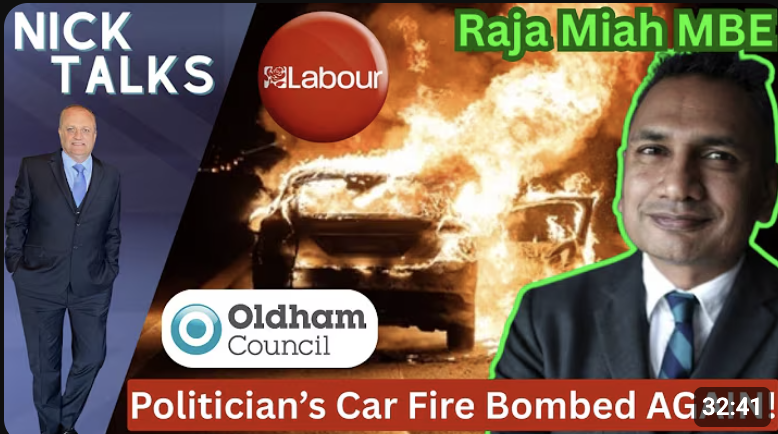
An investigation into political intimidation, institutional silence, and the collapse of local democracy in a northern English town.
When a political candidate's car is firebombed, it should stop a town in its tracks. When that same candidate's mother's house is then targeted while family members are inside, it should trigger an immediate national response.
In Oldham, it barely registered.
The police called it "a small fire in the garden." Local media looked the other way. The institutions charged with protecting democracy closed ranks.
This isn't an isolated incident. This is what rot looks like.
They've Done This Before
Several years ago, Oldham's then-council leader Arooj Shah had her car destroyed in what was widely reported as a firebombing. CCTV footage existed. The police had it. Elements of the media had access to it. No one was charged. But that outcome hardened only after I released the CCTV footage publicly.
The footage raised serious questions. Why was the vehicle reportedly left unlocked in an area known for car crime? Why did the sequence of events appear inconsistent with early reporting? Why did scrutiny lead not to clarification, but to silence?
When evidence introduces anomalies, institutions should explain them. In Oldham, the opposite happened. The case drifted into obscurity, lines of inquiry were quietly abandoned, and the story died. That precedent taught everyone watching that even arson, when politically inconvenient, can be neutralised.
Fast forward to now. Political candidate Shah Bahram, standing in St Mary's Ward, had his car firebombed. Shortly afterwards, his mother's house was targeted with family members still inside. Someone tried to set the property alight.
This wasn't symbolic damage. It was an act intended to terrorise.
Police described the incident as minor. Local media declined to lead with it. The wider political context was ignored. Yet that context matters. Shah Bahram wasn't an establishment candidate. He was contesting territory long understood locally to be under the influence of tightly-controlled political networks aligned with the Labour Party, where bloc voting, intimidation, and patronage shape outcomes more than open debate.
The message was clear. Challenge the order, face the consequences.
This only ends when we make it end. I share all my content for free. I am 100% community funded. Subscribe, share, and support me.
This Is How It Really Works
What operates in Oldham isn't conventional party politics. It's a Biradari system where power flows through family ties, bloc voting, postal vote harvesting, and fear. Much of it is documented in court records, council proceedings, and press archives, though rarely connected into a single picture.
Consider what's already public record:
- Close family links between senior political figures and individuals convicted of serious financial crime.
- Campaign activity involving people convicted of organised criminal offences, including drug trafficking.
- Political organisers previously imprisoned for kidnap and torture - sentencing records are publicly available.
These facts aren't disputed. What's disputed, or rather suppressed, is their relevance. Instead of scrutiny, those at the centre of this system receive awards, promotions, and institutional protection. Critics are marginalised. Whistle-blowers are criminalised.
The Press Won't Touch It
The Manchester Evening News and other outlets had access to footage of recent attacks. They chose not to pursue the story. Why? Because following the evidence trail leads somewhere deeply uncomfortable. It leads into council offices, party hierarchies, and the quiet accommodation of criminal influence under the banner of "community cohesion."
In Oldham, journalists have learned which stories are career-ending to pursue. Access depends on not asking certain questions. The silence is built into the system.
They Rejected Basic Standards
At a recent full council meeting, Labour introduced a motion invoking the Nolan Principles - the ethical standards expected of those in public office. On the surface, it sounded admirable. But amendments exposed the truth.
Two straightforward safeguards were proposed:
- Anyone who has served a custodial sentence for serious crime should be barred from holding public office.
- Councillors should be required to undergo enhanced DBS checks, published alongside their declarations of interest.
Both were rejected.
In Oldham, individuals convicted of dealing Class A drugs can stand for election. People with serious criminal histories can sit on committees overseeing schools, assets, and public funds. The Nolan Principles are conditional.
This isn't abstract. These people make decisions about safeguarding children and spending public money.
Follow the Money
Political control in Oldham isn't just about votes. It's about assets. Council buildings and land worth millions have been transferred to opaque "community groups" at knock-down prices. Names are withheld. Valuations are contested. Transparency is treated as an inconvenience.
Former insiders speak privately of land sold for a fraction of its worth, developments approved under dubious circumstances, and fortunes quietly accumulated. When evidence of this has been submitted to police, the response has been extraordinary - "We asked the council if anything criminal took place, and they said no."
That's not an investigation. That's institutional abdication.
If nothing criminal happened, why won't they release the records?
Violence Is Just Politics Now
In this environment, intimidation is normal. Fire bombings are minimised. Threats are downplayed. Victims are told not to escalate. Violence becomes a tool of political management, not a trigger for intervention.
Oldham increasingly resembles 1930s mob-run American cities more than a modern English borough governed by the rule of law.
It's Coming to Your Town
This matters beyond Oldham. What sets it apart isn't the severity of the problem, but that some residents refuse to stay silent. Towns with similar demographic and political arrangements face the same risks:
- bloc voting enforced through social pressure
- criminal networks laundering influence via local politics
- police reluctant to confront "community leaders,"
- media unwilling to connect obvious dots.
These systems get worse, not better. The extremists are winning.
You can't have democracy with firebombs. You can't have elections when criminals write the rules.
Oldham faces a choice many towns will soon face. Either confront corruption openly and fearlessly, or accept that elections are theatre and governance is for sale.
The law applies or it doesn't.
When institutions won't act, someone else will. When you silence the truth, it finds another way out.
The next firebomb might not miss.
I am Raja Miah. For seven years, I led a small team that exposed how politicians protected the rape gangs.
I cannot do this without you. I need you to stand with me. We’re running out of time. Without the numbers, they will win. It’s as simple as that.
🔴 Subscribe to my newsletter – it’s free. Or support the work for just 75p a week (£3/month or £30/year). Whatever you do, please subscribe;
This is the fight.This is the moment. There will not be another.
🔴 Prefer a one-off contribution?
👉 http://BuyMeACoffee.com/recusantnine
👉 http://paypal.me/RecusantNine
No corporate sponsors. No party machine. Just you and thousands of ordinary people who know what’s at stake. We’ve come this far. Help finish it.
- Raja Miah MBE