King of the Cover Ups
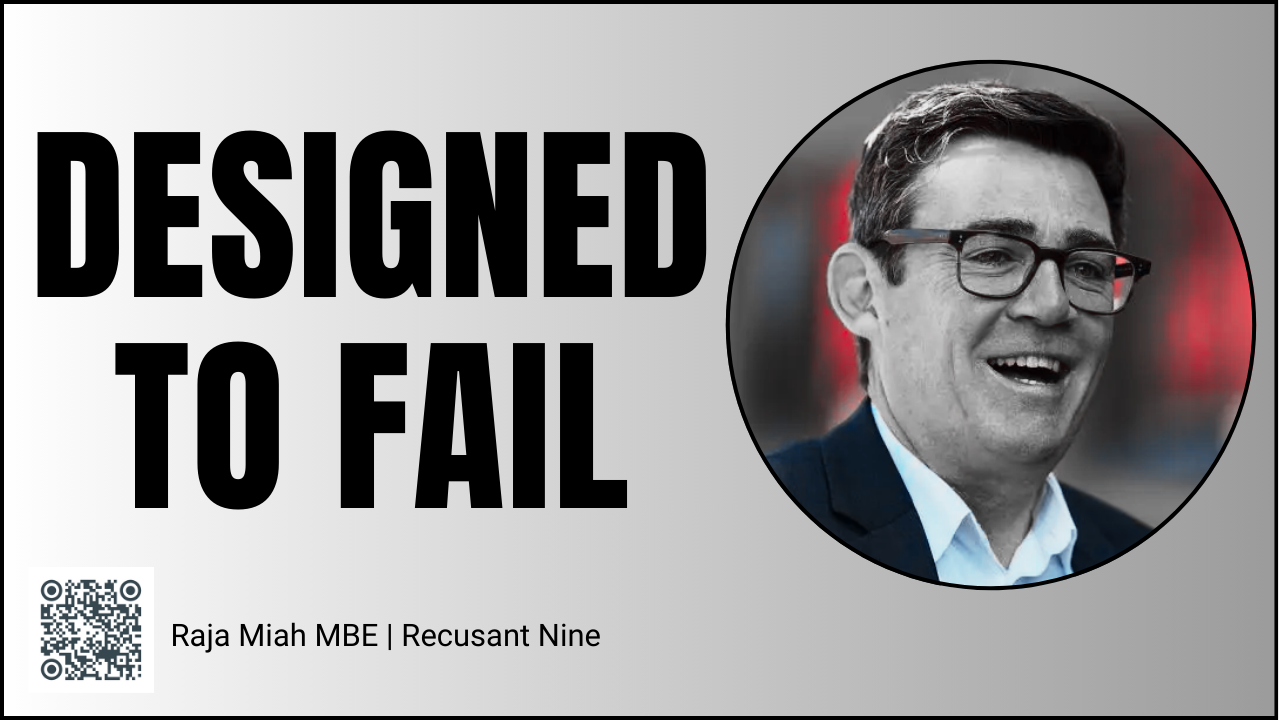
On the Design of a Response That Could Not Expose the Truth
Andy Burnham is the elected Mayor of Greater Manchester. In 2017, following the BBC documentary "The Betrayed Girls," he commissioned a series of non-statutory reviews to examine historic child sexual exploitation across his region. He rejected calls for a statutory public inquiry with legal powers to compel evidence and punish obstruction. Instead, he chose voluntary processes that took seven years to complete and relied entirely on the cooperation of the institutions under scrutiny.By the end, his own expert team had withdrawn, refusing to finish the work.
The reviews found "no evidence" of cover-ups. Reassuring, on the surface, until you read the small print and learn that Burnham’s reviews were structurally forbidden from looking for cover ups.
When, in January 2025, global attention finally forced him to acknowledge the need for compulsion, he still wanted a national inquiry limited and anchored to the same powerless reviews he had already commissioned.
This is the story of how Andy Burnham designed a response that could absorb public outrage while protecting institutional stability. Read it, watch the video, and you will understand why he smears me from behind a keyboard yet too scared to face me in public.
The Question of Design
When institutions are accused of failing children, outcomes are determined by design. Design decides whether truth is forced into the open or buried alive. A process built with power hunts evidence down and drags it into daylight. One built without it waits to be fed whatever scraps others choose to throw.
The response to historic child sexual exploitation in Greater Manchester must be judged on its architecture. Andy Burnham does not want people to do this. It exposes him as the architect of a response structured to contain exposure rather than force accountability.
The Response That Was Chosen
Andy Burnham did not respond to a scandal. He managed one. He chose exactly how allegations would be examined and what powers the process would have. Those decisions mattered more than every public statement he made afterwards.
Burnham rejected a statutory inquiry. He rejected an investigatory process with legal teeth. Instead he chose non-statutory reviews, divided into phases, dependent entirely on the goodwill of the institutions under scrutiny.
The entire process took seven years. No point of escalation was ever allowed to interrupt it. By the end, Burnham's expert team had withdrawn, refusing to complete the task they had been brought in to do.
What Burnham chose decided everything that followed. What he knew while choosing it destroys his defence completely.
The Limits That Were Built In
Non-statutory reviews carry no legal force. Nobody can be compelled to attend. Institutions cannot be forced to surrender documents. Evidence cannot be tested under oath. Silence carries no penalty. Obstruction has no consequence.
Participation is voluntary. Disclosure is selective. Where cooperation ends, investigation dies with it.
These limits were not discovered later. They formed the foundation of the entire response. From the outset, control over evidence remained exactly where it had always been with the institutions under scrutiny. Once those limits are understood, everything that follows becomes inevitable.
Manchester Operation Augusta
The first phase was presented as an independent review into historic child sexual exploitation in Manchester, including the closure of Operation Augusta. Structurally, it was neutered from birth.
Greater Manchester Police decided which documents would be disclosed. Manchester City Council chose which records would see daylight. Individuals could refuse interviews without explanation or penalty. The review team could examine only what it was permitted to see.
The process could describe failure and catalogue missed opportunities. What it could never do was force testimony, test contested accounts, name decision-makers, or punish obstruction. Responsibility was dissolved into narrative. Decisions were reframed as culture. The record closed without a single person held to account.
Rochdale
The second phase, focused on Rochdale, carried the same genetic defect. Despite known convictions and national exposure, it was fed into the same powerless framework.
The review documented harm and failure, but it was never built to establish who failed, who knew, or why warnings were buried. Exposure occurred without escalation. Failure was acknowledged without consequence.
Oldham
Oldham reveals the design in its purest form.
Added later, after sustained pressure, the Oldham Assurance Review was rigged from the outset. Concerns were repeatedly dismissed as rumours. The scope was narrower. Survivors were not interviewed. The terms of reference explicitly excluded examination of whether there had been a cover-up.
That exclusion sealed the outcome before a single interview was conducted.And even these interviews were mired in controversy as Burnham’s experts refused to take verbatim testimony and decided they would take notes on what they felt relevant.
By design, the Oldham review could confirm that abuse had occurred. It was structurally forbidden from examining who knew, whether warnings were suppressed, whether failures were deliberate, or whether information was managed to prevent scandal.
When it was later announced that there was "no evidence of a cover-up," the statement was meaningless. It was the inevitable product of a process that had been forbidden from looking.
Timing
The Oldham Assurance Review was published on 20 June 2022.
By that date, its work was complete. Its limits were fixed. Its exclusions were settled. Survivors had not been interviewed. The question of a cover-up had been formally ruled out. The conclusion that there was "no evidence" of one had already been made structurally inevitable.
For the next two and a half years, nothing changed.
Then, on 10 January 2025, two years, six months, and twenty-one days later, Andy Burnham spoke publicly about the need for a national inquiry.
"I will add my voice into this and say I do think there is the case for a limited national inquiry that draws on reviews like the one that I commissioned, and the one we have seen in Rotherham, the one we have seen in Telford, to draw out some of these national issues and compel people to give evidence who then may have charges to answer and be held to account."
That sentence destroys his defence.
Burnham acknowledges the need to "compel people to give evidence" and hold them "to account." This admission reveals that he knew compulsion was necessary for accountability. He knew voluntary cooperation was insufficient. He knew the reviews he commissioned could not deliver justice.
Yet he chose voluntary processes anyway, knew they had failed, and then waited over 2 ½ years later before speaking up.
The timeline is devastating for a man that wants to be Prime Minister. Burnham commissioned his series of reviews in 2017, following the BBC documentary "The Betrayed Girls," which highlighted repeated failures to protect children in the region. By 2017, the scale of institutional failure was already documented and broadcast nationally.
If compulsion was necessary in January 2025, it was necessary in 2017 when he first commissioned the reviews. If it was necessary in January 2025, it was certainly necessary by June 2022, before Oldham was allowed to exclude the question of a cover-up altogether.
Andy Burnham had eight years to choose compulsion. He rejected it every time.
And when Elon Musk blew the lid off, even then, he only wanted limited inquiry that would "draw on" the same toothless reviews he had already commissioned.
Even under maximum pressure, with global attention focused on grooming gang cover-ups, Burnham was still trying to contain the response rather than allowing full accountability.
Time here was not neutral. Time completed the design.
My work is free because the truth must circulate. But truth without numbers is easy to crush. The government does not fear facts. It fears scale.
Please subscribe to my newsletter or upgrade to a paid subscription if you can afford to do so. Every subscriber is a number they can’t erase. Every paid supporter allows me to continue doing the work no one else can.
The Scope That Was Excluded
Terms of reference are the boundaries of truth. In each phase, the most lethal questions were ruled inadmissible before investigation began.
The Manchester review was forbidden from examining who made the decision to close Operation Augusta and why. It could not investigate whether senior officers suppressed intelligence about organised abuse networks. Political pressure on operational decisions was off limits.
The Rochdale review could document that children were failed but could not examine whether council leaders knew warnings were being ignored. Electoral considerations influencing responses to reports of abuse by men from specific communities could not be investigated.
The Oldham review was explicitly banned from investigating whether there had been a cover-up. Documents destroyed or hidden, witnesses intimidated or silenced, senior figures conspiring to suppress evidence or mislead the public. All of this was inadmissible.
These exclusions were surgical removals of the questions that would have destroyed careers and reputations. Who knew what and when. Deliberate decisions to ignore, suppress, or distort evidence. Whether institutional failure crossed into criminal misconduct.
By excluding those questions, the process guaranteed they could never be answered. Investigations could acknowledge that children suffered but never establish who was responsible for ensuring that suffering continued. They could identify systemic failures but never name the individuals who created and maintained those systems.
Absence of evidence became evidence of absence. Silence became exoneration. Burnham built protection into the architecture.
The Consequences of Voluntary Cooperation
Where cooperation is voluntary, institutions retain absolute control. They decide who speaks and what gets shared. Resistance becomes manageable instead of explosive. When someone refuses to cooperate, it gets noted politely and forgotten quickly.
Voluntary cooperation meant that Greater Manchester Police could choose which officers would be interviewed. They could decide which documents were relevant and which were lost or mislaid. Senior officers who made the most contentious decisions could simply decline to participate. There was no mechanism to compel them.
Manchester City Council operated under the same protection. Council leaders who had received warnings about abuse networks could refuse interviews without consequence. Documents that might reveal political calculations behind operational failures could be withheld without penalty.
Individual social workers and police officers who had raised concerns, and if brave enough to risk destroying their careers, could be interviewed, but their superiors who had ignored or suppressed those concerns remained beyond reach. The people with the most dangerous knowledge about institutional failure had the power to withhold their cooperation.
When cooperation was refused, the reviews recorded this diplomatically. The public was never told the scale of non-cooperation. They were never shown how many critical witnesses had refused to speak or how much vital evidence had been withheld.
Nobody kept a public record of who refused interviews. The public was never told when institutions blocked access to documents or declined to answer questions. Burnham's structure had no means to confront resistance, so resistance all but vanished from the narrative.
Under statutory inquiries with legal powers, refusal to cooperate becomes a public scandal. Witnesses who decline to attend face legal consequences. Obstruction becomes more damaging than cooperation.
Burnham ensured the opposite outcome. He created a system where the most culpable individuals faced the least risk. The most dangerous evidence could be suppressed without penalty. Institutional protection was guaranteed by design.
Does anyone really believe Burnham designed this outcome by accident?
Alternatives That Were Available
Real options existed at every stage.
Burnham could have demanded a statutory public inquiry. As an elected Mayor with national profile and ministerial experience, such a demand would have created immediate political pressure.
He chose otherwise.
Even without statutory powers, he could have imposed a stronger investigatory model. He could have made cooperation mandatory through governance arrangements. He could have made participation a condition of confidence in senior officials.
He did not.
He could have ordered immediate preservation of records across councils and police forces as basic safeguarding discipline. He could have treated failure to comply as gross misconduct.
He chose otherwise.
He could have prevented the accused from shaping their own scrutiny. He could have ensured that survivors and whistleblowers defined the questions that mattered.
He refused.
These were rejected choices, not unavailable options.
Why Reviews Were Sufficient
Reviews serve a specific purpose. They allow politicians to appear serious about accountability while avoiding its consequences.
Reviews can acknowledge that children were harmed without naming who harmed them. They can identify institutional failures without holding individuals responsible. They can catalogue missed opportunities without examining why those opportunities were deliberately missed.
Reviews produce reports that look comprehensive but lack the power to compel truth. They create the impression of thorough investigation while ensuring that the most dangerous questions remain unasked. They satisfy public demand for action while protecting those who should face consequences.
For politicians facing scandal, reviews offer perfect cover. They demonstrate concern while buying time. They create the appearance of accountability while ensuring that accountability never arrives.
Burnham understood this perfectly. He knew that a statutory inquiry would have legal powers to compel witnesses and force disclosure of documents. He knew it could expose decision-makers and test their accounts under oath. He knew it could destroy careers.
So he chose reviews instead. Reviews that would rely on voluntary cooperation from the institutions under scrutiny. Reviews that would exclude examination of cover-ups. Reviews that would document failure without identifying who was responsible.
By choosing reviews over inquiries, Burnham could absorb public outrage while preserving institutional stability. He could acknowledge harm while ensuring that responsibility never hardened into consequence.
Burnham engineered this outcome with surgical precision. He knew exactly what reviews could deliver and what they could not. He chose them for their limitations.
Process and Protection
Modern cover-ups require no conspiracy. They require only process.
The genius of Burnham's approach was its respectability. No documents were shredded in midnight raids. No whistleblowers were threatened. Instead, a process was created that could examine everything while revealing nothing.
Processes that cannot compel evidence allow those with secrets to withhold them legally. Voluntary participation means that silence becomes a perfectly legitimate strategy. Restricted scope renders the most dangerous truths inadmissible from the start.
Institutions protect themselves in the modern era through sophisticated processes that manage exposure while appearing transparent. Not through crude cover-ups that risk exposure.
Burnham's reviews could investigate for years without threatening anyone who mattered. Senior police officers who made catastrophic decisions could decline interviews. Council leaders who ignored warnings could refuse to participate. Politicians who prioritised reputation over child safety could remain silent.
The process itself became the protection. Every refusal to cooperate was noted respectfully. Every withheld document was acknowledged diplomatically. Every excluded question was justified procedurally.
By the end, the process had examined thousands of pages of evidence and conducted hundreds of interviews. It looked thorough and comprehensive. It seemed serious.
But the people with the most dangerous knowledge had never been compelled to share it. The documents that would have exposed the worst decisions had never been forced into the open. The questions that would have destroyed careers had been ruled inadmissible from the beginning.
The process had protected everyone it was supposed to investigate. It had done so while maintaining complete respectability. No laws had been broken. No procedures had been violated.
Burnham had created a mechanism that could absorb any amount of public pressure while delivering the minimum possible accountability. The process was the cover-up.
Burnham and Hillsborough
Andy Burnham built his political reputation exposing exactly these tactics. The Hillsborough campaign revealed how non-statutory reviews, limited scopes, and voluntary cooperation were weaponised to delay truth, deflect blame, and exhaust families.
He knows how accountability is denied. He knows how evidence is buried, how time is used as a weapon, and how processes can be deployed to manage exposure.
Most importantly, he knows the difference between a response designed to reveal the truth and one designed to bury it.
The Question of Intent
Given that knowledge, ignorance is not available as a defence.
When Burnham chose reviews over inquiries, the outcome was guaranteed. Knowing what he knows, it was inevitable. When he finally spoke of compulsion, it was safely displaced into the future and safely anchored to the limits of the past.
This was a deliberate choice. It was not an accident.
Manchester, Rochdale, and Oldham were outcomes of design, not failures of execution.
The response absorbed public outrage, preserved institutional stability, and closed down the most dangerous lines of inquiry while maintaining the appearance of responsibility. It acknowledged harm while ensuring that responsibility never hardened into consequence.
Burnham created a process without power. Structure without consequence. Accountability in name only.
Once this is understood, the pattern becomes unavoidable. Claims of "no evidence" follow naturally from a process that was never empowered to look. Assertions of improvement sit comfortably alongside unanswered questions about who failed children and why.
What was delivered was containment masquerading as investigation. And it worked. Until it didn’t. Which is why he is now attempting to rewrite history whilst hiding behind his keyboard calling me names.
I’m Raja Miah. For seven years, I led a small team that exposed how politicians protected the rape gangs. Before that, I spent over a decade safeguarding children and protecting communities from extremists.
My work is free because the truth must circulate. But truth without numbers is easy to crush. The government does not fear facts. It fears scale.
🔴 Subscribe to the newsletter. It’s free. Every subscriber is a number they can’t erase. Every reader widens the circle they can’t control.
If you can afford it, please support for 75p a week (£3/month or £30/year). Not for perks. Not for access. But because numbers with backing become power. A few supporters can be ignored. Thousands cannot.
This is how this campaign survive. This is how we see this through. This is how voices like ours stops being managed and starts being feared.
🔴 Prefer a one-off contribution?
👉 http://BuyMeACoffee.com/recusantnine
👉 http://paypal.me/RecusantNine
No sponsors. No parties. No institutions to lean on. Just numbers. Growing fast enough that covering this up becomes impossible.
We don’t need everyone. We need you.
– Raja Miah MBE