IS REFORM TOO SCARED TO BE CALLED RACIST?
Zia Yusuf pointed at Somalia and stopped. Jenrick changed the argument. Farage stayed away.
On 2 September Zia Yusuf, Reform UK's Home Affairs spokesman, told 650,000 people that Labour's likely candidate in Holborn was born in Somalia and asked them whether they understood what was happening. He offered no criticism of Sagal Abdi-Wali's record, her council, or a single position she holds. Her birthplace was the whole of the post.
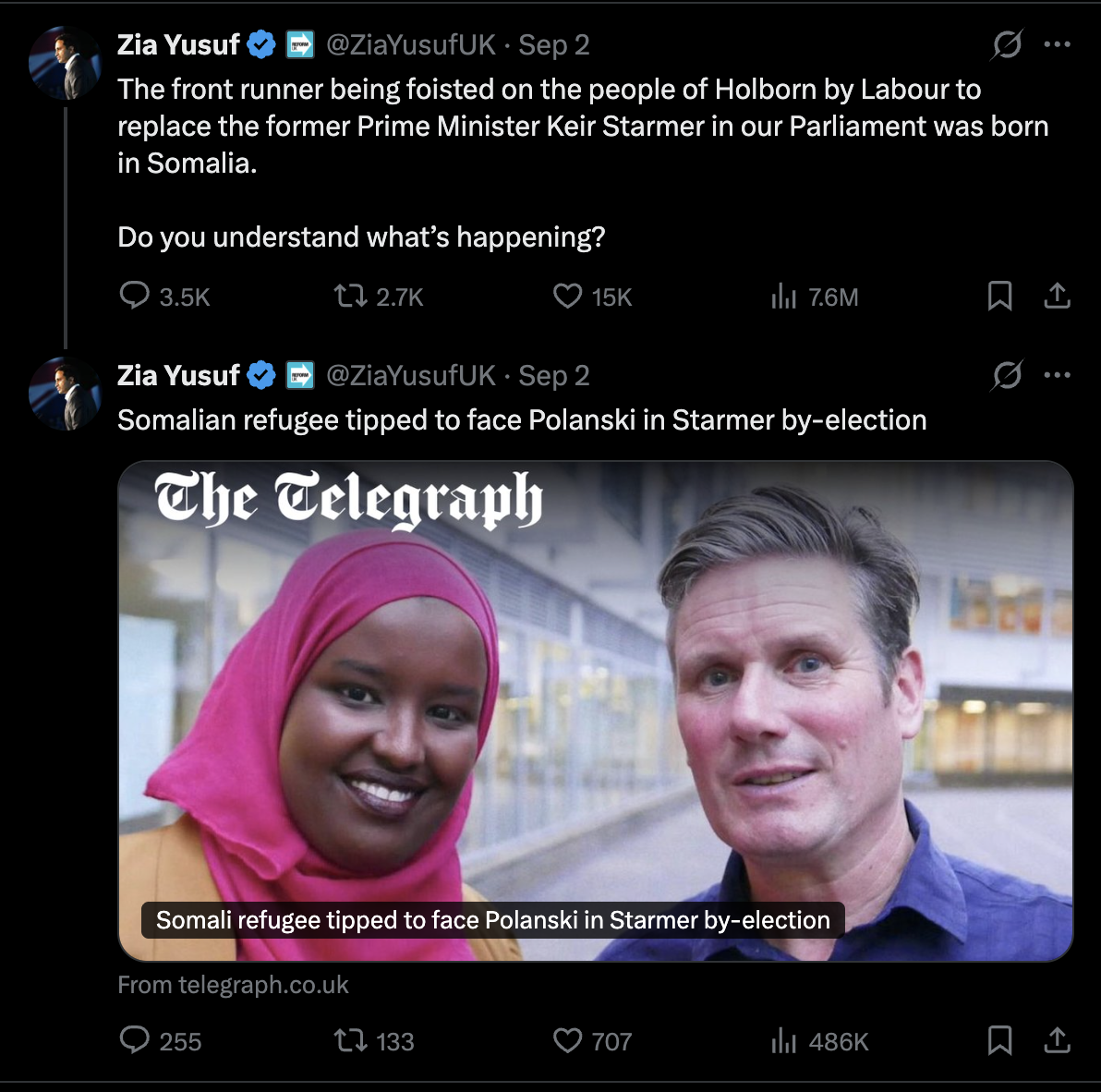
The reply came within hours and it did not come from the left alone. Dan Hodges called it simply racism, with no other word for it. Ed Davey called it racism from the Trump playbook. A Labour councillor called it disgraceful. A broadcaster pointed out that Boris Johnson was born in New York and Kemi Badenoch grew up in Nigeria. One reply took his question literally and told him what was happening: a British citizen was being selected by a party to stand in an election, which is how a parliamentary democracy works.
Then came the defence, and it is the more revealing half. On 3 September Robert Jenrick, who left the Conservatives for Reform, was asked on LBC whether the post was racist and said no. Asked what it meant, he did not mention birthplace once. He said Yusuf was asking whether she would always put this country first. He said he did not know the woman from Adam. Asked whether a refugee could put Britain first, he said not necessarily, which is the closest anyone in Reform has come to answering the question, and it was not Yusuf who said it. So Jenrick defended the post by replacing it. Yusuf's test was where she was born. Jenrick's was whether she loves the country, which is a question about what she does and says, and which Boris Johnson and Kemi Badenoch and Zia Yusuf all have to answer too. That is not a defence of the post. It is a different post.
'Do you think someone who is a refugee can't put Britain first?'
— LBC (@LBC) September 3, 2026
@NatashaC presses Reform’s Robert Jenrick for answers over Zia Yusuf’s tweet about a Somali-born Labour council leader. pic.twitter.com/1Yz08hSK4S
Nigel Farage said nothing. He had slapped Yusuf down in public three weeks earlier for calling Ben Wallace a traitor, and Yusuf had refused to take that tweet down. Reform insiders told reporters at the party's conference on 4 September that Farage would part with Yusuf before long, and that the Somalia post was one of the reasons.
 Rowena Mason and Pippa Crerar and Ben Quinn
I have found no word from Danny Kruger. The man who wrote Reform's only rule on the subject five days earlier appears to have nothing to add to it.
None of them would say it because all of them are frightened of the same word.
- Yusuf wanted the reaction a rule gets without the risk a rule carries, so he posted a birthplace and let people finish it for him.
- Jenrick would not defend the rule because he could not say what it was without being called racist, so he made up a safer one.
- Farage would not go near it at all.
Reform wants to be the party that says the unsayable, and when the moment came its Home Affairs spokesman said half of it and hid, its senior defector changed the subject, and its leader looked at his shoes.
That left me with a question I know how to answer. I stopped listening to what politicians implied and read the documents. I went to the legislation, the manifestos, the amendments, the candidate selections and the constitutions.
The right to vote and the right to govern, which in law is the right to stand, are two different rights, and every party and every country I looked at draws a line for each.
I went through the main parties in Britain, two Commonwealth countries whose citizens can vote here, and the United States, which has written a birth test for its presidency into its constitution. I found every rule I looked for except the one Yusef implied.
The Somalian refugee passes every British rule for both rights, she passes the hardest foreign rules on one condition, and nothing stops her from standing until she reaches the rule I happily define.
THE GREENS HAVE A RULE. I THINK IT IS WRONG.
The Green Party's written policy is that anyone lawfully living in Britain should vote in every election and referendum, and should be able to stand in every one of them.
Not citizens but residents.
The same document says the party's long-term aim is to abolish the concept of British nationality altogether and base every right on where a person lives.
Scotland already does it, for both rights. Since 2020 any foreign national with any form of leave to remain has voted for Holyrood and for Scottish councils, and under the 2025 Act any foreign national with any form of leave can stand for both. Wales lets the same people vote for the Senedd and its councils, and lets those with indefinite leave stand for both. A student on a two-year visa in Glasgow can be elected to the Scottish Parliament. The same student in Cardiff can vote for the Senedd but not sit in it.
My position is clear. I think this position is wrong. But the Greens have it as their policy, Scotland put it into law, and under it Sagal Abdi-Wali votes and stands. So does everyone else who lives here.
LABOUR ONCE WANTED RESIDENCE TO BE ENOUGH
In 2019 Labour promised the vote to all UK residents, whatever passport they held, and Starmer promised it to settled EU citizens when he ran for leader in 2020. Neither promise said a word about standing. In office Labour did neither.
The Representation of the People Bill it introduced in February 2026 lowers the voting age to 16 and changes nothing about who may vote by nationality and nothing about who may stand. So Labour's rule, for both rights, is the law as it stands. Abdi-Wali votes and stands under it.
BRITAIN ALREADY LETS NON-CITIZENS VOTE AND HOLD OFFICE
When voting for Parliament, you need
- a British, Irish or Commonwealth passport
- and if you need leave to be here, any form of leave will do
A student from India on a six-month course votes. A care worker from Nigeria on a two-year visa votes. An Australian on a working holiday votes. Universities run stalls telling them. About two and a half million people from Commonwealth countries live here without British citizenship and about one million seven hundred thousand of them are on the voters register.
When standing for Parliament or for a council in England you need
- a British, Irish or Commonwealth passport,
- and if you need leave to be here it must be indefinite leave.
A Commonwealth citizen can sit in the Commons or on a council without ever taking the oath of citizenship. That is how Reform came to select a Bangladeshi national in Portsmouth. Abdi-Wali is a British citizen. She votes and she stands under the law as it stands.
THE CONSERVATIVES HAD FOURTEEN YEARS TO CHANGE IT. THEY DIDN'T.
The Conservatives governed for fourteen years with those rules and none of their five prime ministers changed either of them for Commonwealth citizens. The one thing they did, in 2022, was deal with EU citizens after Brexit. Those already resident before the end of the transition period kept their local rights. For those arriving after it, the Conservatives introduced reciprocal local voting and candidacy rights where Britain had an arrangement: if your country gives British residents those local rights, your citizens receive them here. It applies to local elections only, not to Parliament.
In opposition they say citizenship rights begin at 18. They have never said the right to vote or the right to stand should require citizenship. Abdi-Wali votes and stands under the Conservatives' rule.
REFORM WROTE ITS RULE FIVE DAYS BEFORE YUSUF'S POST. SHE PASSES IT.
On 28 August 2026 Reform published what it calls its Election Integrity Bill, and Danny Kruger tabled its provisions as amendments to Labour's Representation of the People Bill. The amendment that matters here ends the Commonwealth franchise and restricts the vote in parliamentary and local elections to British and Irish citizens, because, Kruger said, elections are being fought on ethnic and sectarian grounds and the vote should be conditional on membership of the British nation.
Reform's threshold for voting is citizenship. Sagal Abdi-Wali is a British citizen. Whatever Yusuf was telling his readers to notice on 2 September, it was not the rule his own party had tabled five days earlier.
The amendments say nothing about who may stand. Reform has no written rule on candidates. So I did what I have learned to do whenever a politician's words become slippery. I stopped listening to the explanation and checked the record. If foreign birth were a bar, Reform would not have recruited Nadhim Zahawi, born in Baghdad, at a press conference in January 2026. If foreign birth were a bar to holding office, Reform would not have elected Joshua Kim, born in South Korea, and Cristiana Emsley, born in Romania, to the Senedd in May 2026. If citizenship itself were the bar, Reform's Portsmouth branch would not in December 2025 have selected Addy Mo Asaduzzaman, a Bangladeshi national with indefinite leave to remain and no British citizenship, for a council seat, and then defended him when its own supporters objected.
So for standing, Reform's rule by conduct is the law as it stands. No bar on the foreign-born, no bar on immigrants, and by its own selection no bar on non-citizens. Abdi-Wali votes under Reform's written rule and stands under Reform's practice.
RESTORE GOES FURTHER. SOMALIAN REFUGEES PASS THAT TOO.
Restore Britain's written rule is that no foreign national may vote or stand in a British election. For voting it is Reform's rule, except that Restore's wording would take the vote from Irish citizens as well. For standing it is stricter than Reform, because Reform has no candidate rule and Restore's is citizenship. It would have stopped Asaduzzaman. Whatever Rupert Lowe says on a platform, the written rule I can examine stops at citizenship for both rights, and Abdi-Wali has it. She votes and stands under Restore's rule.
PAKISTAN AND AUSTRALIA DRAW THE LINE AT DUAL NATIONALITY
Australia lets only citizens vote, apart from a dwindling number of British subjects who were on the roll before 1984. A dual national votes. To sit in its federal Parliament you must be an Australian citizen and cannot remain a citizen of a foreign power. In 2017 and 2018 that rule, section 44 of its constitution, removed fifteen MPs and senators, including the Deputy Prime Minister, who held New Zealand citizenship through his father and did not know it. Half of Australia's population was born abroad or born to parents who were, and a majority backed the rule while it was throwing their politicians out.
In Pakistan, Article 63 of its constitution disqualifies from the National Assembly, the Senate and every provincial assembly anyone who has acquired the citizenship of a foreign state.
In 2012 its Supreme Court removed eleven sitting parliamentarians for holding foreign citizenship, most of them British. Every candidate swears on oath that he holds no other nationality. Bangladesh has the same clause in its constitution. India does not permit dual citizenship at all.
I do not need a hypothetical for this. I have Oldham. A man born in Mirpur, holding Pakistani and British citizenship, can vote for Parliament here, can stand for it, and can sit on Oldham council. In Pakistan he can vote and he cannot sit in the Punjab Assembly without giving up his British citizenship first. Pakistan trusts him less with its legislature than Britain does with ours. I don't see anyone calling Pakistan racist.
Both rules have thrown out a deputy prime minister and sitting members by the dozen. Both are written down and apply to everyone, and neither is about birthplace. Both turn on a fact Yusuf never mentioned, which is whether a candidate holds another citizenship. A British citizen born in Somalia votes under both and, if she holds no second citizenship, may sit under both.
AMERICA RESERVES ONE OFFICE FOR CITIZENS FROM BIRTH
For federal elections the United States restricts the vote to citizens. For holding office it goes one step further than Australia and Pakistan, for one job. A naturalised American can sit in Congress, become a governor and serve on the Supreme Court. But the presidency is closed to him.
Only a natural-born citizen can be President.
That is a citizenship-from-birth test, written into the Constitution. The British equivalent would be a citizen born abroad who can sit in Parliament but never in Downing Street, and no British party has proposed even that.
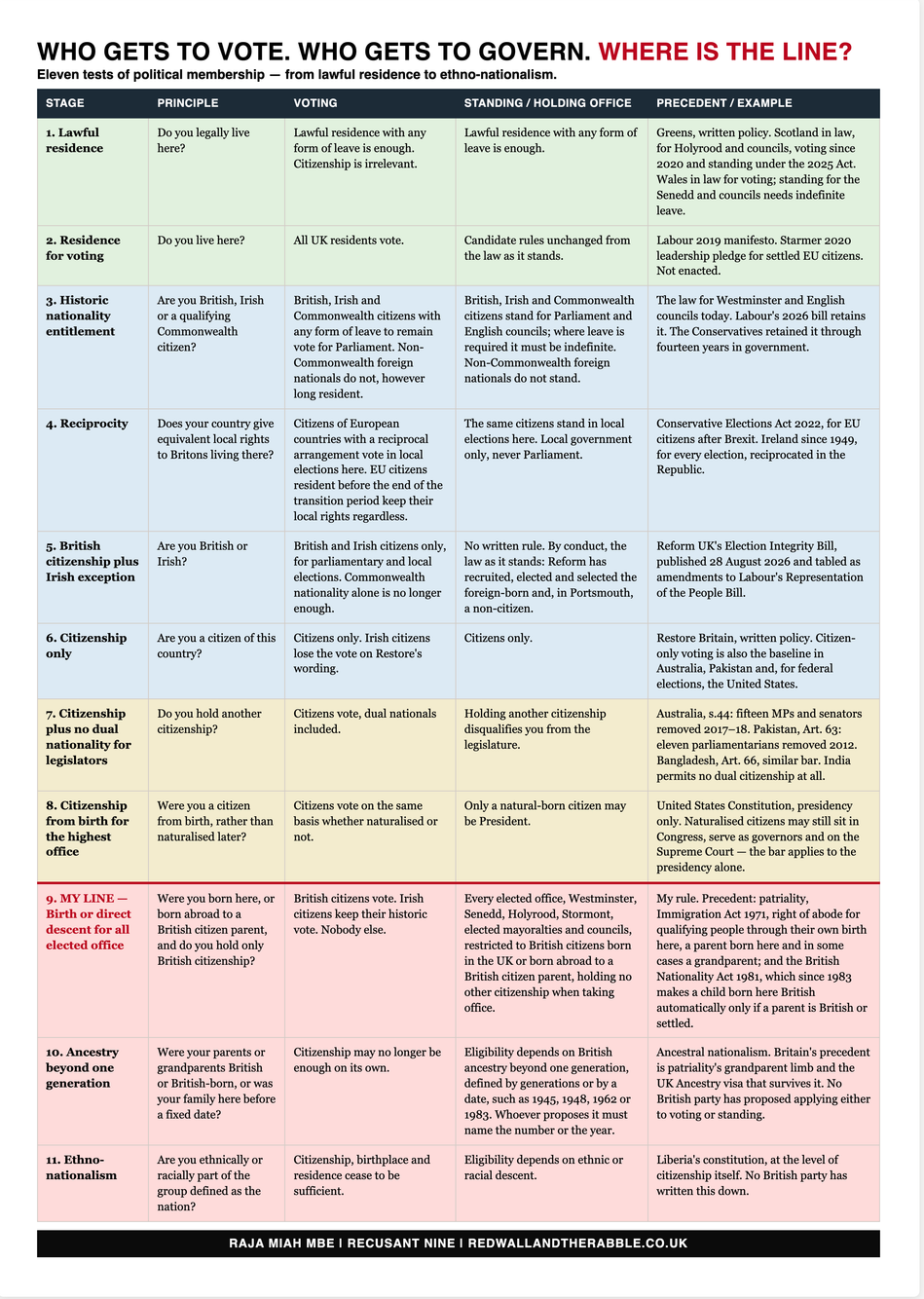
FROM RESIDENCE TO RACE: ELEVEN PLACES TO DRAW THE LINE
Here is the whole scale on one page. Eleven positions, from letting anyone who lives here govern to letting nobody govern whose blood is wrong. The red line is mine. No one else has done this work. Why?
Over 10,000 of you will read what I publish for free every day.
That matters to me. I want this investigation to reach far beyond the people who can afford to pay. But producing thirty parts across twenty-eight days takes time, research, interviews, documents and complete independence from the institutions I am investigating.
That independence is funded by paid subscribers. Only a handful of readers upgraded yesterday. That is not enough to sustain work on this scale.
I am not asking those who cannot afford it. Keep reading. Keep sharing. Help this reach the people who need to see it. But if you read this publication every day, value the work and can afford to support it, please support me.
I TRIED TO PUT ZIA YUSUF ON THE SCALE. I COULDN'T.
Every British rule I can find lets a Somailan refugee vote and lets her stand. The two hardest rules abroad let her vote and turn her right to sit on dual nationality, not birthplace. The one country with a birth test applies it to a single office. Yusuf has never said which of these he meant.
- Is it that she is a foreign national? She is not.
- Is it that she will not put Britain first, as Jenrick suggested on his behalf? Then that is a test of conduct, and Yusuf gave us no conduct.
- Is it that she was born abroad? His party has no such rule for candidates and many of Reform's own elected representatives were born abroad.
- Is it that she is naturalised rather than born British? Then how many years of citizenship does he want before a person may stand? Ten? Twenty? He has not said.
- Is it that she might hold a second citizenship? He has not asked, and it would be a fair rule, and Pakistan applies it. Is it that only citizens from birth should sit in Parliament, as America asks of its President? Then he should say that, and explain it to Zahawi.
- Is it that a British parent is required? Then he should say that too, and explain it to himself, because his parents were born in Sri Lanka.
- Is it that she is a Muslim? He is one.
- Is birthplace itself the test? Then he should say which birthplaces disqualify a British citizen from standing, and why, and he should be ready to say it to the face of every voter in Holborn who was born abroad.
Every one of those can be written down and argued with. He has chosen none of them. He gave people a birthplace and a question, and I do not know what he meant by it, and that is the whole problem. A rule, however bad or hard or unjust, can be challenged. A hint cannot, because it has no boundaries, no hard cases, and no application to the man who made it.
FINE. I WILL DRAW MY OWN LINE.
My rule on who governs is harder than Reform's, which has none. It is harder than Restore's written rule. It goes past Australia and Pakistan, and it takes what America asks of one office and asks it of every elected office in the country. It may well exclude the woman Yusuf pointed at. He will not say where his line is. I will.
And it is not new. Britain has drawn lines of birth and descent in statute twice in living memory.
- In 1971 Parliament wrote patriality into the Immigration Act, giving the right of abode to qualifying people whose connection to Britain could run through their own birth here, a parent and, in some circumstances, a grandparent. The original patriality scheme was recast by the British Nationality Act 1981, but the principle of privileged entry through ancestry survives elsewhere. The UK Ancestry route still allows qualifying Commonwealth citizens with a grandparent born in the UK to come here for five years to live and work, without requiring them to have a job already lined up.
- In 1981 Parliament went further and ended citizenship by birth alone, so that since 1 January 1983 a child born on British soil is British automatically only if a parent is already British or settled here.
Both Acts were attacked as discriminatory when they passed, and both stood. My rule takes the birth-and-parentage test Parliament has used for the automatic citizenship of children born here since 1983 and applies a version of it to who may hold elected office. I am asking that a test this country already applies to its children be applied to the people who make its laws.
Who Votes:
British citizens, and Irish citizens under the arrangement that has stood since 1949. Nobody else. Not a Commonwealth citizen on a visa, not a European under a reciprocal deal, not anyone with leave to remain who has not taken citizenship. Reform's amendment to end the Commonwealth franchise would do exactly that, and I support it. On the vote, Reform and I are in the same place.
Who Governs,
In any elected office in Britain;
- British citizens born in the United Kingdom
- and British citizens born abroad to at least one parent who was a British citizen at the time
That means Parliament, the Senedd, Holyrood, Stormont, every elected mayoralty and every council. And when they take the seat they hold one citizenship, and it is ours. If you hold another, you give it up before you sit, which is what Pakistan and Australia already ask.
For voting, citizenship. For holding office, citizenship, birth here or one generation of direct descent, and one citizenship only. Not race, not religion, not surname, and not whether Rupert Lowe likes the look of you. Belonging is not DNA. A child born in Camden to a British citizen from Somalia is as British as any child born in Kent, and has been since 1983.
A passport makes you a British citizen with the rights that follow from it, and the vote is one of them. It does not, on its own, make you one of the people who should govern this country. Being born here does, or being born to someone who was does.
MY RULE EXCLUDES PEOPLE I WOULD DEFEND
Before I ask anyone else to live under my rule, I have to try to break it myself. So here is who it catches, starting with the people it hurts, because that is the part Yusuf would not do.
It very probably catches Sagal Abdi-Wali. She was born in Somalia and arrived as a refugee. Whether either of her parents held British citizenship at the time has not been reported and I do not know it. If neither did, then under my rule she votes in every election and holds office in none, not on Camden council and not in Parliament. My rule can be checked against the facts. Yusuf's insinuation cannot be checked against anything, because he has not given us one.
It catches Nadhim Zahawi, born in Baghdad, and Joshua Kim and Cristiana Emsley, born in South Korea and Romania. They vote and they do not sit. Asaduzzaman fails both tests, because under my rule he neither votes nor stands.
It catches anyone born in Mirpur or Sylhet or Lagos or Warsaw who came here as an adult, took citizenship and wants a seat. They vote. They cannot stand. It catches the councillor born in Oldham who holds Pakistani citizenship. He votes, he passes the birth test, and he does not take his seat until he has given the second citizenship up.
And here is the case designed to make me abandon it. A person brought into Britain as a baby, naturalised at five, resident for sixty years, would under my rule vote in every election and never hold office in one. That is severe. I hold it anyway, because a clear rule stated once and applied to everyone is better than no rule and a birthplace kept back for use against the other side's candidate. I have looked for the person who makes my rule hardest to defend.
THE BEST TEST OF MY RULE IS WHETHER IT PROTECTS MY ENEMIES
It protects Zia Yusuf, born in Bellshill, and Laila Cunningham, born in Paddington. Both vote and both may stand. It protects any of Zahawi's, Abdi-Wali's or Kim's children who are born here. It protects every Bangladeshi child born in Tower Hamlets and every Pakistani child born in Oldham who holds one citizenship.
And it protects the people I have spent years fighting. Most of the councillors I have exposed in Oldham were born here. The cartels do not run on immigrants. They run on second and third generation men, born in this country, who choose candidates by clan and village and deliver the bloc to Labour. My birth rule does not touch one of them, and it should not, because I have never needed to hint at where anyone came from. When I accuse a man in Oldham, I say what I accuse him of. The postal votes I say he harvested. The biraderi I say he organised. The office I say he abused. The children I say he failed. I do not need his birthplace because I have his conduct, and I put my name to it.
BEYOND MY LINE LIES ANCESTRY. THEN RACE.
There are two stages beyond mine, and both can be written down. The first is ancestry. One generation is no longer enough and the test for holding office reaches back to parents, grandparents or beyond. It can be written as generations, or it can be written as a date: your family was here, or was British, before 1945, or 1948, or 1962, or 1983, when citizenship by birth on British soil alone came to an end.
Britain has done this too. Patriality in 1971 reached to the grandparent, and the Ancestry visa still does. Whoever proposes it for voting or holding office has to name the number or the year, and then defend it. Nobody has.
The final stage is ethnic nationalism. Citizenship, birthplace and generations of legal belonging are no longer enough for voting or for holding office. Ethnic or racial descent itself becomes the test. Nazi Germany wrote that principle into law in 1935. The Reich Citizenship Law reserved full citizenship and political rights for people of “German or related blood”, and the Nuremberg Laws used ancestry, including a person's grandparents, to determine who was Jewish and therefore excluded.
Liberia has a racial qualification in its constitution today, at the level of who may be a citizen at all. This is the final line. Not where you were born, not what citizenship you hold, and not how many generations your family has belonged to the country, but what race you are.
None of the political parties fighting it out in Britain has written this down either.
I HAVE FINISHED MY SENTENCE. ZIA YUSUF CAN FINISH HIS.
I have done what Reform will not. I drew the line. I tested it against Labour. I tested it against Restore. I tested it against the people I have spent years fighting. I found the case that makes my own rule hardest to defend and I published that too. You can call my rule wrong, or harsh, or discriminatory, and you can call me a racist for it, and some of you will. You can campaign against it, defeat it at an election, or take apart every premise underneath it.
Zia Yusuf did something easier. He did not tell people that Sagal Abdi-Wali was ineligible because she was not British, because she is British. He did not tell them that Reform opposes foreign-born candidates, because it does not. He did not tell them that naturalised citizens should be barred from Parliament, because Reform has proposed no such thing. He did not tell them that dual nationals should be barred, and he did not establish that she is one. He did not tell them that candidates must have a British parent, and he did not tell them that candidates must be British-born. He gave them one word.
Somalia.
Then he asked them whether they understood.
I went through the law, the parties, the candidates and the constitutions trying to find the rule behind his post, and I could not find it. So finish the sentence, Zia. And to my friends in Reform. Tell us the rule and put your name to it. I have put mine to mine.
Just what do you disagree with?
Let's have it. Or is it as I suspect, when it really comes down to it, you are too scared to be called racist and no different to the social workers that looked the other way whilst children were being gang raped?
For eight years I have exposed how politicians, police and public bodies failed working class White girls who were systematically raped by Pakistani grooming gangs. Together, with the support of the people of Oldham, we forced the Government to concede a National Statutory Inquiry after years of resistance.

Now the harder fight begins.
Andy Burnham is no longer the Mayor of Greater Manchester. He is the Prime Minister. That does not place him beyond scrutiny. If anything, it makes scrutiny more important than ever.
As Mayor, Burnham commissioned a series of Assurance Reviews across Greater Manchester, including one in my hometown of Oldham. They were presented as a search for the truth. They were nothing of the sort. They were cover ups of cover ups that allowed those responsible to escape proper accountability.
Don't take my word for it. Even former Greater Manchester Police detective Maggie Oliver has described what happened in Oldham as 'nothing short of a cover up'.
Despite every effort to stop us, we forced a National Inquiry. Now Burnham and others are attempting to rewrite the history of what happened under their watch.
At present, the inquiry has made no commitment to examine Burnham's own role or the decisions taken during his time as Mayor. That must change before the Oldham investigations begin.
The pressure to protect a serving Prime Minister will be immense. The institutions that failed these girls will have every incentive to avoid putting the country's most powerful politician under oath. Much of the media will once again find reasons to look the other way.
That is why this campaign cannot slow down now.
For too long this has been a one man operation. It needs to become something much bigger. We need the resources to build a genuinely independent investigative organisation with:
- A professional website capable of reaching far larger audiences.
- Video production that takes our investigations to millions more people.
- Research support so no lead is left unexplored.
- Live events to educate, organise and train others.
- The resources to investigate, travel and expose institutional failure wherever it is found.
Over the last six weeks we have secured over 800 paid supporters towards our target of 2,000. That is an incredible achievement. Every new supporter strengthens this campaign, increases our voice and makes it harder for those in power to ignore the evidence.
If you believe the truth should be followed wherever it leads, please stand with us.
If you cannot afford the £3 a month or £30 for the full year, just sign up for free. There are no paywalls to access any of my work. I publish everything for free.
If you can’t commit to a regular subscription, a one-off contribution genuinely helps keep this alive. You can support me using one of these links;
👉 http://BuyMeACoffee.com/recusantnine
👉 http://paypal.me/RecusantNine
Should we succeed, politicians will go to prison. Even if there is only the smallest chance of this happening, isn't it worth your support?
Raja Miah MBE