BRITAIN ALREADY HAS THE LAW TO HUNT ALL THE MEN INVOLVED IN THE RAPE GANGS. IT ONLY USES IT ON TERRORISTS.

Britain says it cannot reach the men behind the rape gangs unless it proves what each one did. That is not how its terrorism law works. There, belonging is enough.

PART 3.
Twenty-five men were charged over the rape and sexual exploitation of one Halifax schoolgirl. They came from seven towns across three counties and from Newport in Gwent, over a child who never left West Yorkshire.
Part 1 set out what sits behind that charge sheet. Greater Manchester Police identified ninety-seven people and sorted them into perpetrators, facilitators and associates, and the operation produced two criminal justice outcomes for the children it existed to protect. Part 2 set out how Italy dealt with the same problem. It made belonging to the mafia a crime and then proved in court that the mafia existed. Part 2 ended on the fact that Britain also has an offence of belonging, that it has had one since 2000, and that Parliament wrote it for one kind of organisation.
This part is about that offence, and about the one Parliament wrote for organised crime instead. I am going to take one case and walk it through both of them, one line of the statute at a time, so that you can see exactly where the first one stops and the second one does not.
THREE HUNDRED AND TWENTY-THREE SUSPECTS. FIFTY-TWO CONVICTIONS.
Professor Alexis Jay found at least one thousand four hundred children sexually exploited in Rotherham between 1997 and 2013. Children doused in petrol and threatened with being set alight. Children threatened with guns. Children made to watch other girls being raped and told the same would happen to them if they spoke.
Jay counted the children. The National Crime Agency then counted the men. Operation Stovewood, which the NCA calls the largest investigation of its kind in the country, identified three hundred and twenty-three designated suspects. Twelve years on, only fifty-two of them have been convicted. The vast majority of the known suspects have escaped.
It is the same across the United Kingdom. Andy Burnham will not be able to deny it. The vast majority of predominantly Pakistani Muslim men involved in the grooming, gang rape of trafficking little White girls have escaped justice.
Here is one of the cases that made up the fifty-two. In March 2025 three men were convicted over two girls of fifteen, both living in a care home, who were taken to party after party in Rotherham between 2011 and 2012, kept drunk, and raped by the men there. One defendant had found the girls in the town centre and raped one of them in an alleyway within minutes of meeting her, then took both to the party. The house belonged to the second. The third was his lodger. The girls told investigators that some of the men at those parties called them 'fresh meat'.
Three men were convicted. The NCA says there were a number of other men at those parties. It does not say how many.
In June this year three brothers were sentenced. Amar Ilyas got twenty-seven years for twenty sexual offences against five women, four of them children at the time, and a firearms charge. Kamar Ilyas got ten years and Kamran Ilyas three.
The girl at the centre of the case was twelve when it started.
Kamar raped her, then Amar raped her, then Kamran abused her. Amar put a handgun to one child and told another she would be made to perform sex acts on his friends. He was released on unconditional bail, flew to Pakistan, and was sentenced in his absence.
In February 2016 Arshid Hussain was sentenced to thirty-five years. His brothers Basharat and Bannaras were convicted alongside him and their uncle Qurban Ali was convicted of conspiracy to rape.
Fifteen girls gave evidence. The men those girls were driven to, and the men who drove them, were convicted only where a girl could name one and a jury could be made sure of him.
In every one of those cases the man in the dock was convicted of what he did, and only of what he did. That is the question these prosecutions were built to answer. The men who owned the houses, drove the cars, made the calls and were in the room are charged with nothing unless something they did can be proved against them by name. Augusta's three words say the same thing. A perpetrator can be charged for his act. A facilitator can be charged where his help meets an offence. There is no charge for being the associate.
THE LAW REACHES WHAT HE DID. NOT WHAT HE BELONGS TO.
Parliament has legislated for organised crime. Section 45 of the Serious Crime Act 2015 has been in force from 3 May that year. It specifies the following;
(1) A person who participates in the criminal activities of an organised crime group commits an offence.
(2) For this purpose, a person participates in the criminal activities of an organised crime group if the person takes part in any activities that the person knows or reasonably suspects (a) are criminal activities of an organised crime group, or (b) will help an organised crime group to carry on criminal activities.
(3) "Criminal activities" are activities within subsection (4) or (5) that are carried on with a view to obtaining (directly or indirectly) any gain or benefit.
(4) Activities are within this subsection if they are carried on in England or Wales, and they constitute an offence in England and Wales punishable on conviction on indictment with imprisonment for a term of 7 years or more.
(6) "Organised crime group" means a group that has as its purpose, or as one of its purposes, the carrying on of criminal activities, and consists of three or more persons who act, or agree to act, together to further that purpose.
(7) For a person to be guilty of an offence under this section it is not necessary for the person to know any of the persons who are members of the organised crime group, or for the gain or benefit referred to in subsection (3) to be financial in nature.
(9) A person guilty of an offence under this section is liable on conviction on indictment to imprisonment for a term not exceeding 5 years.
Nobody has ever put the Rotherham parties through that section, so I am going to. This is my reading of the statute against the NCA's account, not a court's.
Is there an organised crime group? Subsection (6).
Three or more persons acting together, with criminal activity as one of their purposes. The NCA's account gives a man who found the girls in the town centre, a man whose house the parties were held in, and that man's lodger. Three men, one house, one purpose, across a year. On those facts I would put subsection (6) as met.
Are the activities criminal activities? Subsections (3) and (4).
The offence has to carry seven years or more. Rape carries life. Sexual activity with a child carries fourteen years. Trafficking for sexual exploitation carries life. Met.
Were they carried on for gain or benefit? Subsection (3), read with (7).
The section says gain or benefit, and then says it need not be financial. The explanatory notes published with the Act, at paragraph 158, say the phrase is to be read broadly to include crimes where the predominant motivation is sexual gratification. Explanatory notes are not law, but they are the government's own account of what the words were meant to cover. The men kept two children drunk at parties so that men could rape them. On the government's own reading, the benefit is the rape.
Did the man in the room participate? Subsection (2).
This is the element that does the work, and it is where the section stops.
Add a fourth man. The NCA says there were a number of men at those parties. Take one of them. He did not rape either girl, or nobody can prove he did. He participates under subsection (2) if he took part in activities he knew or reasonably suspected were the group's criminal activities, or would help the group carry them on. So the prosecutor has to prove an activity. He drove the girls to the house. He paid for the taxi. He handed them the drink. He let the house be used. He was told to keep the door. Any of those will do, if it can be proved against him by name.
Being at the party, by itself, is not enough. Presence is evidence, but the prosecutor still has to get from presence to an act. Being known to every man in the room is not an act. Being the cousin of the man who owned the house, or the brother of the man who drove, is not an act. If the girls cannot say what he did, and no other man will, the prosecution cannot prove participation, and he is not convicted under section 45.
Sentence. Subsection (9). Five years, if all of the above is proved.
Run it through and this is what happens. The group exists. The crimes are proved. The benefit is proved, on the government's own reading. And the fourth man walks out of the section at subsection (2), because nobody proved what he did with his hands.
That is the organised crime law as Parliament wrote it. It reaches the man who helped, if you can prove the help, and says nothing about the man who belonged.
The drafting was a choice. The explanatory notes say the offence was written to meet the UN Convention against Transnational Organised Crime, which Britain ratified in 2006, and the government said it would learn from legislation already used elsewhere.
Italy had already criminalised membership. Britain chose participation.
In February 2025 the Crown Prosecution Service put a cash courier in a £22 million tax fraud in front of a jury at Southwark Crown Court on a section 45 count, and he got three and a half years for it. Prosecutors know the offence exists and they use it.
I have gone through the NCA's and CPS's published accounts of the Stovewood prosecutions, the reported Tendersea trials, and the Rochdale, Rotherham, Telford and Newcastle cases. The charges are rape, sexual activity with a child, trafficking for sexual exploitation, conspiracy to rape, false imprisonment, supplying drugs. Section 45 is not on any charge sheet I can find.
Eleven years on the statute book, used against a man carrying cash for tax fraudsters, and never once against a man who carried children to a house where other men were waiting. The only group offence ever used on them is conspiracy, and conspiracy still requires the crime.
Parliament has since further legislated as this April.
- The Crime and Policing Act 2026 received Royal Assent on 29 April. On Casey's recommendation it creates new offences of rape and other penetrative sexual activity with a child under sixteen by an adult, regardless of apparent consent.
- On IICSA's recommendations it puts a duty on adults in relevant roles to report, makes grooming a statutory aggravating factor, and removes the three-year limit on civil claims. Offences, sentencing, reporting and redress.
Four months ago, with Casey on the table and a national inquiry sitting, Parliament still did not make membership of an organised crime group a crime.
Over 10,000 of you will read what I publish for free every day.
That matters to me. I want this investigation to reach far beyond the people who can afford to pay. But producing thirty parts across twenty-eight days takes time, research, interviews, documents and complete independence from the institutions I am investigating.
That independence is funded by paid subscribers. Only a handful of readers upgraded yesterday. That is not enough to sustain work on this scale.
I am not asking those who cannot afford it. Keep reading. Keep sharing. Help this reach the people who need to see it. But if you read this publication every day, value the work and can afford to support it, please upgrade now.
YOU CANNOT JUST COPY THE MAFIA LAW
I am not asking for the Italian statute.
Article 416-bis runs on the mafia method. Members use the intimidatory force that membership carries, and the subjection and silence that follows from it. The statute assumes fear, and it assumes the fear does not need to be spoken because everyone knows what the name means. Put that into English law and a prosecutor would have to prove a kind of power these men have never needed to use.
The biraderi does not need fear. It has obligation, and the state has known that for twelve years.
In 2014 the Electoral Commission named sixteen council areas at higher risk of electoral fraud. All but one had a large Pakistani or Bangladeshi population. Oldham was on the list. So were Kirklees and Calderdale, which are Huddersfield and Halifax. The Commission then paid academics at Manchester and Liverpool to find out why.
They interviewed thirty-five activists, councillors, candidates and mosque leaders across eight wards, most of them Pakistani or Bangladeshi themselves, and thirty-four of the thirty-five raised the biraderi without being asked.
This is what those interviewees described. A structure run by male elders, in which the elders provide work, housing, help with forms and help with the state to people who arrive with none of those things, and in which the debt is repaid in loyalty. The loyalty includes the vote. The elder promises a bloc of votes to a party in exchange for favours, and then calls the bloc in.
 Default / Author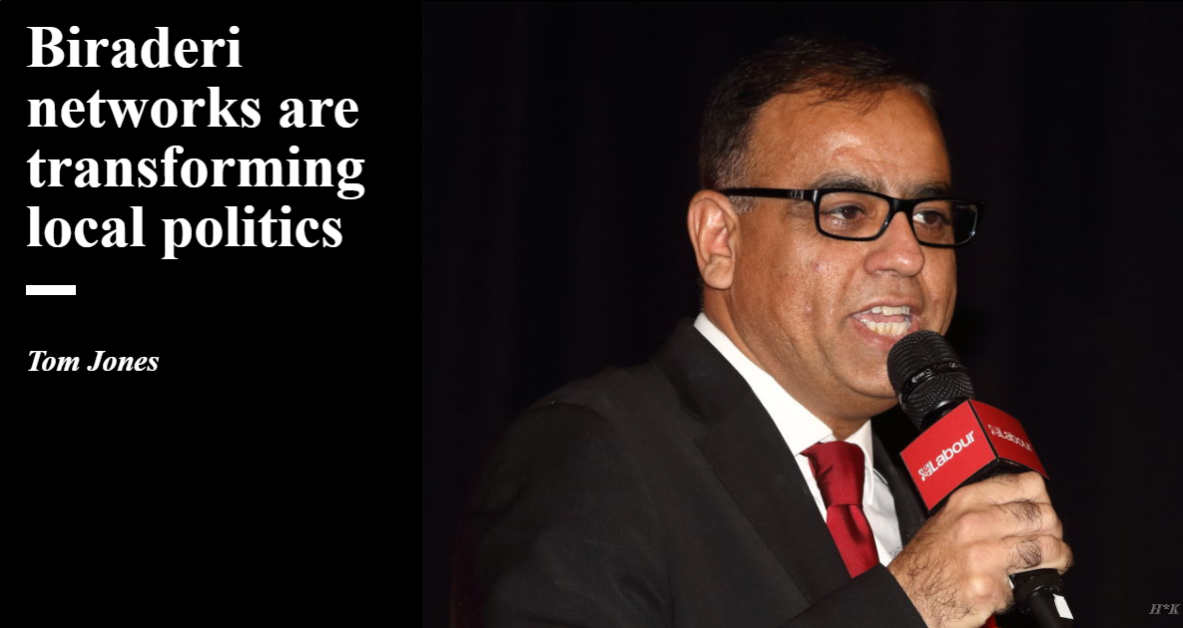
Women and young people apply for postal votes they never see, or are told how to fill them in. Heads of household hand over the family's ballots in bulk. More than one interviewee used the phrase carrier bags of votes. One described a man splitting his family's five votes between two candidates so that both would owe him. A councillor elected this way is on call at all hours to the people who voted for him, and to nobody else.
In one area the interviewees spoke of the Asian Labour party as something separate from the Labour party.
Sir Eric Pickles, reviewing electoral fraud for the Prime Minister in 2016, put it in one sentence. Pressure on women and young people to vote according to the will of the elders, particularly in communities of Pakistani and Bangladeshi background, with state institutions turning a blind eye because of politically correct over-sensitivities about ethnicity and religion.
In his foreword he wrote that people who cheat their way to power then manipulate local authority policy and funding to their own ends, and that electoral fraud is intertwined with other forms of crime.
A court has already seen the funding side. In April 2015 Richard Mawrey, sitting as an election commissioner, found the Mayor of Tower Hamlets guilty of bribery through the council's own grant programme. Auditors sent in by Pickles found councillors had intervened to give grants to groups that did not meet the criteria. Mawrey found the lion's share went to organisations run by and for the Bangladeshi community, that the grants went to the wards where the mayor's support was strongest, and that his supporters told people at council-funded lunches they owed their good fortune to him. Nobody was threatened. The money did the work.
Tower Hamlets is not the only place where this has taken place. I have documented it extensively in my own town of Oldham. I have spoken with people who have witnessed the same in almost all of the towns and cities where the rape gangs operate. The political infiltration is open.
THE NETWORK DOES NOT LIVE ON PAPER
The money does not need a bank either. It moves through something known as kameti, or the committee.
Here, a group of people pay a fixed sum into a pot each month and each takes the whole pot in turn. Usually no interest, often no written record, and no bank. It is lawful, it is old, and it is one of the ways houses, taxi plates and takeaways have been bought in those towns for as long as those communities have been there.
It also means that capital moves through relationships a bank statement does not show. A house sits in one man's name and the money that bought it came through everyone else in the pot. The Land Registry sees the owner. It does not see the pot, or who else is in it, or what the owner now owes them.
The state's records work the same way for people. Registers of interests are built around relationships the law defines. A spouse. A partner. A business interest. A brother's stake in the taxi firm may be caught in terms. A cousin, a wife's cousin, or a man connected through village and marriage can sit quite differently on the formal record.
On the register that man is a stranger. Inside the biraderi he may owe the councillor everything, and the councillor him. A house bought with a kameti pot and registered in a cousin's name is the family's house. A licence granted to a cousin's firm is the family's licence. The register records the relationships the state recognises, and obligation is not one of them.
Between them they leave the social map and the financial one largely off the paperwork. That is how an organisation can be real and still invisible to a state that files people one at a time.
Now the part the academics and Pickles did not reach, because it is what happens to the people who will not comply. What follows is mine. Eight years of it, and every piece is linked.
If a family from the wrong biraderi puts a candidate forward, the party branch is suspended. No branch, no selection meeting. No selection meeting, no candidate. Nothing is written down and there is nobody to complain to, and it cannot be done without the party's own machinery agreeing to do it.
The Labour Party are complicit in this. The evidence trail is clear. They are partners with the biraderi.
Separate to the political party, if someone has the courage to stand anyway, the visit comes to the family home late at night. Men arrive. Unannounced. Within days the candidate withdraws. Sometimes he records a video endorsing the clan's man, and it is round the community on WhatsApp groups before anybody outside has noticed.
Then there is a business that will not fall in line gets a visit from council food safety inspectors, and a five star rating becomes a one star. Or a taxi license handed out as reward for a man that never should have obtained one.
Think of every little power a local authority has and there are instances where it is leveraged by the biraderi. I know of people who do not even pay their council tax because of the arrangement. No explanation is offered and none is needed.
That is the method. The mafia method is intimidation. This one is obligation and reward. Who owes whom. Who married whom. Who paid into the pot. Who found the job. Who delivered the votes. Who called the councillor. Who got the grant. Who shut the door when somebody refused.
None of those facts proves an organisation on its own. Put together, they are the shape, and they are the shape Falcone went looking for when the individual prosecutions had left the organisation standing.
Put Article 416-bis against that and the prosecutor is looking for the wrong mechanism, because the power does not work through the fear the Italian statute describes. It works through what is given and what is withdrawn. That is why forty years of English policing have never touched it. They were looking for threats.
The biraderi does not make threats. It makes arrangements.
So the Italian offence does not fit the method, and the organised crime offence stops at subsection (2).
That leaves the other law we have. The one that carries fourteen years.
The stories that expose them are the stories they tried and failed to imprison me for sharing.
Eight years in and even the mainstream media blacklist has failed to censor our campaign. Millions now know the truth of the grooming gangs, and who covered up what took place.
What comes next is the National Inquiry, and forcing it to go where it does not want to go. The only way to do that is pressure. We got it this far. Now help push it further, to a place where politicians are forced to testify. That includes the Prime Minister.
My name is Raja Miah. I led the campaign that helped force the National Inquiry. I need your help to make sure it is not a whitewash.
My ask of you is a simple one. Please follow my work on social media and take a minute to sign up to and subscribe to my newsletter Red Wall and the Rabble.
I cannot do this without you.
FOR TERRORISTS, BELONGING IS THE CRIME
Section 11 of the Terrorism Act 2000.
(1) A person commits an offence if he belongs or professes to belong to a proscribed organisation.
(2) It is a defence for a person charged with an offence under subsection (1) to prove (a) that the organisation was not proscribed on the last (or only) occasion on which he became a member or began to profess to be a member, and (b) that he has not taken part in the activities of the organisation at any time while it was proscribed.
(3) A person guilty of an offence under this section shall be liable on conviction on indictment to imprisonment for a term not exceeding 14 years.
Now take the fourth man from before, the one who walked out of section 45 because nobody proved an act, and put him through this one.
Is there a proscribed organisation? Subsection (1).
This is the only thing the prosecution has to establish about the group, and it is not established in court. It is established by the Home Secretary laying an order and Parliament passing it. Once the name is on the list, the prosecution does not have to prove the group committed a crime, does not have to prove it carried on criminal activities, does not have to prove any seven-year threshold, and does not have to prove any gain or benefit. Every element that section 45 made the prosecutor prove about the group has already been decided before the trial starts.
Does he belong to it? Subsection (1).
This is the only thing the prosecution has to prove about him. Not that he drove anyone. Not that he paid for a taxi. Not that he handed a child a drink or held a door. Whether he is a member. The girls do not have to prove what he did to them. The prosecution has to prove something different, that he belongs, and what it needs for that is the evidence Falcone knew mattered. What the organisation is, and where this man sits inside it. Who he owes. Who owes him. Whose name the house is in. Whose pool the money went through. Who sat at the selection meeting and who was not allowed to.
Does he have the defence? Subsection (2).
He has one way out and it has two parts, and he has to prove both himself. That he joined before the organisation was proscribed, and that he has taken no part in it since. The section does not punish him for the past, only for staying.
Sentence. Subsection (3).
Fourteen years.
Three questions. Is it on the list, is he part of it, has he stopped. None of them asks what he did.
Put the two sections side by side on the same man. Under section 45 the prosecution proves the group, proves the crimes, proves the benefit, and then fails at subsection (2) because it cannot prove his act, and he leaves. Under section 11 the prosecution proves he belongs, and he faces up to fourteen years. Same man. Same house. Same parties. Same girls.
WHAT COUNTS AS AN ORGANISATION
The objection is that the biraderi is not an organisation. There is no membership card, no constitution and no named leader, so there is nothing to put on a list.
Section 121 of the Act answers that. "Organisation" includes any association or combination of persons. That is the entire definition. And we have precedent.
 Home Office
In April 2024 the Home Secretary proscribed Terrorgram. It is an online collective. It has no headquarters, no constitution, no membership list, and no process by which anyone joins. The government's assessment was that it had a core leadership which directed and coordinated what the rest did. The minister told the Commons on 24 April 2024 that it had been assessed to operate as an organisation in accordance with section 121, and both Houses passed the order.
So the law does not require the thing to look like an organisation. It requires enough structure to be one. Somebody decides, others follow, and the following can be shown.
Everything in the section above is a decision followed by compliance. The elders decide who stands and the families follow. The branch is suspended, the candidate withdraws, the grant is paid, the inspector calls, the pot is handed over. Whether that adds up to enough structure under section 121 is a question of evidence, and evidence is a question of whether anyone goes and gets it.
It is the question Falcone answered about Cosa Nostra with three thousand six hundred checks, and it is the question nobody in this country has ever been asked to put to the biraderi.
WHO DECIDES
Section 3. The Home Secretary may add an organisation to the list if she believes it is concerned in terrorism and considers it proportionate to do so. She is advised by the Proscription Review Group, officials drawn from across Whitehall. She lays a draft order before Parliament. Each House votes to approve it or reject it. Neither can amend it.
She does not need Parliament to write her an offence. The offence has existed since 2000. She needs Parliament to agree that a name goes on the list.
Go back to the fourth man in my Rotherham example. Under section 45, if nobody can prove his participation, the question of what he belongs to never arises. Under the law Parliament wrote for terrorists, if the organisation he belongs to were on the list, he would be a member, and he would face up to fourteen years.
The consequence is that tens of thousands of men would face prosecution. Because tens of thousands of men belong to the Biraderi that is involved in organised crime, electoral fraud, and the gang rape of little girls. It is the same network operated by the same men.
So, as I have demonstarted, the offence exists, the membership model exists and the machinery for putting a name on the list exists. What has never been asked is whether the biraderi meets the test that lets her use it.
I have spent eight years saying the biraderi is the organisation those men belong to. I have described them as Pakistani Cartels. The law has had a way of testing that for twenty-six years. Nobody has been asked to use it.
Part 4 asks the question nobody in government has asked. Does the biraderi meet Britain's legal definition of an organisation concerned in terrorism? If it does, the decision belongs to Shabana Mahmood. A woman, whose own family members, including her father, I would argue belong to the biraderi. But that, as they say, is another story.
I am Raja Miah MBE. It is now eight years since I first started to expose how politicians protected the rape gangs. I have spent almost a decade of my life fighting to safeguard little White girls from gang rape by politically protected gangs of predominantly Pakistani men.
I have spent three years on bail as Andy Burnham's police force was involved in falsifying evidence in an attempt to imprison me. My mother died before I was able to clear my name.
The truth is now out and there is a national inquiry because I helped force it.
If my words have ever helped you make sense of a broken system, if they’ve ever made you feel seen, heard, or hopeful, please don’t scroll past.
Support my work. This fight is far from over.
There are no paywalls to access any of my work. I share all of my content for free.
As well as sharing my work on social media and running online workshops, each month, I travel across the country to meet with ordinary people. I charge no speaker fees. Nor do I claim a single penny in expenses.
All I ask in return, for those that can afford to do so, is support me from just £3/month or £30/year. That’s 75p a week. Pennies to most, yet everything to help keep me going.
Prefer a one-off contribution?
If you can’t commit to a regular subscription, a one-off contribution genuinely helps keep this alive. You can support me using one of these links;
👉 http://BuyMeACoffee.com/recusantnine
👉 http://paypal.me/RecusantNine
Should we succeed, politicians will go to prison. Even if there is only the smallest chance of this happening, isn't it worth your support?
Raja Miah MBE